In short
A hydrocele is a painless collection of fluid around a testicle. In many newborn boys it goes away by around the first birthday; in men it is treated only if it causes pain, discomfort or embarrassment. Sudden severe testicle pain is different, possibly a twisted testicle, and needs an emergency department now.
Emergency if: Sudden, severe pain in a testicle, testicle pain with feeling sick, being sick or tummy pain, or testicle pain that lasts more than an hour or continues at rest: go to an emergency department now. The NHS says these can be signs of a twisted testicle that needs hospital treatment as soon as possible and can lead to loss of the testicle if not treated quickly. For a child with a lot of sudden pain and swelling in the scrotum or groin, the American Academy of Pediatrics says to call the paediatrician immediately or go to the nearest emergency room, because the testicle may have twisted or bowel may be stuck in the groin. A groin lump or hernia that suddenly becomes painful, hard or tender and cannot be pushed back, especially with being sick or a bloated tummy, also needs an emergency department now, because the bowel may be stuck.
On this page
01
What is a hydrocele (andkosh mein pani), and is it dangerous?
A hydrocele is fluid that collects around a testicle and makes the scrotum swell. HealthLink BC describes it as a painless buildup of watery fluid around one or both testicles that causes the scrotum or groin area to swell. The swelling may look unsightly and feel uncomfortable, but it usually is not painful and generally is not dangerous.
Hydroceles are common in newborns, especially premature babies, and older boys and men can get them too. The American Academy of Pediatrics says they can occur at any age but are most common in newborns and infants. The cause of most hydroceles is unknown, according to HealthLink BC.
02
Baby's hydrocele: will it go away on its own, and how long does it take?
Often yes. The American Academy of Pediatrics says many newborn boys have this problem, though it usually goes away by around their first birthday without any treatment, and that babies born prematurely are at increased risk. Nemours KidsHealth says hydroceles in babies usually go away on their own by the time a child is 1 to 2 years old. Many hydroceles resolve on their own, says the Academy, but if they have not gone away by one year of age, your child may need surgery, and the doctor will refer you to a paediatric urologist or paediatric surgeon.
A baby's hydrocele may change size through the day, getting bigger with crying or straining and smaller at night when the child lies down, and its size may also change over weeks. This changing size is typical and is not a reason for alarm by itself, but it is also how a hernia behaves, which is why the doctor examines the groin too.
03
What is the difference between communicating and non-communicating hydrocele, and between hydrocele and hernia?
In a communicating hydrocele there is an opening between the scrotum and the belly that lets fluid pass freely between the two. It forms because the tunnel the testicle travelled down before birth did not close. In a non-communicating hydrocele the tunnel has closed but the fluid cannot drain away; this type can also follow surgery, injury or inflammation, the Academy says.
A hydrocele is very similar to an inguinal hernia. In a communicating hydrocele the tunnel may be so small that only fluid passes. Inguinal hernias often have larger openings, so bowel or other tissue can slip through, and if it gets stuck this can become an emergency. The Academy adds that inguinal hernias often need surgery sooner than hydroceles, which is why telling them apart matters.
04
How is a hydrocele diagnosed? What are transillumination and ultrasound?
Most of the time a doctor can diagnose a hydrocele by examining the child or man. The Academy says hydroceles usually transilluminate: a light shone through the swelling is seen from the other side, because it is filled with fluid. HealthLink BC explains why this matters for adults: light will not pass through solid masses, which may be caused by problems such as cancer of the testicle.
An ultrasound may be ordered to look for the testicle inside the hydrocele or to separate a hydrocele from an inguinal hernia or a mass. Do not rely on swelling feeling soft: the NHS says a lump, swollen testicle, change in shape, or a testicle that has become bigger than the other needs an urgent appointment, so that cancer and other causes can be ruled out.
05
Hydrocele in adult men: does it go away, and when is surgery needed?
In adults, HealthLink BC says hydroceles that appear later in life may follow an injury or surgery to the scrotum or groin, or inflammation or infection of the epididymis or testicles, and in rare cases occur with cancer of the testicle or left kidney. HealthLink BC says this type can occur at any age but is most common in men older than 40. It adds that hydroceles in men younger than 65 may go away by themselves, but in older men they do not usually go away.
Treatment is only needed when a hydrocele causes pain or embarrassment, or in rare cases reduces the blood supply to the penis. Draining the fluid with a needle is possible, but hydroceles that are drained often return and surgery may then be needed, so HealthLink BC recommends needle drainage only for men who cannot have surgery. If the hydrocele gets larger or causes discomfort, an operation to remove it (hydrocelectomy) may be needed. HealthLink BC adds that treatment is not usually needed if a hydrocele does not change in size or gets smaller as the body reabsorbs the fluid.
06
Boys with a hydrocele after age 1: will it still settle without an operation?
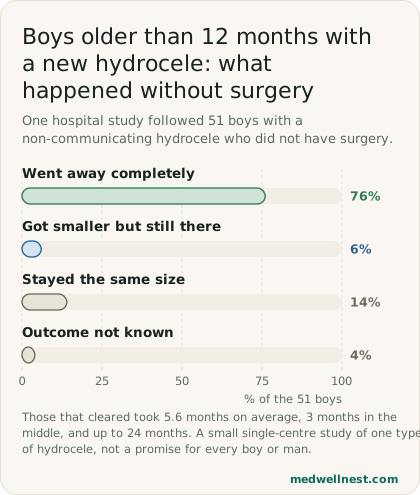
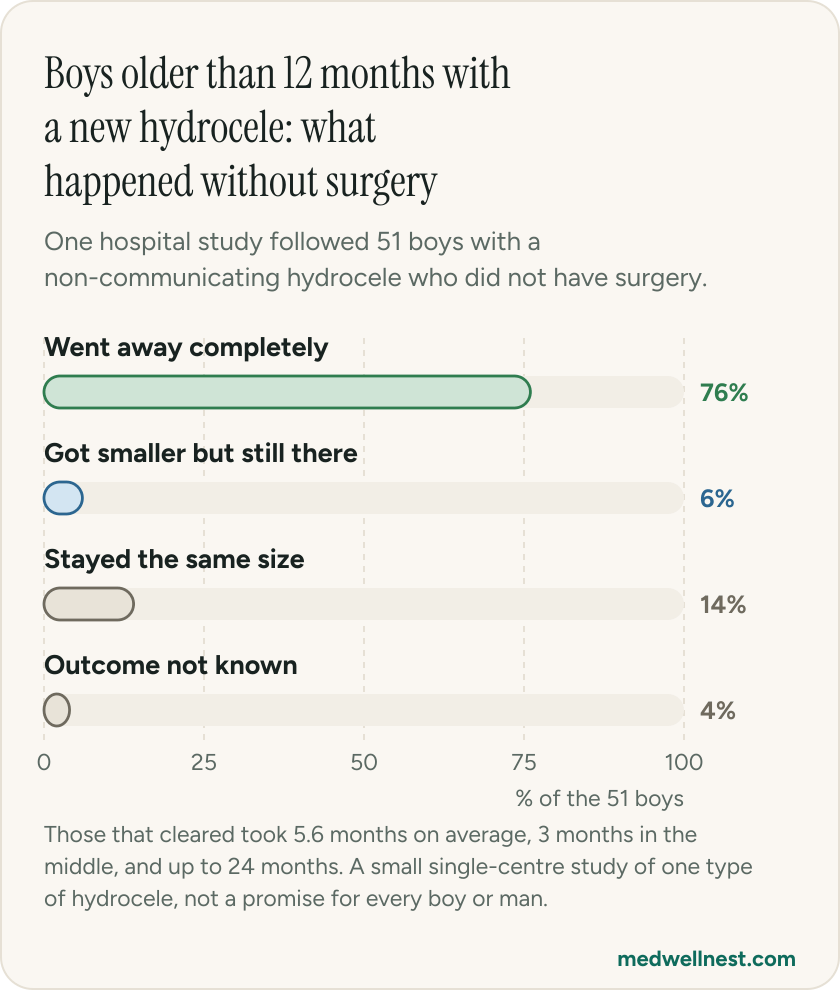
A hospital study of 302 boys older than 12 months with a new hydrocele found 35% were non-communicating, 59% were communicating and 6% were hydroceles of the spermatic cord. Surgery was done in 97% of communicating hydroceles, 71% of cord hydroceles and 34% of non-communicating ones. Of 51 boys with a non-communicating hydrocele who were not operated on and were followed up, 76% cleared completely, 6% got smaller, 14% stayed the same size and 4% had an unknown outcome.
Clearing took 5.6 months on average, 3 months in the middle, and from 1 day to 24 months. The authors concluded that about 75% of new non-communicating hydroceles resolve by themselves whatever their size, and that watching for 6 to 12 months would be reasonable before repair. This is one centre's experience with one type of hydrocele, so your child's surgeon decides, using the exam and ultrasound.
07
What is hydrocele surgery like, and when is scrotal swelling an emergency?
For children, the Academy says surgery uses a small cut in the groin, the surgeon checks for any connection with the belly that needs closing, then opens the sac, drains the fluid and removes the sac. It generally takes 30 minutes to an hour, is usually done under general anaesthetic and is typically a same-day operation. In fewer than 1 in 100 children a hydrocele comes back.
A hydrocele is usually painless, so pain changes the picture. The NHS says to go to an emergency department immediately for sudden, severe testicle pain, testicle pain with feeling sick, being sick or tummy pain, or pain lasting more than an hour or continuing at rest, because these can be signs of twisting of the testicle (torsion), which can lead to loss of the testicle if not treated quickly. For children, the Academy says lots of sudden pain with swelling in the scrotum or groin could be a twisted testicle or bowel stuck in the groin: call the paediatrician immediately or go to the nearest emergency room. In an adult, a hernia that suddenly becomes painful, hard or tender and cannot be pushed back, especially with being sick or a bloated tummy, may be strangulated: the NHS says pain in or around a hernia can be a sign of strangulation, so go to an emergency department now.
When to act
Emergency — act now
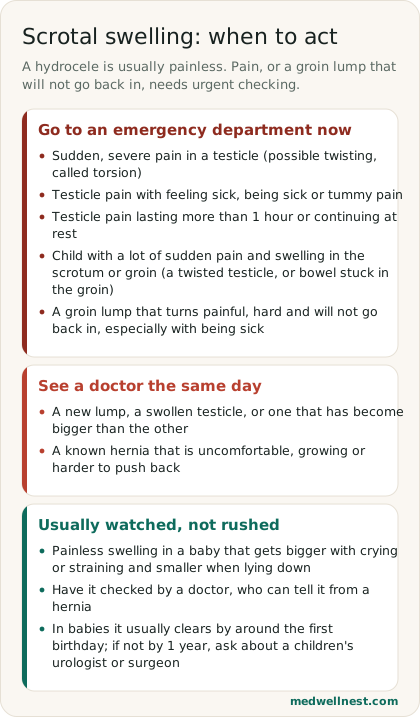
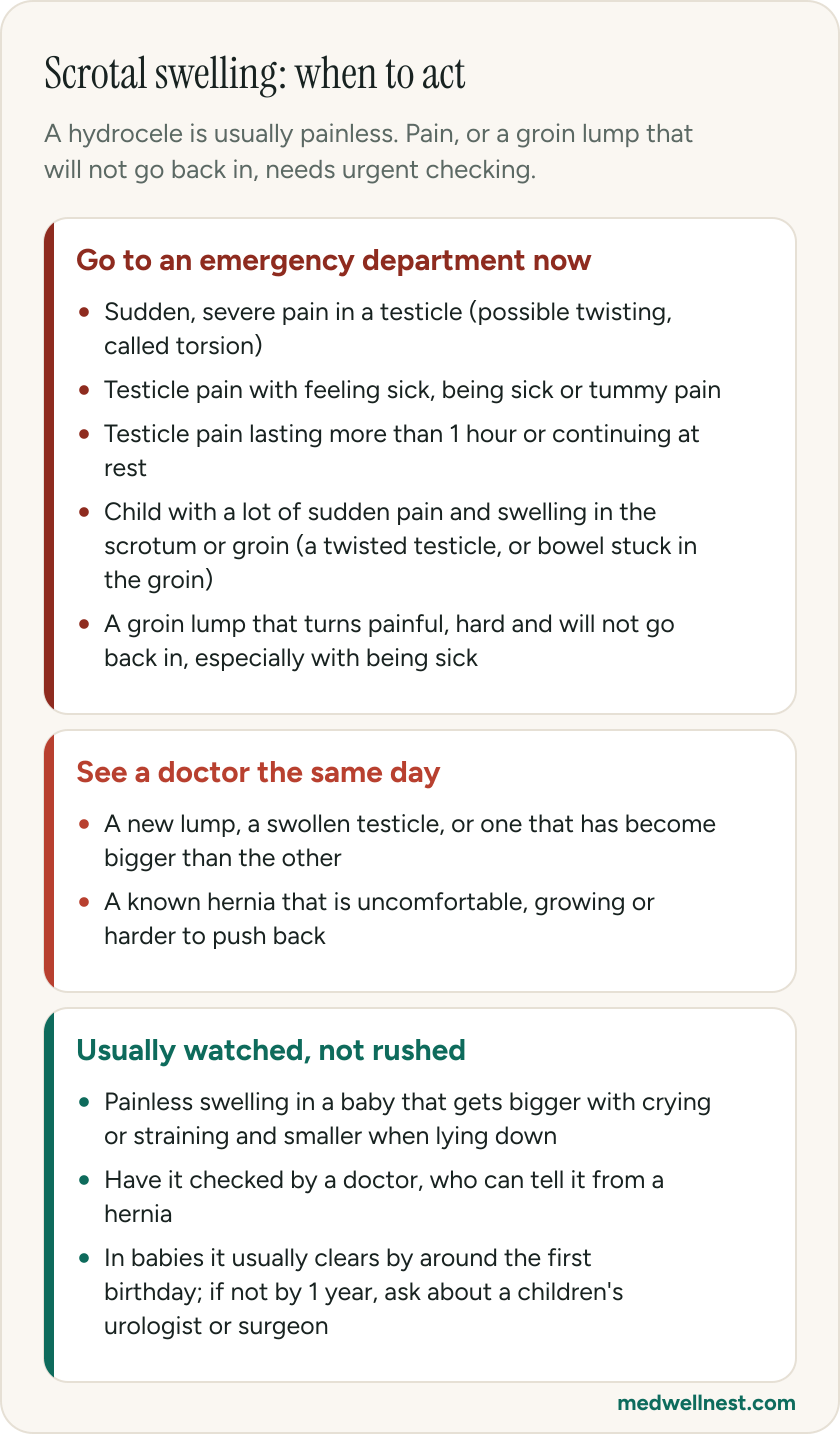
Sudden, severe pain in a testicle, testicle pain with feeling sick, being sick or tummy pain, or testicle pain that lasts more than an hour or continues at rest: go to an emergency department now. The NHS says these can be signs of a twisted testicle that needs hospital treatment as soon as possible and can lead to loss of the testicle if not treated quickly. For a child with a lot of sudden pain and swelling in the scrotum or groin, the American Academy of Pediatrics says to call the paediatrician immediately or go to the nearest emergency room, because the testicle may have twisted or bowel may be stuck in the groin. A groin lump or hernia that suddenly becomes painful, hard or tender and cannot be pushed back, especially with being sick or a bloated tummy, also needs an emergency department now, because the bowel may be stuck.
Same-day — call promptly
You find a new lump, a swollen testicle, a change in the shape or feel of a testicle, or one testicle has become bigger than the other: see a doctor today, because the NHS lists these as urgent and a doctor must tell a hydrocele from other causes, including cancer. Also see a doctor today if a known hernia has become uncomfortable, is getting bigger, or is harder to push back than before.
Routine — see a doctor
Your baby has a painless swelling in the scrotum that changes size with crying and lying down: mention it at the next check-up. If it has not gone away by 1 year of age, ask for a referral to a paediatric urologist or paediatric surgeon. An adult with a painless swelling that is stable should still have it examined once, and can ask whether an ultrasound is needed and whether treatment is wanted at all.
Sources
- Scrotal Swelling in Children: What Is a Hydrocele? — HealthyChildren.org (American Academy of Pediatrics)healthychildren.org
- Hydrocele — Nemours KidsHealthkidshealth.org
- Hydrocele — HealthLink BC (Healthwise)healthlinkbc.ca
- New onset of hydroceles in boys over 1 year of age — International Journal of Urology, 2006pubmed.ncbi.nlm.nih.gov
- Testicle pain — NHSnhs.uk
- Hernia — NHSnhs.uk
Share this story
Curious where your own values stand?
Two minutes from upload to a full visual picture. Free to analyze.