In short
Implantation bleeding is light spotting blamed on the egg attaching to the womb, but one careful study found no support for it, and bleeding in early pregnancy has many causes. Sources agree that any bleeding in pregnancy needs advice, and severe pain, shoulder pain, fainting or heavy bleeding needs emergency care now.
Emergency if: You are pregnant, or think you might be, and you have sudden, severe tummy or pelvic pain, pain in the tip of your shoulder, or feel very weak, faint or dizzy, with or without bleeding; or you are bleeding heavily, soaking a pad soon after putting it on: call emergency services now or go to an emergency department now. ACOG says to go to an emergency room for sudden severe pain, shoulder pain or weakness, which can mean a ruptured ectopic pregnancy, and the NHS says that with bleeding these can be signs you need immediate treatment.
On this page
01
What is implantation bleeding and when does it happen?
Implantation bleeding is the name for light spotting said to happen when the fertilised egg attaches to the lining of the womb. ACOG says light bleeding or spotting can occur 1 to 2 weeks after fertilisation when the egg implants, and the NHS lists implantation bleeding in very early pregnancy among the causes of bleeding in pregnancy. So the idea is in the guidance. The question is how well it is supported.
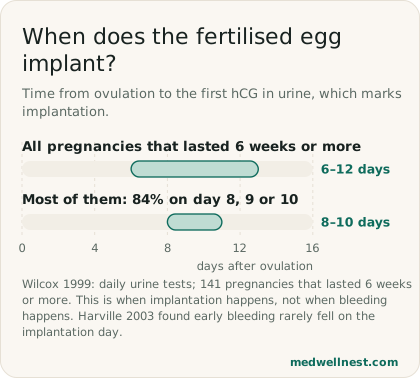
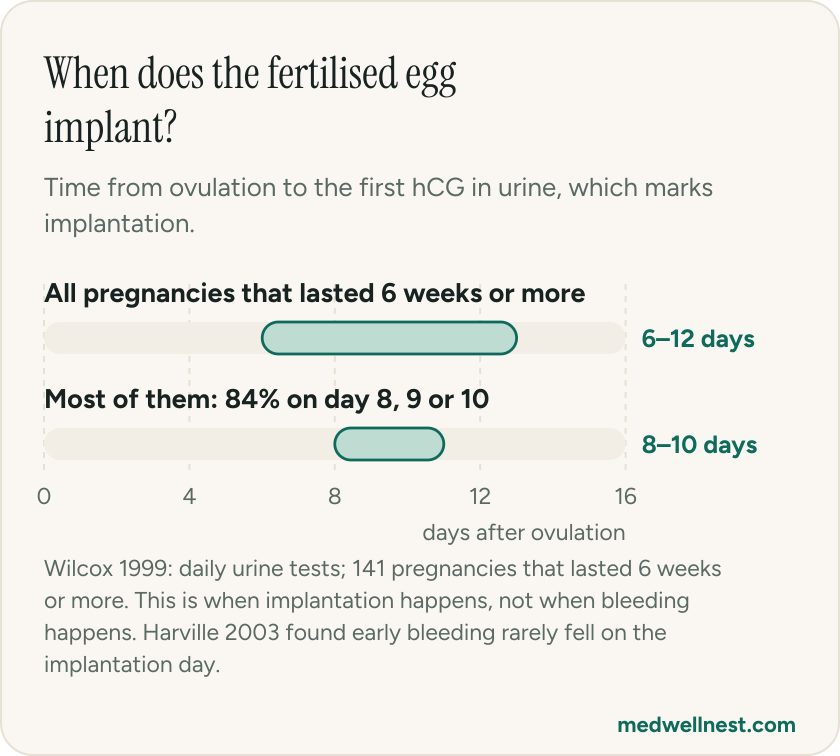
The timing of implantation itself was measured by Wilcox and colleagues in 1999, who tested daily urine from 221 women trying to conceive and defined implantation by the first appearance of the pregnancy hormone hCG. The women had 199 conceptions, 189 with enough data to analyse, and 141 of those pregnancies lasted at least 6 weeks past the last period. In those 141, hCG first appeared 6 to 12 days after ovulation, and 118 (84%) had implantation on day 8, 9 or 10. The study also found that the risk of early pregnancy loss rose with later implantation.
02
Is implantation bleeding real?
Less certain than the internet suggests. The same research group followed the same women for bleeding. Harville and colleagues (2003) counted 151 of the 221 women as clinically pregnant, meaning the pregnancy lasted at least 6 weeks past the last period; this is a slightly different total from Wilcox's 141 because the two papers analysed different groups from the same study. Of these 151, 14 (9%) recorded at least 1 day of vaginal bleeding in the first 8 weeks. The bleeding tended to happen around the time the women would expect their periods, though rarely on the day of implantation, and it was not linked to sex. The authors concluded that they found no support for the idea that implantation can produce vaginal bleeding.
One study cannot settle it, and ACOG and the NHS still name implantation bleeding as a possible cause. The honest summary is that spotting before or around a missed period can happen in early pregnancy, but because it usually comes near the expected period it does not prove the egg has implanted, and it does not rule out the other causes below. The bleeding figures in this story count different things: Harville's 9% is any recorded bleeding in the first 8 weeks, in one research study, among pregnancies that lasted at least 6 weeks, while ACOG's 15 to 25 in 100 covers bleeding at any time in the first trimester, the first 13 weeks, in pregnancies in general. So ACOG's figure is expected to be higher.
03
How is implantation bleeding different from a period?
The sources do not give a reliable test of colour, length or amount to tell implantation bleeding from a period. Harville found that bleeding in the early pregnancies it studied was generally light, but that describes a research group on average, not a way to tell one episode of bleeding from a period.
The NHS describes early pregnancy bleeding as spots of pink, red or brown blood on underwear or toilet paper, larger areas that need a pad, or red blood that soaks a pad, which may come with clots. It may be constant or come and go. Because looks cannot be trusted either way, the way to tell is a pregnancy test and, if there is any bleeding with a positive test, a call to your maternity or early pregnancy unit.
04
When should I take a pregnancy test if I have spotting?
The NHS says pregnancy tests are most reliable from the first day of your missed period. If you do not know when your next period is due, do the test at least 21 days after you last had unprotected sex. Some very sensitive tests can be used before a missed period. All tests detect hCG, which the NHS says starts to be made around 6 days after fertilisation, and which was first seen in urine 6 to 12 days after ovulation in the study above.
The NHS says a positive result is almost certainly correct but a negative result is less reliable, particularly if the test is taken too early. If you get a negative result and still think you are pregnant, wait a few days and test again, and see a doctor if a second test is negative and your period has not come. Our stories on a late period with a negative test and on faint lines explain the possible reasons.
05
Is spotting in early pregnancy normal, and does it mean a miscarriage?
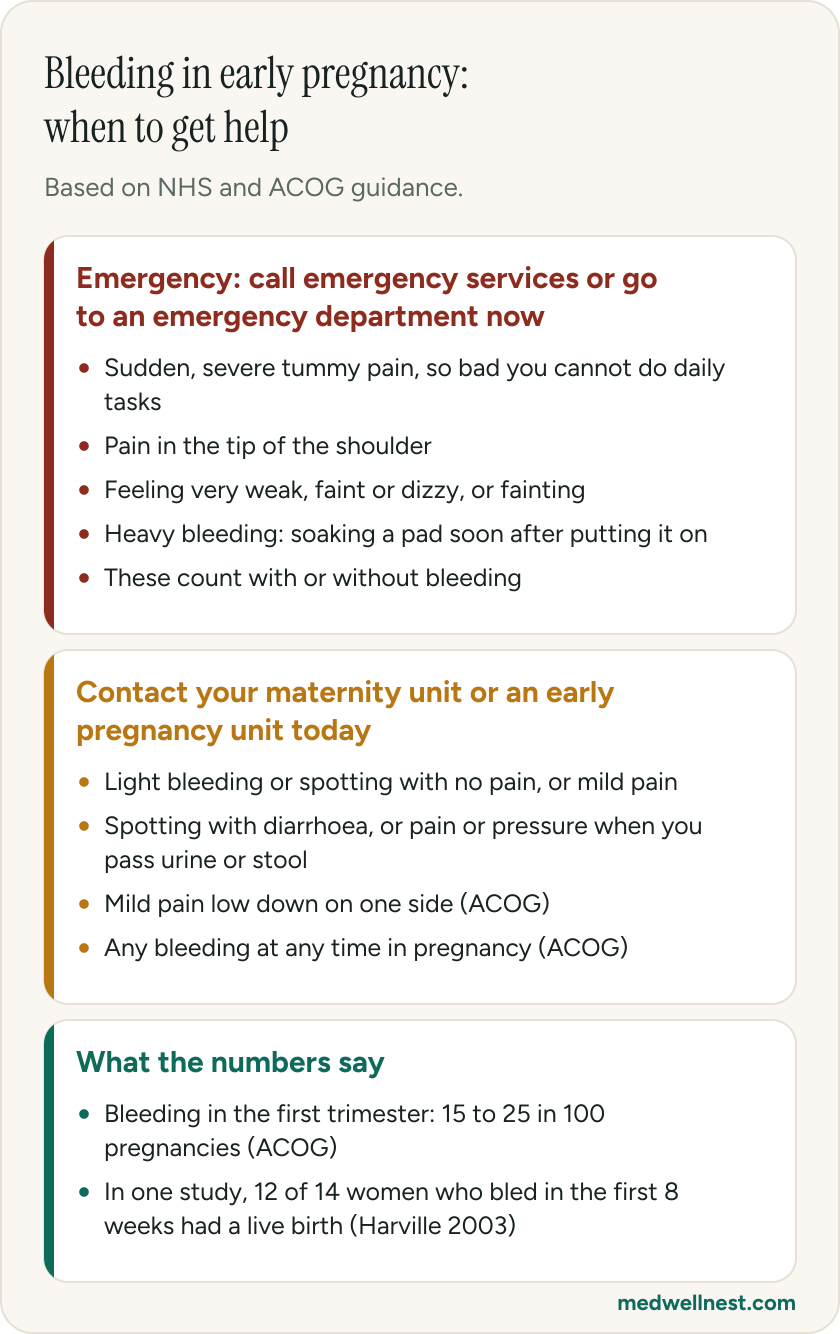
ACOG says bleeding in early pregnancy is common and in many cases does not signal a major problem. It says bleeding in the first trimester happens in 15 to 25 in 100 pregnancies. In Harville's study, 12 of the 14 women who bled in the first 8 weeks went on to a live birth, and the authors say nearly all women with bleeding had successful pregnancies. These were pregnancies that had already lasted at least 6 weeks, so the figure does not cover very early losses. Light bleeding can also come from the cervix, which bleeds more easily in pregnancy, and ACOG says spotting after sex or a pelvic exam is not uncommon.
But bleeding can also signal a problem. ACOG says problems that cause bleeding in early pregnancy include infection, early pregnancy loss and ectopic pregnancy. It says early pregnancy loss, loss in the first 13 weeks, happens in about 10 in 100 known pregnancies, and that about half of women who have a miscarriage have no bleeding beforehand, so bleeding is not a reliable alarm either way. ACOG says to contact your doctor for any bleeding at any time in pregnancy, and the NHS says it is important to get advice.
06
When is bleeding in early pregnancy an emergency, such as ectopic pregnancy?
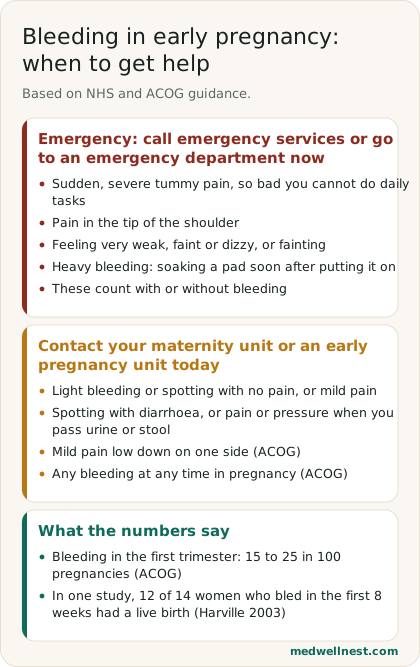
The NHS gives two levels for bleeding. For light bleeding or spotting with no pain or only mild tummy pain, or with diarrhoea or pain or pressure when you pee or poo, get urgent help by calling your maternity unit, or an early pregnancy unit if you are under 20 weeks. We treat this as a same-day sign: call that day, and do not wait for a routine appointment. If you are pregnant and bleeding and you have severe tummy pain, so bad that you cannot read a book or do daily tasks, pain in your shoulder, feel sick, faint or dizzy or lose consciousness, or the bleeding is heavy and soaks a pad soon after putting it on, the NHS says these can be signs you need immediate treatment and to call emergency services. Pain can be the first sign without any bleeding: ACOG says that if you have sudden, severe pain, shoulder pain or weakness, you should go to an emergency room, because a ruptured tube can cause life-threatening internal bleeding. ACOG also says mild cramping on one side of the pelvis should be reported to your ob-gyn.
ACOG explains why: in an ectopic pregnancy the fertilised egg implants outside the womb, usually in a fallopian tube, and if the tube ruptures, internal bleeding can cause weakness, fainting, pain, shock or even death. It says sometimes vaginal bleeding is the only sign, and that abdominal, pelvic or shoulder pain can start before you even know you are pregnant. Our ectopic pregnancy and miscarriage guides have more detail.
Bleeding in early pregnancy: how fast to act
Emergency — act now
You are pregnant, or think you might be, and you have sudden, severe tummy or pelvic pain, pain in the tip of your shoulder, or feel very weak, faint or dizzy, with or without bleeding; or you are bleeding heavily, soaking a pad soon after putting it on: call emergency services now or go to an emergency department now. ACOG says to go to an emergency room for sudden severe pain, shoulder pain or weakness, which can mean a ruptured ectopic pregnancy, and the NHS says that with bleeding these can be signs you need immediate treatment.
Same-day — call promptly
You have light bleeding or spotting with no pain or mild tummy pain, or with diarrhoea, or pain or pressure when you pee or poo, or you have mild pain or cramping low down on one side, even without bleeding: call your maternity unit or, if you are under 20 weeks, an early pregnancy unit today, without waiting for a routine appointment. The NHS calls this getting urgent help. ACOG says to contact your doctor for any bleeding at any time in pregnancy, and to report mild cramping on one side of the pelvis and pelvic pain to your ob-gyn.
Routine — see a doctor
You have light spotting around the time of your expected period and no pregnancy test yet: test from the first day of your missed period, or at least 21 days after unprotected sex if you do not know when your period is due, and test again in a few days if negative but you still think you are pregnant (NHS). If a second test is negative and your period has not come, see your doctor.
Sources
- Time of implantation of the conceptus and loss of pregnancy — Wilcox et al., NEJM 1999pubmed.ncbi.nlm.nih.gov
- Vaginal bleeding in very early pregnancy — Harville et al., Human Reproduction 2003pubmed.ncbi.nlm.nih.gov
- Bleeding During Pregnancy — ACOG patient FAQacog.org
- Ectopic Pregnancy — ACOG patient FAQacog.org
- Vaginal bleeding in pregnancy — NHSnhs.uk
- Doing a pregnancy test — NHSnhs.uk
Share this story
Curious where your own values stand?
Two minutes from upload to a full visual picture. Free to analyze.