In short
The evidence is mixed: a 2023 review of 14 studies linked weather to osteoarthritis pain, while a 2024 review of 11 studies found no link for knee, low back or rheumatoid arthritis pain. Staying active helps either way, and a hot, swollen joint with fever is never just the weather.
Emergency if: A joint has suddenly become very painful, hot, swollen or red and you have a high temperature or feel hot, cold or shivery, or feel generally unwell, especially if you cannot move the joint or put weight on it: get medical help now, and go to an emergency department now if you cannot see a doctor within a few hours. The NHS says septic arthritis needs to be checked straight away and is usually treated in hospital. The same applies to a gout-like painful joint that is getting worse with a very high temperature, feeling sick or being unable to eat.
On this page
01
Does cold weather really make joint pain worse?
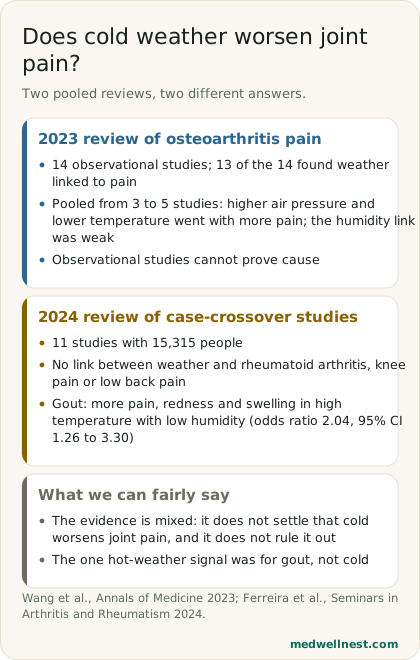
Many people feel their joints ache more in winter, and the research does not give a clean yes or no. A 2023 systematic review of weather and osteoarthritis pain in the journal Annals of Medicine included 14 observational studies (12 cohort and 2 case-crossover studies). It reported that 13 of the 14 found weather factors in general were associated with osteoarthritis pain. In the pooled results, which came from only 3 to 5 of the studies, higher barometric pressure went with more pain and lower temperature went with more pain; the link with higher humidity was very weak.
The authors list limits. All the studies were observational, which may carry bias from other factors, and they call for more studies with consistent weather measures to confirm the findings. They also note that the mechanisms of pain in osteoarthritis are still unclear. The 2023 paper's own summary says many people with osteoarthritis think the weather affects their pain, while the link between the two is still unclear.
02
What did the 2024 review find, and why do the two disagree?
A 2024 meta-analysis in the journal Seminars in Arthritis and Rheumatism pooled case-crossover studies. It identified 1,107 studies and included 11, with 15,315 participants and 28,010 pain or other events compared against 102,536 control periods, across seven musculoskeletal conditions. Its pooled results showed no association between relative humidity, air pressure, temperature or precipitation and the risk of rheumatoid arthritis, knee pain or low back pain. Its conclusion was that, despite what patients report, weather changes do not seem to be risk factors for rheumatoid arthritis, or for knee, hip or low back pain, although hip pain is not among the pooled results in its summary.
The two reviews asked different questions, so they are not direct opposites: the 2023 one combined cohort and case-crossover studies of osteoarthritis pain and measured how pain intensity tracked the weather, while the 2024 one used only case-crossover studies across several conditions and asked whether weather changes raised the risk of a pain flare. From the published summaries we cannot say exactly why they differ, and neither is the last word. One notable detail is that the 2024 review found high temperature combined with low humidity linked to more pain, redness and swelling in gout (odds ratio 2.04, 95% confidence interval 1.26 to 3.30), which is hot, dry weather and not cold.
03
Why does my joint pain feel worse in winter?
We found no source that settles this. The 2023 authors say the mechanisms of pain in osteoarthritis are still unclear. In their discussion they raise one hypothesis, that temperature-sensitive channels on nerve cells may play a part, based on a study in cold-exposed mice. That is an idea to test, not an established cause in people, and this story does not offer other explanations as facts.
What we can say from the NHS is that arthritis symptoms can suddenly get worse in what it calls a flare-up, which can last several days, and that symptoms can come and go. So a bad week is real, and it can have causes other than the weather. If pain is changing, keep a note of what you were doing and show it to your doctor.
04
What helps joint pain in winter?
The NHS says exercise is one of the most important treatments for people with osteoarthritis, whatever your age or level of fitness, and that regular exercise that keeps you active, builds muscle and strengthens the joints usually helps to improve symptoms. For arthritis in general it says low-impact activities such as swimming, walking, pilates and yoga are best.
The NHS adds that applying hot or cold packs to the joints can relieve the pain and symptoms of osteoarthritis in some people. It also warns that doing too much exercise too quickly, or the wrong sort, may damage your joints, so build up gradually and ask your doctor or a physiotherapist for a plan. The NHS does not give a rule that cold weather itself damages joints.
05
When is joint pain not just the weather?
A joint that suddenly becomes hot, red and swollen with a fever needs urgent attention. The NHS says septic arthritis, a serious joint infection, causes sudden severe pain in a joint, not being able to move it or put weight on it, hot, swollen or red skin over it, and a high temperature, although not everyone has a fever. It says these symptoms usually develop quickly over a few days and need to be checked straight away, that you need urgent medical help, and that people are usually admitted to hospital for treatment.
Gout is the other common cause of a sudden hot, swollen joint. The NHS says it causes sudden severe pain, usually in the big toe, with hot, swollen, red skin, and to see a doctor if it is your first attack. But if the pain is getting worse and you also have a very high temperature or feel hot, cold or shivery, or you feel sick or cannot eat, the NHS says it could be an infection inside the joint and needs urgent medical help. Having rheumatoid arthritis, diabetes, a weak immune system, a recent joint operation or an artificial joint raises the risk of septic arthritis.
When to act
Emergency — act now
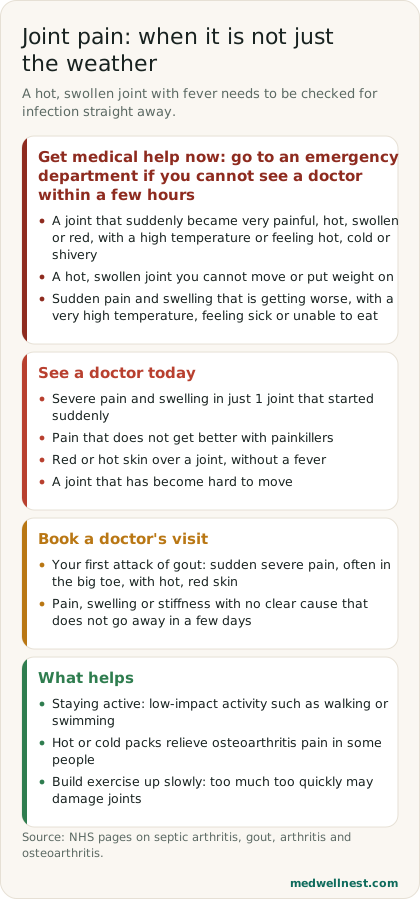
A joint has suddenly become very painful, hot, swollen or red and you have a high temperature or feel hot, cold or shivery, or feel generally unwell, especially if you cannot move the joint or put weight on it: get medical help now, and go to an emergency department now if you cannot see a doctor within a few hours. The NHS says septic arthritis needs to be checked straight away and is usually treated in hospital. The same applies to a gout-like painful joint that is getting worse with a very high temperature, feeling sick or being unable to eat.
Same-day — call promptly
You have severe pain and swelling in just 1 joint that started suddenly; your pain does not get better with painkillers; the skin over a joint is red or hot but you have no fever; or you find it difficult to move a joint: see a doctor today. The NHS lists these as needing an urgent appointment. If any of these comes with a high temperature or feeling hot, cold or shivery, follow the emergency advice above.
Routine — see a doctor
You have had a first attack of gout, or you have pain, swelling or stiffness with no clear cause that has not gone away in a few days: book a doctor's visit. If you already have osteoarthritis, ask for an exercise plan, and note whether your pain really follows the weather.
Sources
- Associations between weather conditions and osteoarthritis pain: a systematic review and meta-analysis — Annals of Medicine, 2023pmc.ncbi.nlm.nih.gov
- Come rain or shine: is weather a risk factor for musculoskeletal pain? A systematic review with meta-analysis of case-crossover studies — Seminars in Arthritis and Rheumatism, 2024pubmed.ncbi.nlm.nih.gov
- Osteoarthritis treatment — NHSnhs.uk
- Arthritis — NHSnhs.uk
- Septic arthritis — NHSnhs.uk
- Gout — NHSnhs.uk
Share this story
Curious where your own values stand?
Two minutes from upload to a full visual picture. Free to analyze.