In short
A karyotype photographs a person's chromosomes to count them and check their structure. Here is how to read 46,XX or 46,XY, what 47,XX,+21, 45,X, a translocation or mosaicism look like, who is offered the test for miscarriage or infertility, and what a karyotype cannot see.
On this page
01
What a karyotype is, and when it is done
A karyotype is a picture of a person's chromosomes, arranged in order of size, so that missing, extra or damaged chromosomes can be seen. The American College of Obstetricians and Gynecologists (ACOG) describes it exactly that way when it lists the tests that can be done on cells taken in pregnancy, by amniocentesis, usually between 15 and 20 weeks, or by chorionic villus sampling (CVS), between 10 and 13 weeks.
It is also done outside pregnancy. The three situations readers most often meet are a prenatal diagnostic test, the work-up after repeated miscarriage, and the work-up of male infertility, and each has its own guideline, covered below.
02
Reading the line: 46,XX, 46,XY and the abnormal formulas
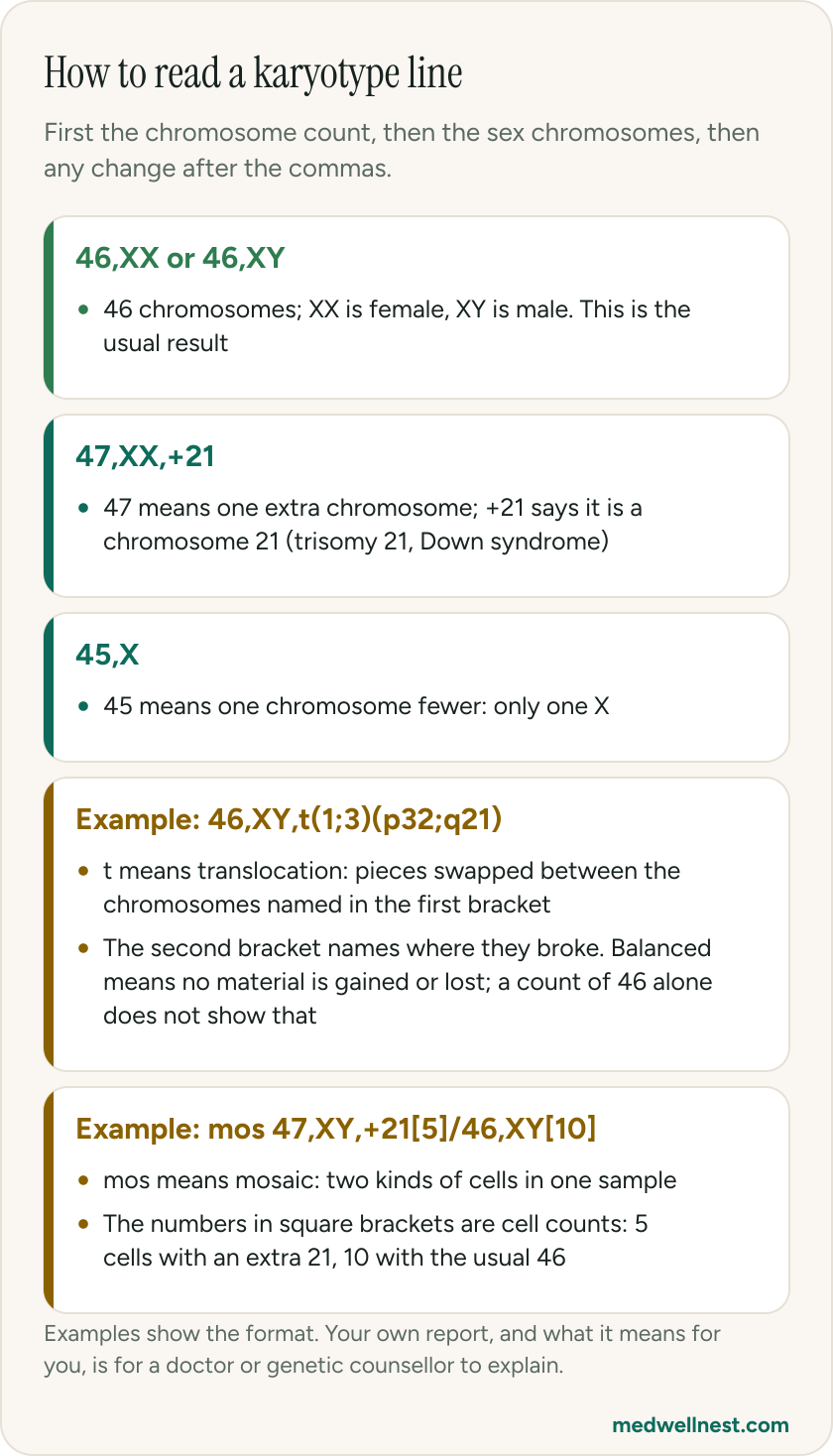
The first number is the chromosome count and the letters that follow are the sex chromosomes. A usual result is 46,XX for a female or 46,XY for a male, the usual number being 46. Anything after a further comma describes a change. Labs write results in a standard system, the International System for Human Cytogenomic Nomenclature (ISCN), so the same finding is written the same way by every lab.
A line such as 47,XX,+21 has 47 chromosomes, one more than usual, and the +21 says the extra one is a chromosome 21; MedlinePlus lists 47,XX,+21 and 47,XY,+21 among the other names for Down syndrome, most cases of which are caused by trisomy 21. A line such as 45,X has one chromosome fewer, with a single X. A line is a finding, not a prognosis, and what it means for you is for a doctor or genetic counsellor to explain. A prenatal karyotype also shows the sex chromosomes; the rules on telling parents the baby's sex are covered in our NIPT guide.
![Five cards on reading a karyotype line. 46,XX or 46,XY: 46 chromosomes, XX female and XY male, the usual result. 47,XX,+21: 47 means one extra chromosome and +21 says it is a chromosome 21, trisomy 21 or Down syndrome. 45,X: 45 means one chromosome fewer, only one X. Example 46,XY,t(1;3)(p32;q21): t means translocation, pieces swapped between the chromosomes named in the first bracket, the second bracket names where they broke, and balanced means no material is gained or lost; a count of 46 alone does not show that. Example mos 47,XY,+21[5]/46,XY[10]: mos means mosaic, two kinds of cells in one sample, and the square-bracket numbers are cell counts, 5 cells with an extra 21 and 10 with the usual 46.](/diagrams/en/karyotype-formula-decoder.svg)
03
Translocations: balanced and unbalanced
In a translocation a piece of one chromosome moves to another. It is written with a t and two brackets: the first names the chromosomes involved and the second the points where they broke, so t(1;3)(p32;q21) is an exchange between chromosomes 1 and 3.
Balanced means no genetic material is gained or lost. MedlinePlus explains that a balanced translocation usually does not cause any health problems in the person who carries it, but that as the translocation is passed to the next generation it can become unbalanced. It gives translocation Down syndrome as an example, where an unaffected parent carries a rearrangement between chromosome 21 and another chromosome. This is how a healthy carrier may still have pregnancies that are affected, and why an unbalanced change found in pregnancy tissue is one reason that parents are offered a karyotype themselves.
04
Mosaicism
Mosaicism means a person has two or more kinds of cells. MedlinePlus describes mosaic Down syndrome as an extra copy of chromosome 21 in only some of the body's cells, the others having the usual two copies. On a report it is written with mos, and the numbers in square brackets give how many cells of each kind were counted, so mos 47,XY,+21[5]/46,XY[10] means 5 cells with an extra chromosome 21 and 10 with the usual set.
How much a mosaic result matters depends on which chromosome is involved and in how many cells, which is a question for a genetic counsellor rather than something the formula answers.
05
Who is offered a karyotype: miscarriage and infertility
The Royal College of Obstetricians and Gynaecologists (RCOG) defines recurrent miscarriage as three or more first-trimester miscarriages, and encourages clinicians to evaluate after two if they suspect a pathological cause. Its 2023 guideline says cytogenetic analysis should be offered on the pregnancy tissue of the third and later miscarriages and of any second-trimester miscarriage. Parents' blood karyotyping should be offered if the pregnancy tissue shows an unbalanced structural chromosome abnormality, or if there is no tissue or the test failed.
The European Society of Human Reproduction and Embryology (ESHRE) is more cautious. Its guideline says genetic analysis of pregnancy tissue is not routinely recommended but could be done for explanatory purposes, that array-based comparative genomic hybridisation is recommended for it, and that parental karyotyping is not routinely recommended in couples with recurrent pregnancy loss but could be carried out after individual assessment of risk. ESHRE also defines the problem as the loss of two or more pregnancies, so the two bodies differ in their definitions as well as in how readily they test parents. They agree on counselling: ESHRE says all couples with an abnormal foetal or parental karyotype should receive genetic counselling.
For infertility, the 2026 NICE fertility guideline recommends testing for karyotype abnormalities in men with idiopathic azoospermia, meaning no sperm in the semen with no known cause, and considering it in men with a persistent sperm concentration of less than 5 million per ml. It makes no such recommendation for the woman's initial work-up. NICE's guideline on miscarriage covers diagnosis and first management and does not set out a karyotype rule for repeated loss, so the RCOG and ESHRE guidelines are the ones to look to.
06
Turnaround, what a karyotype cannot see, and counselling
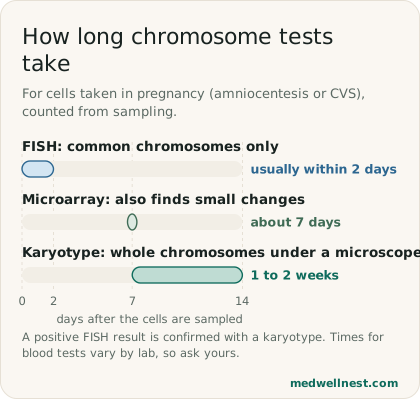
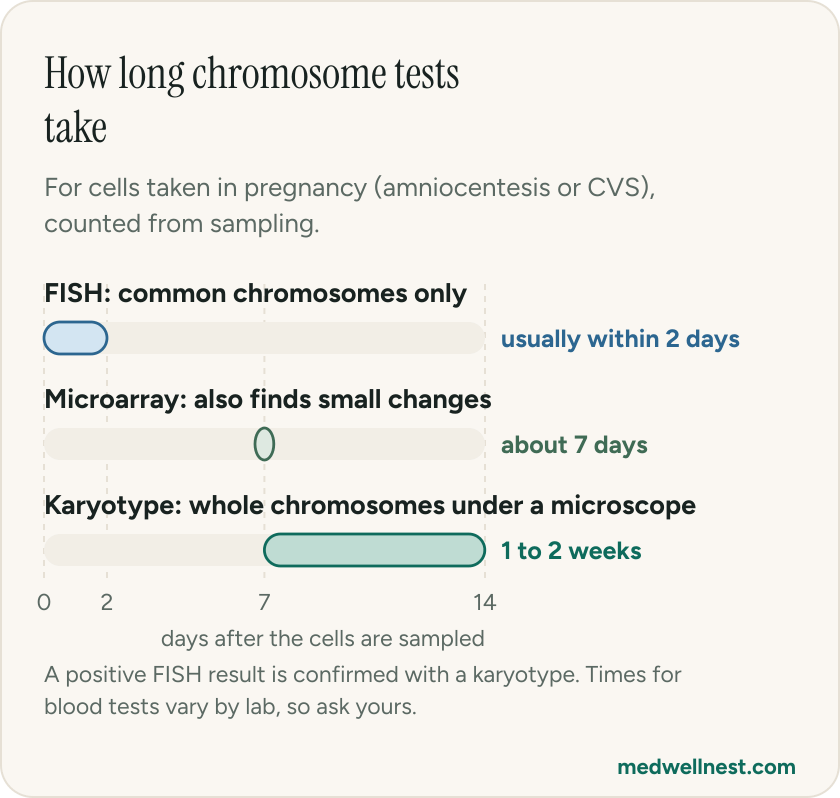
ACOG says karyotype results on cells taken in pregnancy are ready 1 to 2 weeks after sampling. A quicker test called FISH, which looks for common changes in chromosomes 13, 18, 21, X and Y, is usually back within 2 days, and a positive result is confirmed with a karyotype. For a blood karyotype the time depends on the lab, so ask yours.
A karyotype is a picture under a microscope, so it cannot see very small changes. ACOG says a chromosome microarray can find some chromosome problems that karyotyping can miss, with results ready in about 7 days. A normal karyotype therefore does not rule out every genetic cause. If a result is abnormal, a genetic counsellor can explain what it means for you and for future pregnancies; our NIPT guide and miscarriage guide cover the tests around it.
Sources
- Down syndrome — MedlinePlus Geneticsmedlineplus.gov
- Prenatal Genetic Diagnostic Tests — ACOG patient FAQacog.org
- Recurrent Miscarriage (Green-top Guideline No. 17) — RCOG, 2023rcog.org.uk
- ESHRE guideline: recurrent pregnancy loss (2018, updated 2022) — Human Reproduction Openpmc.ncbi.nlm.nih.gov
- Fertility problems: assessment and treatment (NG257), investigation chapter — NICE, 2026nice.org.uk
- Assessing the reliability of ChatGPT in cytogenetic reporting and interpretation (ISCN nomenclature examples) — Molecular Cytogenetics, 2025pmc.ncbi.nlm.nih.gov
Share this story
Curious where your own values stand?
Two minutes from upload to a full visual picture. Free to analyze.