In short
NIPT reads placental DNA in your blood to screen for Down, Edwards and Patau syndromes. Here is what low-chance and high-chance results mean, why a high-chance result needs CVS or amniocentesis before any decision, what a no-result report means, and why it is never a sex test.
On this page
01
What NIPT reads in your blood
NIPT, short for non-invasive prenatal testing and also called cell-free DNA screening, is a blood test taken from the mother. During pregnancy, short fragments of DNA from the placenta circulate in her blood alongside her own. The Society for Maternal-Fetal Medicine (SMFM) says this placental share, called the fetal fraction, is generally 10% to 20% of the free DNA at its peak, between 10 and 21 weeks. The laboratory checks whether there is more material than expected from chromosome 21, 18 or 13.
SMFM says the test is available from 9 to 10 weeks of pregnancy, and ACOG says results take about a week. In November 2025 ACOG endorsed new SMFM guidance, and its January 2026 practice advisory says this replaces its older practice bulletin. It recommends that screening for trisomies 21, 18 and 13 be made routinely available to all pregnant patients, and calls cell-free DNA the most sensitive and specific screening test for them. It can be a first test, or the next step after a higher-chance result on the double marker or quadruple test.
02
What it finds, and what it misses
NIPT screens for Down syndrome (trisomy 21), Edwards syndrome (trisomy 18) and Patau syndrome (trisomy 13), and some panels add conditions with an extra or missing sex chromosome, such as Turner syndrome (45,X). SMFM puts its detection rate for trisomy 21 at about 99%, against 82% to 97% for first-trimester combined screening and 81% for the quadruple test.
It is not a test for everything. SMFM says cell-free DNA does not screen for all possible genetic conditions and does not look at how the baby is formed, so it recommends an anatomy scan for every pregnancy, whatever screening was done. The International Society for Prenatal Diagnosis (ISPD) adds that a low-chance result does not exclude all genetic conditions and that false negatives can occur, and that a baby found to have a structural problem on a scan should still be offered diagnostic testing. SMFM does not recommend routine screening for microdeletions.
03
Low risk and high risk are chances, not answers
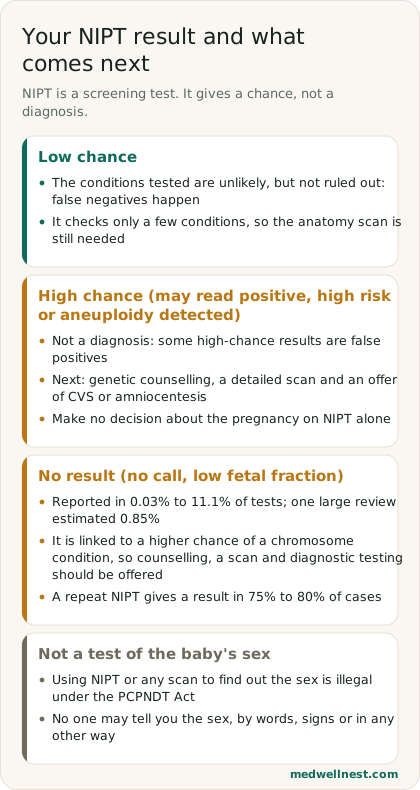
Reports use different words for the same thing. SMFM notes that a high-chance result may be printed as positive, high risk, aneuploidy detected or aneuploidy suspected, and that this wording can wrongly suggest a diagnosis. The test does not give a yes or a no. A low-risk result means the conditions tested are unlikely; a high-risk result means the chance is raised.
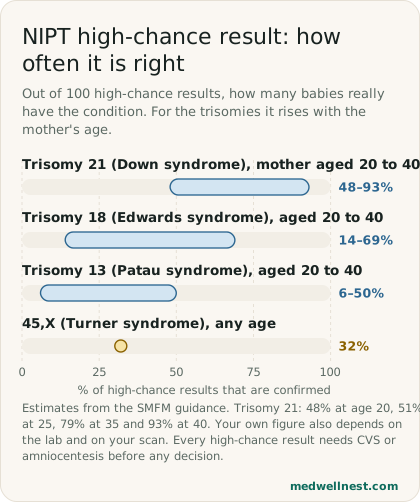
How often a high-risk result is right is called the positive predictive value, and it depends on how common the condition is. For the trisomies that rises with the mother's age. In SMFM's table, a high-risk result for trisomy 21 is correct 48% of the time at age 20, 51% at 25, 79% at 35 and 93% at 40. For trisomy 18 the figures run from 14% at 20 to 69% at 40, and for trisomy 13 from 6% to 50%. For 45,X it is 32% at any age. So at 25, a high-risk result for trisomy 13 is far more often wrong than right.
Other sources give different figures. ISPD quotes pooled values of 91.78% for trisomy 21, 65.77% for trisomy 18 and 37.23% for trisomy 13, not split by age. False positives have known causes: ISPD says abnormal cells confined to the placenta occur in 1% to 2% of pregnancies, and SMFM lists a vanished twin, fibroids, a previous transplant, a recent blood transfusion and, rarely, cancer in the mother.
04
A high-risk result needs CVS or amniocentesis
SMFM says a positive result should be followed by genetic counselling, a detailed anatomy scan and a recommendation for diagnostic testing by chorionic villus sampling (CVS) or amniocentesis. These tests look at cells from the placenta or the fluid around the baby rather than fragments in the mother's blood, so they can say whether the baby actually has the condition. SMFM does not recommend making decisions about the pregnancy on NIPT alone, and ISPD strongly recommends diagnostic testing before anyone considers ending a pregnancy.
This is not a formality. SMFM cites a 2014 study of more than 30,000 women in which about 6% of those with a positive result had an abortion without confirmation, and notes that the FDA, the medicines and devices regulator, warned the public about false positives in April 2022. Which test comes next depends on the result and the scan: for trisomy 13 or 45,X with a normal early scan, SMFM's table suggests amniocentesis, because placental mosaicism can mislead CVS. Every patient can also choose to decline further testing.
05
Fetal fraction and a no-result report
Sometimes the lab cannot give an answer, and the report says no call, no result, test failure or low fetal fraction. SMFM says such results have been reported in 0.03% to 11.1% of tests, with one large review estimating 0.85%. Most labs need a fetal fraction of at least 2% to 4%. The fetal fraction rises as pregnancy goes on, and SMFM lists what makes a no-result report more likely: testing very early, higher body weight, IVF or a donor egg, twins, some conditions such as lupus, and a blood thinner called low-molecular-weight heparin.
A no-result report is not just a lab problem. SMFM says it is linked to a higher chance of a chromosome condition: in one 2023 study the risk of trisomy 21, 18 or 13 was about 130 times higher after a failed first attempt, and low fetal fraction is more common with trisomies 13 and 18. So it recommends genetic counselling, a detailed scan and an offer of diagnostic testing. A repeat NIPT gives a result in 75% to 80% of cases, but some people prefer not to lose the time.
06
NIPT is not a sex test, and using it as one is illegal
Sex determination is illegal. The Pre-Conception and Pre-Natal Diagnostic Techniques (PCPNDT) Act defines a prenatal diagnostic test to include any test of a pregnant woman's blood done to detect chromosomal abnormalities, which covers NIPT. Section 6 says no person shall conduct or cause to be conducted any prenatal diagnostic technique, including ultrasonography, for the purpose of determining the sex of a foetus. Section 5(2) says no one, including the person doing the test, may tell the pregnant woman, her relatives or anyone else the sex, by words, signs or in any other manner.
The penalties are real. A doctor, lab or clinic that breaks the Act faces up to 3 years in prison and a fine of up to 10,000 rupees for a first offence. Anyone who seeks help for sex selection faces up to 3 years and a fine of up to 50,000 rupees for a first offence, although that section does not apply to a woman who was forced into it. SMFM also advises against using cell-free DNA to find the sex for non-medical reasons. If a sex chromosome panel is offered, its purpose is to look for an extra or missing sex chromosome, and the law forbids anyone from telling you the sex from it.
When to act
Routine — see a doctor
A high-risk or no-result NIPT report: ask for genetic counselling and a detailed scan soon, and discuss CVS or amniocentesis. Do not make any decision about the pregnancy on the NIPT result alone.
A low-risk result: carry on with routine pregnancy care, including the anatomy scan, because NIPT does not check how the baby is formed and does not rule out every genetic condition.
Sources
- SMFM Consult Series #74: Cell-free DNA screening for aneuploidies, updated guidance (2025)obgyn.onlinelibrary.wiley.com
- Screening for Fetal Chromosomal Abnormalities, Practice Advisory (January 2026) — ACOGacog.org
- Position statement on non-invasive prenatal testing in singleton pregnancies (2023) — ISPDobgyn.onlinelibrary.wiley.com
- Prenatal Genetic Screening Tests — ACOGacog.org
- Screening for Down's, Edwards' and Patau's syndrome — NHSnhs.uk
- PCPNDT Act 1994, full text as amendedindiacode.nic.in
Share this story
Curious where your own values stand?
Two minutes from upload to a full visual picture. Free to analyze.