In short
Worry about low milk is common, but low supply is judged from your baby: swallowing, wet nappies, weight gain. The NHS and ABM say frequent, effective milk removal raises supply, and sources do not recommend relying on herbs or foods. A floppy or non-feeding baby needs an emergency department now.
Emergency if: Your baby is floppy, difficult to wake or cannot be woken for feeds, is not feeding, has blue, grey, pale or blotchy skin or lips, is breathing very fast or with grunting, has a weak, high-pitched or continuous cry, or has had no wet nappy or has not peed for at least 12 hours: call emergency services now or go to an emergency department now. The NHS lists these as emergency signs. Do not wait for a lactation appointment.
On this page
01
How do I know if my milk supply is really low?
Start with your baby, not with how your breasts feel. The AAP says a baby who is tracking along their growth curve as they should is very reassuring, and the Academy of Breastfeeding Medicine (ABM) says that when there is no evidence of low supply, the mother should be reassured. The AAP says all mothers share the concern about whether their milk is enough for their baby.
So worry about low supply is common, and true low supply is judged by what the baby does: swallowing at feeds, wet nappies, stools and weight. ABM says low supply is often related to suboptimal milk removal, though it also lists medical causes, covered below. Milk removal is something that skilled help can often improve.
02
What are the signs that my baby is getting enough milk?
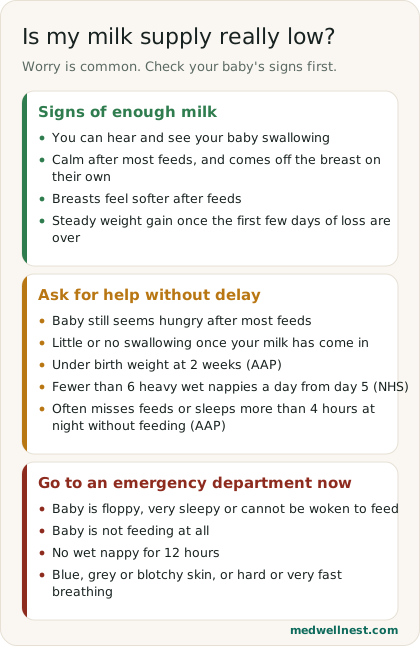
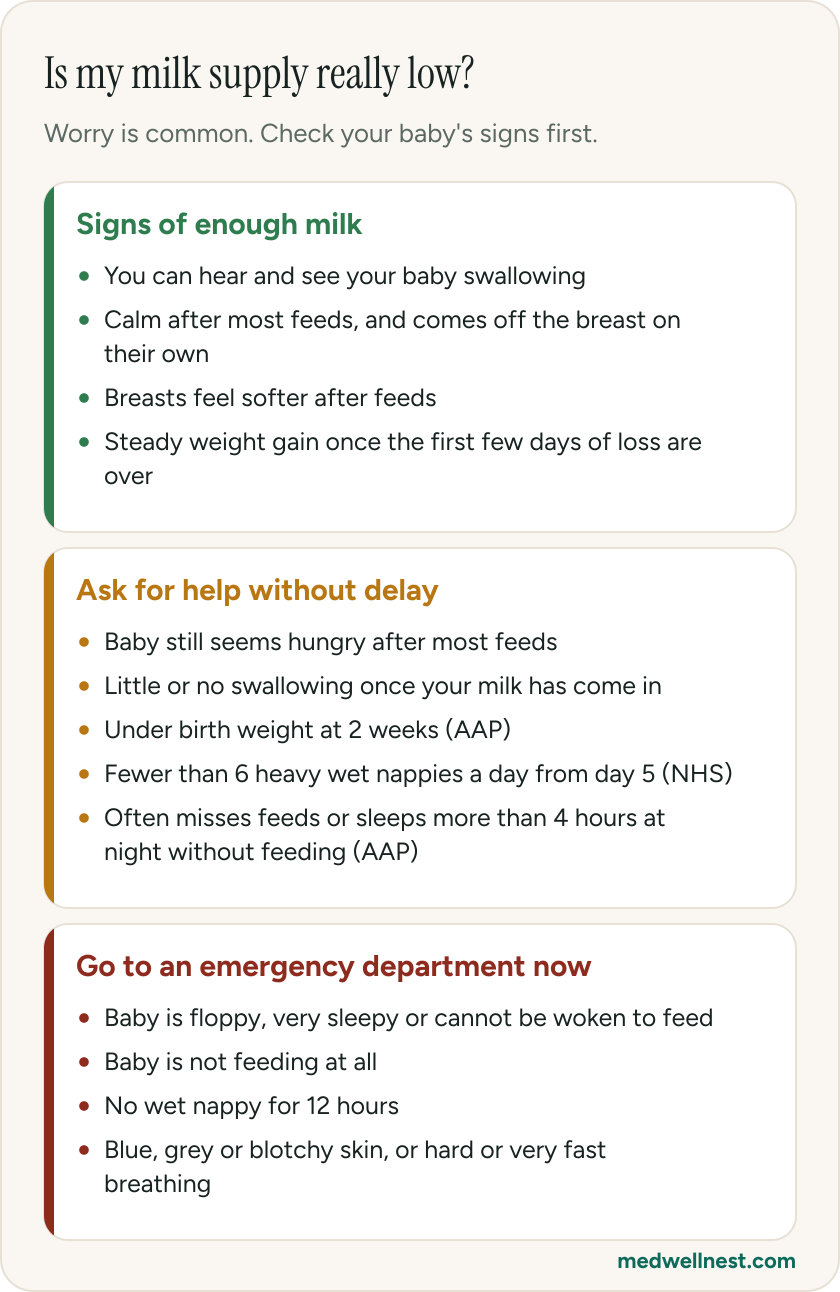
The NHS lists signs of effective feeding: feeds begin with a few rapid sucks followed by long, rhythmic sucks and swallows with pauses, you can hear and see your baby swallowing, the cheeks stay rounded, the baby is calm and relaxed, comes off the breast on their own and seems content after most feeds, and your breasts feel softer after feeds. In the first 48 hours your baby is likely to have only 2 or 3 wet nappies, and from the fifth day there should be at least 6 heavy wet nappies every 24 hours. The NHS suggests adding 2 to 4 tablespoons of water to an unused nappy to learn how a wet one feels.
Weight is the slower confirmation: the AAP treats a baby who is under birth weight at 2 weeks as a warning sign. Our story on newborn weight loss explains how much loss is normal and when a feeding check is needed. The main point here is that a hungry-seeming or frequently feeding baby is not by itself proof of low supply, and a baby who is swallowing well and passing the expected wet nappies is probably getting enough.
03
What causes low breast milk supply?
The NHS lists things that can affect supply: poor attachment and positioning, not feeding often enough or not offering the breast whenever the baby shows hunger, alcohol and smoking, previous breast surgery, time away from the baby, illness in you or the baby, anxiety, stress or depression, and a tongue-tie that restricts the baby's tongue. It also says that giving formula top-ups can make a baby want to feed less, and that the less often you feed, the less milk you make. Feeding on a clock rather than on demand, a dummy that replaces feeds and long gaps between feeds can all reduce how often the breast is emptied.
ABM adds medical causes a doctor should look for, including medicines, primary glandular insufficiency, breast surgery, polycystic ovary syndrome, an underactive thyroid, retained placenta, heavy smoking or alcohol use. The AAP lists the return of your periods, thyroid problems, infections, a premature baby, a caesarean or difficult delivery, twins or more, and a previous breast biopsy or surgery as factors that can lower supply. With skilled help, many of these problems can be sorted out, according to the NHS.
04
How does milk supply work, and how do I increase it?
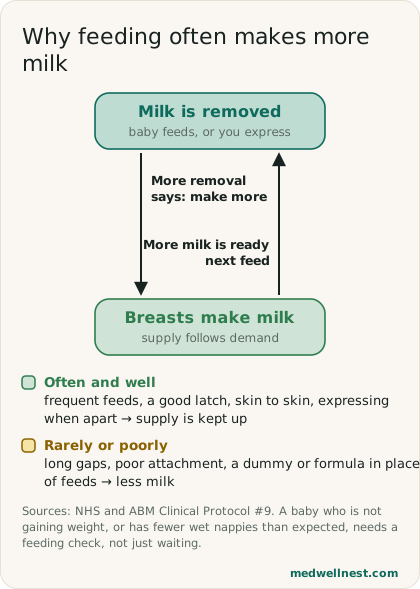
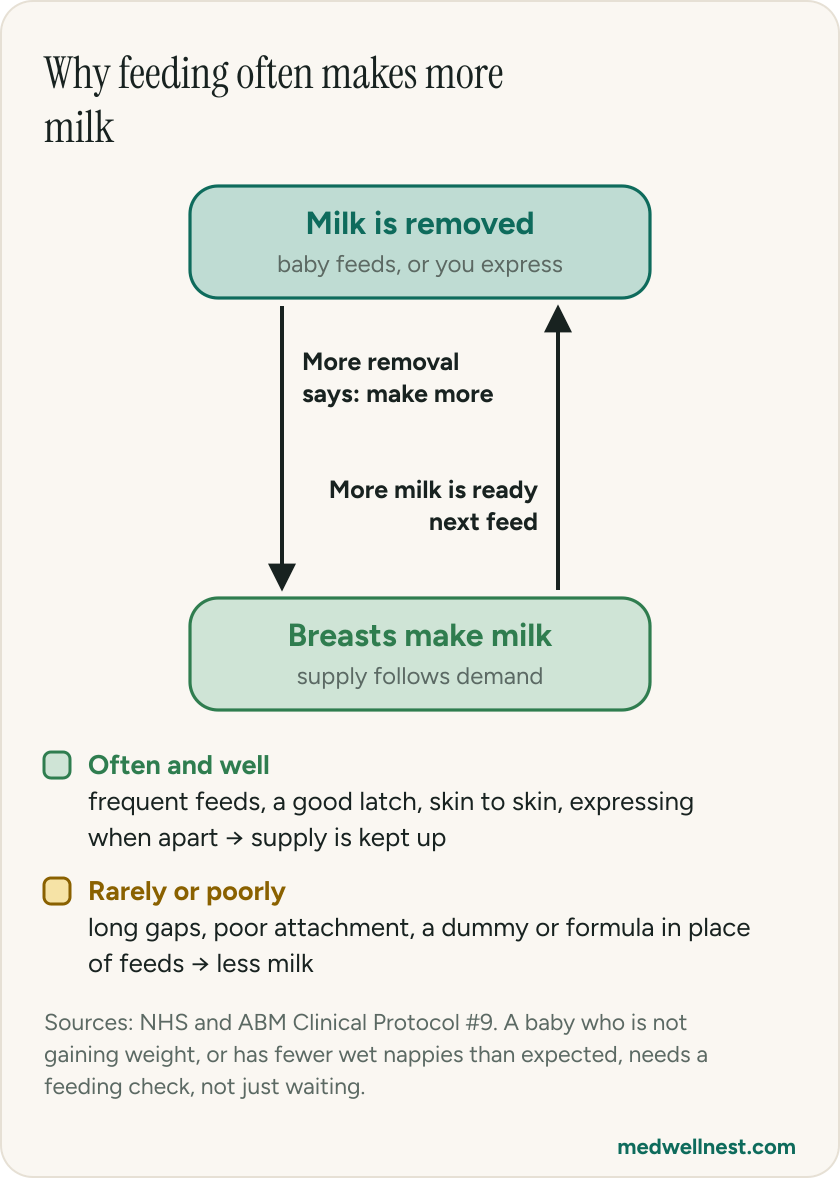
Milk is made on supply and demand. The NHS says the more your baby feeds, the more milk you make, and that if you feed hours apart you may start to make less. ABM describes the same thing in more detail: if the breasts are not drained regularly and thoroughly, milk production declines, while more frequent and thorough drainage typically increases the rate at which milk is made. The AAP says effective milk removal is the best way to keep supply up.
The NHS lists what you can try: let your baby feed when they want and for as long as they need, offer both breasts and switch which breast you start with, hold your baby close and skin to skin, try not to give anything other than breast milk, wait on a dummy until you are both comfortable with breastfeeding, and express regularly if you are apart from your baby. If your baby cannot feed well at the breast, ABM says regular expressing by hand or pump is necessary, and the AAP says to check the fit and valves of your pump and that a double electric pump is best when you need to express. If you do all of this and are still worried, the NHS says to ask your midwife to refer you to a breastfeeding specialist.
05
Do foods, herbs or tablets for increasing breast milk work?
The sources do not recommend relying on them. The AAP says no special tricks or products are needed and that specific foods or supplements marketed to promote breast milk production are not necessary; it suggests eating healthfully and drinking plenty of water. ABM, in its protocol on galactogogues (substances believed to increase milk supply), says the research on both medicines and herbs is inconclusive, that all of them have potential adverse effects, and that ABM cannot recommend any specific galactogogue at this time. It calls herbal products problematic because of lack of regulation of preparations and insufficient evidence of efficacy and safety.
ABM also says a galactogogue will not increase milk supply if the breasts are being emptied infrequently or ineffectively, and that medication should never replace evaluation and counselling on the things that can be changed, such as how often and how well milk is removed, anxiety and any medical condition. Any medicine for milk supply is a decision to make with a doctor after a feeding assessment, not something to start from a list. The NHS notes that some medicines, including dopamine, ergotamine and pyridoxine, can reduce supply, so tell your doctor or pharmacist that you are breastfeeding before starting any medicine.
06
When should I see a lactation specialist or a doctor?
The NHS says that if you are worried your baby is not getting enough milk, talk to your midwife or a breastfeeding specialist as soon as possible, because the problems are easier to fix early. The AAP lists signs that need help right away: baby still hungry after most feeds, no frequent swallowing once your milk has come in, under birth weight at 2 weeks, fewer than 6 wet nappies a day after 7 days, dark yellow or red-specked urine, your milk not coming in by day 5, a baby who often misses feeds or sleeps more than 4 hours at night without feeding, feeds that are consistently shorter than about 10 minutes or longer than about 50 minutes, and severe engorgement or pain that stops breastfeeding.
A hungry baby must be fed in the meantime. The NHS says topping up with formula can make a baby want to feed less, which lowers supply, so ask a specialist to plan any top-up with you so that you can also protect your supply. The AAP also says to consider seeing your own doctor or ob-gyn if you have health concerns, since a return of periods, thyroid problems or infections can affect supply. Our breastfeeding guide covers latch, engorgement and mastitis.
Milk supply worries: how fast to act
Emergency — act now
Your baby is floppy, difficult to wake or cannot be woken for feeds, is not feeding, has blue, grey, pale or blotchy skin or lips, is breathing very fast or with grunting, has a weak, high-pitched or continuous cry, or has had no wet nappy or has not peed for at least 12 hours: call emergency services now or go to an emergency department now. The NHS lists these as emergency signs. Do not wait for a lactation appointment.
Same-day — call promptly
Your baby still seems hungry after most feeds, you hear little or no swallowing once your milk has come in, your baby often misses feeds or sleeps more than 4 hours at night without feeding, there are fewer than 6 heavy wet nappies in 24 hours from day 5 onwards, the urine is dark yellow or red-specked, your milk has not come in by day 5, or the baby is under birth weight at 2 weeks: have your baby weighed and feeding checked today by your midwife, baby's doctor or a breastfeeding specialist. The AAP and NHS say to ask for help without delay. The NHS says to expect at least 6 heavy wet nappies every 24 hours from day 5; the AAP uses the same count of 6 after day 7, so the day-5 check comes first.
Routine — see a doctor
You are worried your supply is low but your baby is swallowing, content and passing the expected nappies: ask your midwife or a breastfeeding specialist to watch a whole feed and check the latch, and ask your doctor about any medicine you take. ABM says that when there is no evidence of low supply, the mother should be reassured.
Sources
- Milk supply — NHS Best Start in Lifenhs.uk
- Breastfeeding: is my baby getting enough milk? — NHSnhs.uk
- Low Breast Milk Supply: 5 Steps That Can Help — AAP, HealthyChildren.orghealthychildren.org
- Warning Signs of Breastfeeding Problems — AAP, HealthyChildren.orghealthychildren.org
- ABM Clinical Protocol #9: Use of Galactogogues in Initiating or Augmenting Maternal Milk Production, Second Revision 2018 — Breastfeeding Medicinepubmed.ncbi.nlm.nih.gov
- When to get urgent medical help for babies and children under 5 — NHSnhs.uk
Share this story
Curious where your own values stand?
Two minutes from upload to a full visual picture. Free to analyze.