In short
Most newborns lose some weight in the first 3 to 4 days. NICE says a loss of more than 10% of birth weight needs a check of the baby and of feeding, and most babies are back at birth weight by 3 weeks. A baby who is floppy, not feeding or has had no wet nappy for 12 hours needs an emergency department now.
Emergency if: Your baby is floppy, difficult to wake or cannot be woken, is not feeding, has a weak, high-pitched or continuous cry, has blue, grey, pale or blotchy skin or lips, has grunting or very fast breathing, has had no wet nappy or has not peed for at least 12 hours, or has a sunken soft spot, dry mouth or sunken eyes: call emergency services now or go to an emergency department now. The NHS lists these as signs that need emergency or urgent medical help, and NICE lists the dehydration signs. Also go to an emergency department now if a baby under 3 months has a temperature of 38 °C or higher, unless a doctor can see your baby within 2 hours (NICE NG143).
On this page
01
How much weight loss is normal in a newborn, and is 10% normal?
Some loss is expected. NICE says it is common for babies to lose some weight in the early days of life, that the loss usually stops after about 3 or 4 days, and that it usually relates to body fluid adjustments. The AAP says a well-nourished newborn should lose no more than 8% to 10% of birth weight in the first few days before starting to gain again. For example, 10% of a 3 kg birth weight is 300 grams.
The sources use 10% as the line for a check, not as a diagnosis. NICE says that if a baby loses more than 10% of birth weight, the baby should be examined for signs of dehydration or of an illness that could explain it, feeding should be assessed in detail, and direct observation of feeding by someone with training in breastfeeding and bottle feeding considered. It also says to offer feeding support and to weigh again at intervals that depend on the level of concern, but no more often than daily. A loss above 10% is a reason to look closely at feeding, not proof that something is wrong.
02
Why does a newborn lose weight after birth?
NICE says the early loss usually relates to body fluid adjustments. A 2015 paper in Pediatrics adds that weight loss is nearly universal among newborns who are exclusively breastfed in hospital, that the amount varies a lot between babies, and that higher losses carry a higher risk of illness. So some loss is the normal pattern, and the question is how much and whether it is turning around.
Feeding is how it turns around. The AAP says a breastfed newborn should nurse at least 8 to 12 times every 24 hours and should be seen for a first check no more than 48 hours after leaving hospital, because the weight check at that visit helps show whether the baby is getting enough milk.
03
Does a C-section baby lose more weight than a baby born normally?
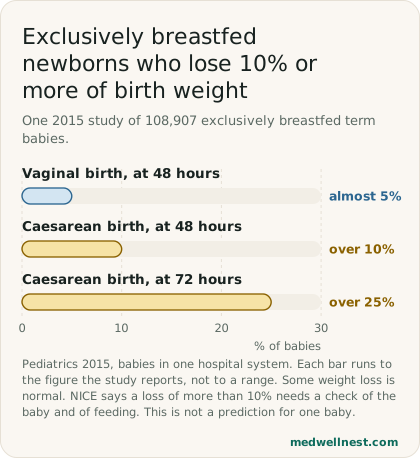
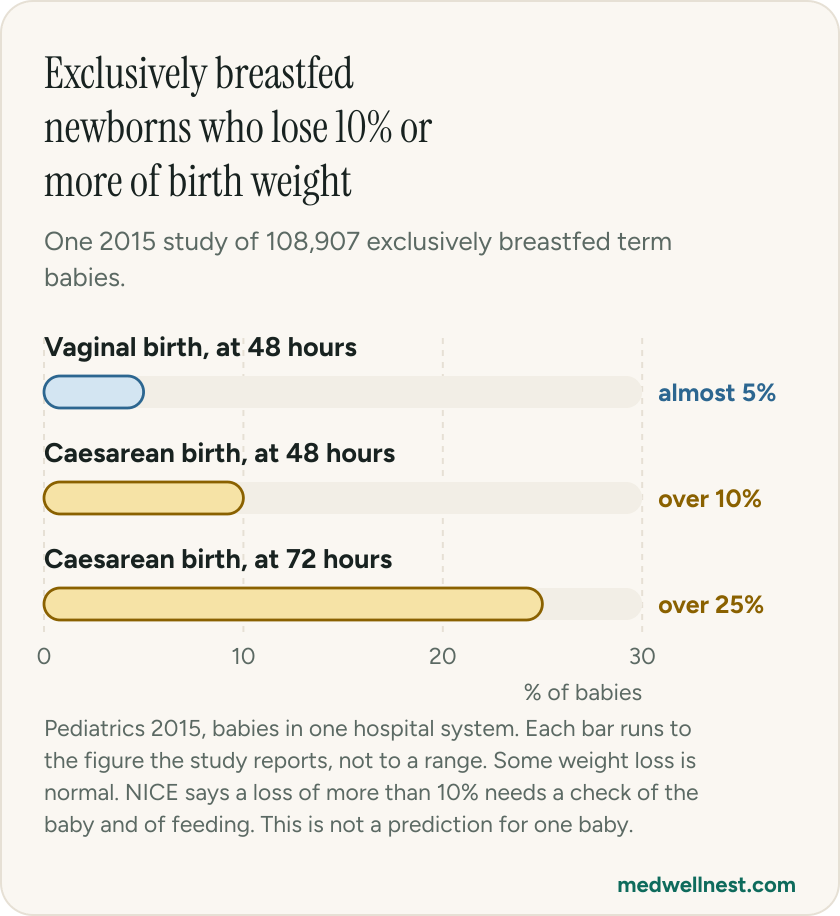
In one large study, yes, on average. Flaherman and colleagues studied 108,907 term babies, born at 36 weeks or later in one hospital system between 2009 and 2013, who had weights recorded while exclusively breastfed: 83,433 born vaginally and 25,474 by caesarean. The difference by delivery mode appeared 6 hours after birth and persisted. Almost 5% of babies born vaginally and more than 10% of those born by caesarean had lost 10% or more of birth weight 48 hours after delivery. By 72 hours, more than 25% of babies born by caesarean had lost 10% or more.
Read this with care. It describes exclusively breastfed term babies in one hospital system, not every baby, and it does not say that caesarean babies are unwell. The authors built the charts to help spot babies who are on a path to greater weight loss early. The same rule applies to every baby: a loss above 10% is a reason to have feeding checked, whichever way the baby was born. Our breastfeeding guide explains how to get that help.
04
When does a newborn get back to birth weight?
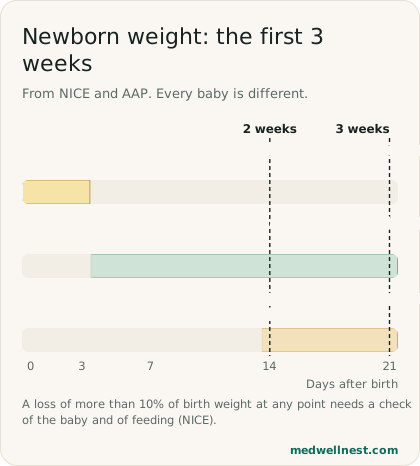
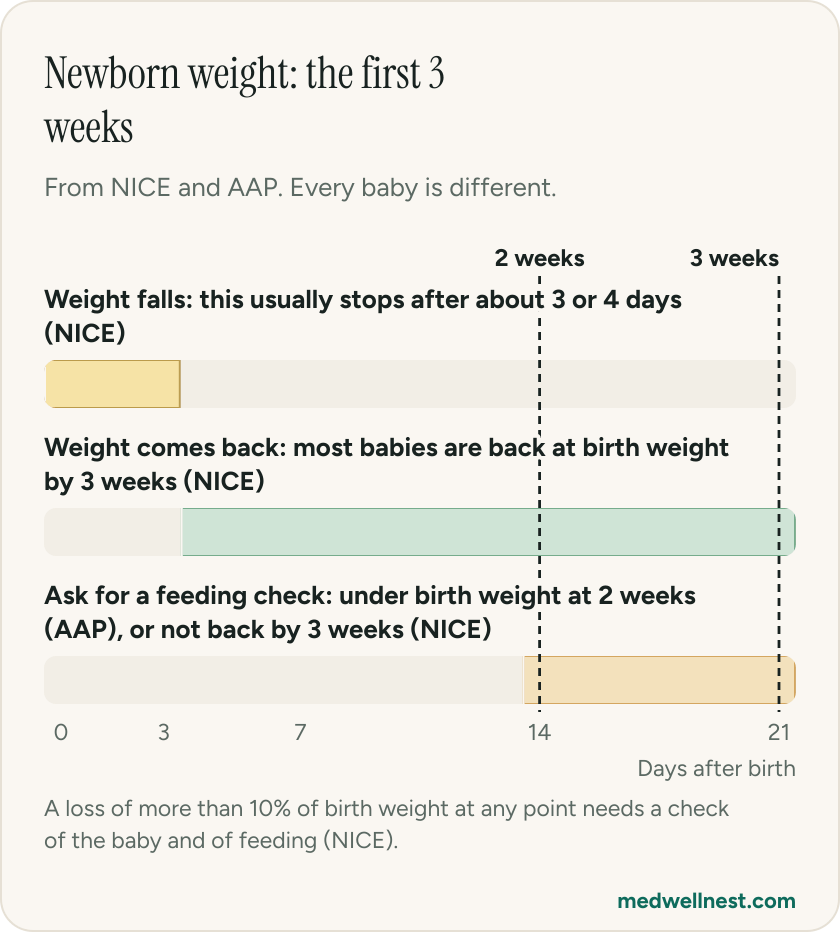
NICE says most babies have returned to their birth weight by 3 weeks of age. It says that if a baby has lost more than 10% or is not back at birth weight by 3 weeks, referral to children's specialists should be considered when there is also evidence of illness, marked weight loss or no response to feeding support. The AAP is stricter: it lists being under birth weight by 2 weeks of age, or not gaining at least 5 to 7 ounces (roughly 140 to 200 grams) a week once the milk has come in, as a sign of a feeding problem.
So the sources differ, and a baby who is still under birth weight at 2 weeks should be reviewed even though NICE allows until 3 weeks for most babies. Ask for a feeding check at 2 weeks rather than waiting. Our baby weight chart by month takes over after the newborn period.
05
How many wet and dirty nappies mean a newborn is getting enough milk?
The AAP gives a guide for a breastfed newborn. On days 1 and 2 there are 1 or 2 stools a day, blackish and tarry. On days 3 and 4 there are at least 2 stools a day that are beginning to look greenish to yellow. By 5 to 7 days the stools should be yellow and loose with small curds, at least 3 to 4 a day, and there should be 6 or more wet nappies a day with nearly colourless or pale yellow urine. The AAP also says a baby should seem satisfied for an average of 1 to 3 hours between feeds.
The AAP warning signs are the mirror image. After 7 days, the AAP lists any of these as a reason to have the baby weighed: fewer than 6 wet nappies a day, fewer than 4 stools a day, urine that is dark yellow or specked with red, or stool that is still dark rather than yellow and loose. The same applies if the milk has not come in by day 5. If your baby has 2 or 3 poos a day but 6 or more wet nappies, swallows well and weight is on track, mention it at the next check rather than worrying. Fewer than 6 wet nappies a day is a same-day sign either way. Our newborn poop chart and jaundice guide cover the colours in more detail.
06
When should I worry about newborn weight loss, and when is it an emergency?
Ask for a feeding check, promptly, if the loss is more than 10%, if weight is still falling after about day 4 (NICE says the loss usually stops by then), if the baby seems hungry after most feeds, if nappies are fewer than the guide above, or if your milk has not come in by day 5. NICE says that formula given to a breastfed baby may help weight gain but often ends breastfeeding, and that if a top-up is needed the mother should be supported to keep breastfeeding. A hungry baby must be fed, so ask for a plan rather than guessing, and a fed baby comes first.
The signs below are different: they are about the baby being unwell, not about the number on the scale. The NHS lists these as signs that need emergency or urgent medical help: a baby who is difficult to wake or cannot be woken, is floppy, is not feeding, has a weak, high-pitched or continuous cry, has blue, grey, pale or blotchy skin or lips, is breathing very fast or with grunting, or has had no wet nappy or has not peed for at least 12 hours. NICE lists a sunken soft spot, dry mouth, sunken eyes and absence of tears as signs of dehydration to look for, and says a baby under 3 months with a temperature of 38 °C or higher is at high risk and should be seen face to face within 2 hours, so go to an emergency department now unless a doctor can see your baby in that time. For yellow skin, see our newborn jaundice guide.
Newborn weight: how fast to act
Emergency — act now
Your baby is floppy, difficult to wake or cannot be woken, is not feeding, has a weak, high-pitched or continuous cry, has blue, grey, pale or blotchy skin or lips, has grunting or very fast breathing, has had no wet nappy or has not peed for at least 12 hours, or has a sunken soft spot, dry mouth or sunken eyes: call emergency services now or go to an emergency department now. The NHS lists these as signs that need emergency or urgent medical help, and NICE lists the dehydration signs. Also go to an emergency department now if a baby under 3 months has a temperature of 38 °C or higher, unless a doctor can see your baby within 2 hours (NICE NG143).
Same-day — call promptly
Your baby has lost more than 10% of birth weight, is still losing weight after about day 4, seems hungry after most feeds, has fewer than 6 wet nappies a day after 7 days, has dark yellow or red-specked urine, or your milk has not come in by day 5: have your baby weighed and feeding checked today. The AAP says to have the baby weighed right away for these signs, and NICE says a loss above 10% needs a clinical assessment.
Routine — see a doctor
Your baby is feeding and has wet and dirty nappies but is not back at birth weight yet, or you are unsure how much loss is normal: ask your midwife or your baby's doctor at the next check, and ask for a feeding check at 2 weeks if your baby is still under birth weight. NICE says most babies are back at birth weight by 3 weeks.
Sources
- Faltering growth: recognition and management of faltering growth in children (NG75), section 1.1 weight loss in the early days of life — NICE guidelinenice.org.uk
- How to Tell if Your Breastfed Baby is Getting Enough Milk — AAP, HealthyChildren.orghealthychildren.org
- Warning Signs of Breastfeeding Problems — AAP, HealthyChildren.orghealthychildren.org
- Early weight loss nomograms for exclusively breastfed newborns — Flaherman et al., Pediatrics 2015pubmed.ncbi.nlm.nih.gov
- When to get urgent medical help for babies and children under 5 — NHSnhs.uk
- Fever in under 5s: assessment and initial management (NG143) — NICE guidelinenice.org.uk
Share this story
Curious where your own values stand?
Two minutes from upload to a full visual picture. Free to analyze.