In short
Low HDL flags higher heart risk, but drugs that raise it have not cut heart attacks beyond what they do to LDL-type particles, and very high HDL has been linked with higher death rates. Exercise moves HDL most; LDL or non-HDL remain the numbers doctors treat.
Emergency if: Pain or discomfort in the centre of the chest, or in the arms, left shoulder, elbows, jaw or back, especially with shortness of breath, feeling or being sick, light-headedness, a cold sweat or turning pale; or sudden weakness or numbness of the face, arm or leg, especially on one side, sudden confusion, trouble speaking or understanding speech, sudden trouble seeing, walking or keeping your balance, a sudden severe headache with no known cause, or fainting: call emergency services now. The WHO lists these as symptoms of a heart attack or stroke and says people who have them should seek medical care immediately.
On your report
HDL Cholesterol, LDL Cholesterol, Triglycerides
On this page
01
Is low HDL cholesterol dangerous?
Low HDL is a warning sign, not a disease by itself. The ESC/EAS guideline calls the link between HDL and heart disease 'among the most consistent and reproducible associations in observational epidemiology', and says low HDL is associated with excess events and deaths in people with coronary artery disease, even at low LDL. MedlinePlus gives a healthy HDL as more than 40 mg/dL for men and more than 50 mg/dL for women aged 20 or older; our lipid profile guide gives the full guide levels.
But the guideline adds that Mendelian randomisation studies, which use inherited gene differences as a natural experiment, do not provide compelling evidence that HDL itself causes heart disease, and that no HDL treatment goal has been set. In plain terms: low HDL often travels with other problems, so it flags risk, but making the HDL number rise has not been shown to lower that risk.
02
What causes low HDL?
NHLBI says an unhealthy lifestyle is the most common cause of low HDL, but inherited genes, other medical conditions and some medicines can also lower it. Smoking lowers HDL, particularly in women, and lack of physical activity is linked to unhealthy cholesterol levels. Its list of conditions to discuss with your doctor includes overweight and obesity, diabetes, an underactive thyroid, chronic kidney disease, polycystic ovary syndrome, sleep apnea, HIV and lupus.
NHLBI also names medicines that can raise LDL or lower HDL, including beta-blockers, thiazide water tablets (diuretics), steroids such as prednisone and retinoids used for acne. Do not stop any of them on your own. If your HDL is low, ask your doctor whether a medicine could be part of the reason. Our triglycerides guide explains why low HDL and high triglycerides so often travel together.
03
How can I raise HDL, and by how much?
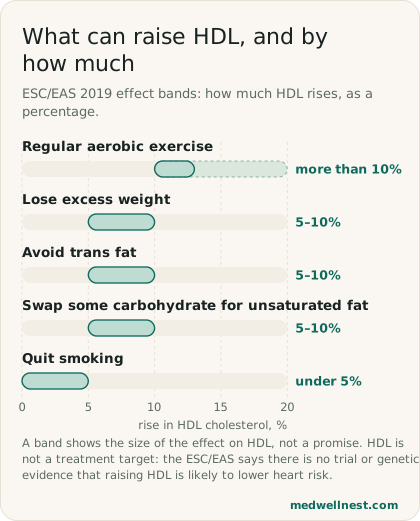
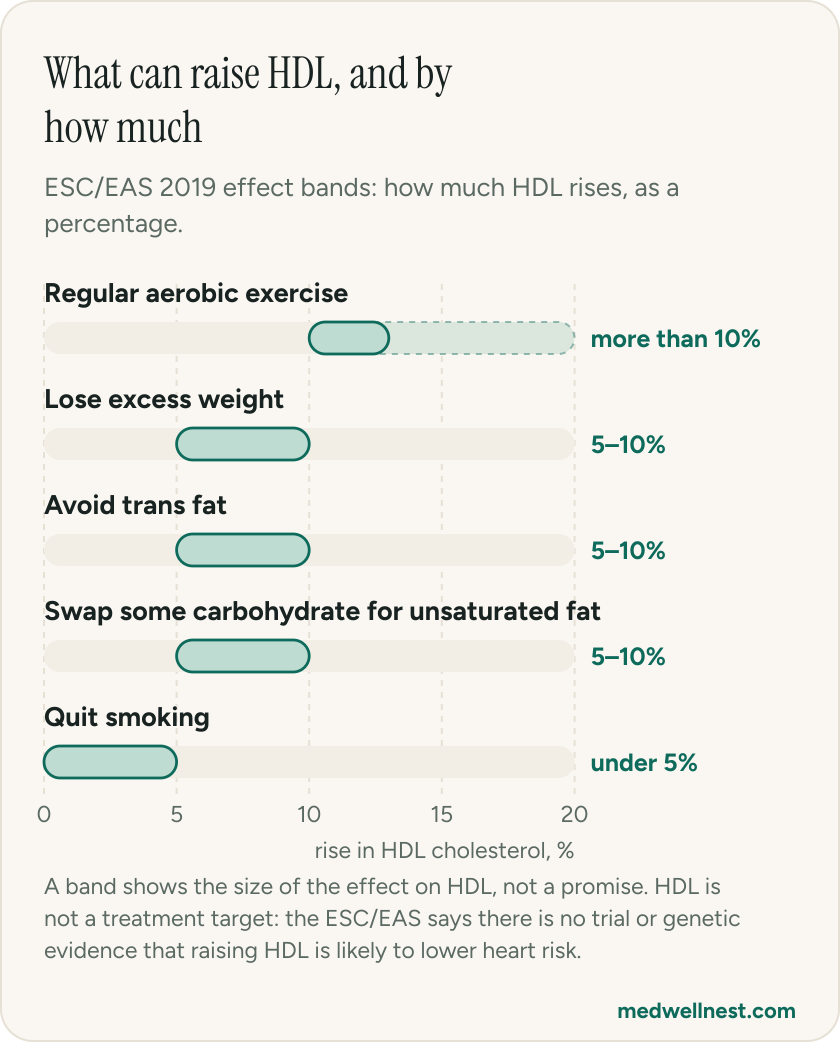
The ESC/EAS grades each change by the size of its effect on HDL. Regular aerobic exercise has the largest, more than 10%. Losing excess weight, avoiding trans fat, and eating less carbohydrate and replacing it with unsaturated fat are each rated at 5 to 10%. Quitting smoking is rated under 5%, and the guideline says it may help provided weight gain is prevented.
In numbers, the guideline says about 25 to 30 km of brisk walking a week, or any equivalent activity, may raise HDL by 3.1 to 6 mg/dL, and that once weight has stabilised, each kilogram lost is linked with a rise of about 0.4 mg/dL. The effect is real but modest, and it comes on top of other benefits, such as lower triglycerides, so exercise is worth doing whatever your HDL.
Do not start drinking to raise HDL. The guideline only says that people who already drink alcohol in moderation may continue if their triglycerides are not raised.
04
Is there a medicine to raise HDL?
Drugs that raise HDL have not reduced heart attacks beyond what their effect on LDL-type particles would explain. The ESC/EAS says there is currently no randomised-trial or genetic evidence to suggest that raising HDL is likely to reduce the risk of cardiovascular events. In AIM-HIGH, 3414 people with heart disease who were already on a statin took niacin or a dummy pill. Niacin raised median HDL from 35 to 42 mg/dL and lowered triglycerides, yet heart events were the same, 16.4% against 16.2% (hazard ratio 1.02, 95% confidence interval 0.87 to 1.21), and the trial was stopped after about 3 years for lack of benefit.
A class of drugs called CETP inhibitors raised HDL even more. The ESC/EAS says that two of them, evacetrapib and anacetrapib, more than doubled HDL but did not appear to reduce events beyond what the modest fall in apoB-carrying particles would predict, and that a third, dalcetrapib, raised HDL without any effect on LDL or apoB and did not reduce major events.
So if someone sells you a niacin or 'HDL booster' product, ask your doctor first. The guideline sets no HDL goal, and doctors use LDL, or non-HDL, as the treatment target.
05
Can HDL be too high?
Possibly. In two large population studies with 52 268 men and 64 240 women, the link between HDL and death from any cause was U-shaped: the lowest risk was at about 73 mg/dL in men and 93 mg/dL in women, and risk rose again above that. Compared with the lowest-risk groups, men with HDL of 116 mg/dL or more had a hazard ratio for death of 2.06 (95% confidence interval 1.44 to 2.95), and women with 135 mg/dL or more had 1.68 (1.09 to 2.58).
These are associations, and the authors say the findings need confirmation. The practical message is simple: a high HDL is not a licence to ignore LDL, blood pressure, blood sugar and smoking, and a low HDL is a prompt to look at those same things.
06
Which cholesterol number should I act on?
The ESC/EAS says LDL lowering is the primary target for reducing cardiovascular risk. So if your report shows low HDL, focus on LDL or non-HDL, blood pressure, blood sugar, weight, smoking and activity, and ask your doctor for your goals. Our lipid profile guide explains the goals by risk group, and our cholesterol ratios story explains why total cholesterol alone can mislead.
07
What warning signs need emergency help?
Low HDL itself causes no symptoms. The WHO says a heart attack or stroke may be the first sign of disease in the blood vessels. It lists pain or discomfort in the centre of the chest, or in the arms, left shoulder, elbows, jaw or back, as heart attack symptoms, and sudden weakness of the face, arm or leg, most often on one side, as the most common stroke symptom. These need emergency help, whatever your cholesterol report says.
Low HDL and warning signs: how fast to act
Routine — see a doctor
Your report shows low HDL, with or without high triglycerides, high blood sugar or a larger waist: book a visit, bring the report, and ask about your LDL or non-HDL goal, your blood sugar and your blood pressure. Ask whether any medicine you take could lower HDL, and do not stop it on your own.
Emergency — act now
Pain or discomfort in the centre of the chest, or in the arms, left shoulder, elbows, jaw or back, especially with shortness of breath, feeling or being sick, light-headedness, a cold sweat or turning pale; or sudden weakness or numbness of the face, arm or leg, especially on one side, sudden confusion, trouble speaking or understanding speech, sudden trouble seeing, walking or keeping your balance, a sudden severe headache with no known cause, or fainting: call emergency services now. The WHO lists these as symptoms of a heart attack or stroke and says people who have them should seek medical care immediately.
Values mentioned in this story
Each one opens a visual guide with its normal range and what moves it — upload a report and we place your own numbers on the same scale.
Sources
- 2019 ESC/EAS Guidelines for the management of dyslipidaemias — Atherosclerosisdoi.org
- Blood cholesterol: causes and risk factors — NHLBInhlbi.nih.gov
- Niacin in patients with low HDL cholesterol receiving intensive statin therapy (AIM-HIGH) — NEJM 2011pubmed.ncbi.nlm.nih.gov
- Extreme high HDL cholesterol and mortality in men and women: two cohort studies — Eur Heart J 2017pubmed.ncbi.nlm.nih.gov
- Cardiovascular diseases (CVDs) — WHO fact sheetwho.int
- HDL: The "Good" Cholesterol — MedlinePlusmedlineplus.gov
Share this story
Curious where your own values stand?
Two minutes from upload to a full visual picture. Free to analyze.