In short
A low platelet count on a CBC is not always dengue. Normal is 150,000 to 450,000 per microlitre, and a mild low often causes no symptoms. Here is what else causes it, when the report is a lab artefact, which tests follow, and the bleeding signs that need an emergency department now.
Emergency if: Go to an emergency department now if bleeding does not stop after firm pressure, you vomit blood or pass black, tarry or red stool, you have a sudden, severe headache (bleeding in the brain is a known danger of a very low count), or you have a fever with a widespread rash of tiny red or purple spots that does not fade when you press it. With a low platelet count, serious bleeding or bleeding in the brain can be life-threatening. If you have a fever now or had one in the past week, bleeding gums or nose, very heavy periods, repeated vomiting or belly pain can be dengue warning signs: go to an emergency department now (see our dengue report guide).
On your report
Platelet Count, Mean Platelet Volume, WBC / Total Leukocyte Count, Vitamin B12 +2 more
On this page
01
What does a low platelet count on a blood report mean?
Platelets are tiny blood cells that stick together to form a plug when you are hurt. The NHLBI gives the normal platelet count in adults as 150,000 to 450,000 platelets per microlitre of blood. A count below 150,000 is lower than normal, and a low count is called thrombocytopenia. Platelets are counted as part of a complete blood count (CBC).
Mild thrombocytopenia often has no symptoms and is found on a routine blood test. The NHLBI says you may not have serious bleeding until the count is very low, and that a fully normal count is not needed to prevent serious bleeding, even with serious cuts or accidents.
So one low number is a reason to look for the cause and to repeat the test, not a diagnosis in itself.
02
At what platelet count does the risk of bleeding rise?
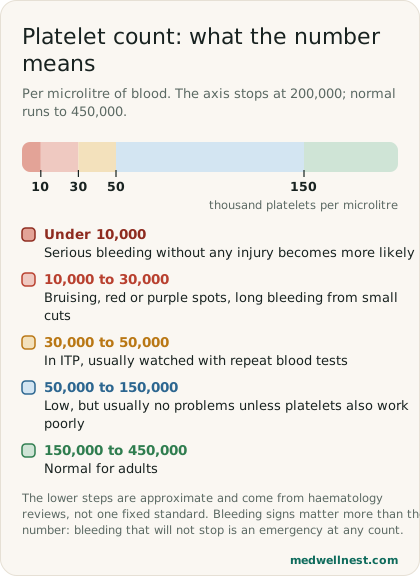
There is no single fixed line, but haematology reviews give a rough ladder. A 2014 review by Izak and Bussel says counts above 50,000 usually do not cause clinical problems unless the platelets also work poorly. People usually seek medical help below 30,000, because of spontaneous bruising and purple spots or bleeding that lasts a long time after small injuries. Clinically significant spontaneous bleeding does not usually occur until the count is below 10,000.
The same review notes that counts under 50,000 in immune thrombocytopenia (ITP) are usually watched with regular blood tests, and that the American Society of Hematology 2011 guideline suggested starting treatment for a newly diagnosed adult with a count below 30,000. Whether treatment is needed also depends on bleeding, not on the number alone.
The signs matter more than the number. The NHLBI lists bleeding that lasts a long time even from small injuries, petechiae (small flat red spots under the skin), purpura (red, purple or brownish-yellow patches), nosebleeds or bleeding gums, blood in the urine or stool, and heavy periods.
03
What causes low platelets other than dengue?
The NHLBI groups the causes into three: the bone marrow does not make enough platelets, the body destroys or uses up platelets, or the spleen holds too many. A healthy spleen normally stores about one-third of the body's platelets, so an enlarged one can remove or store too many and leave too few in the blood.
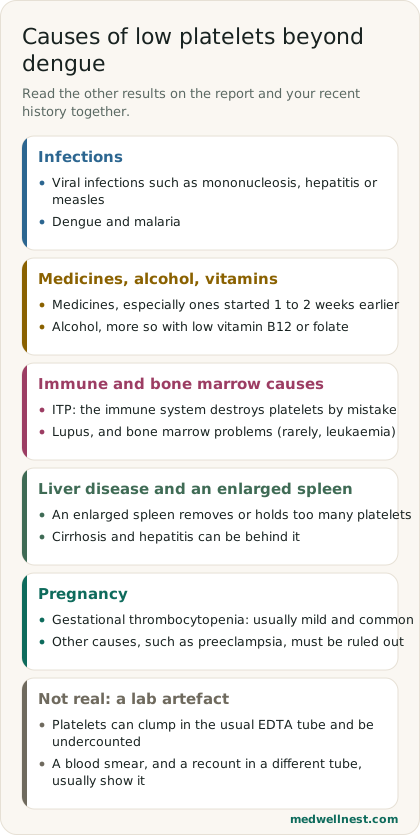
Infections are a common cause. MedlinePlus lists viral infections such as mononucleosis, hepatitis and measles, and the NHLBI says bacterial and viral infections can lower the count for a period. A 2014 haematology review adds recent travel with exposure to malaria or dengue to the history doctors take, which is why they ask about recent fevers and travel. Our dengue report guide covers the dengue pattern, so this page does not repeat it.
Medicines can lower platelets, either by slowing production or through an immune reaction, and doctors pay particular attention to medicines started 1 to 2 weeks before the count fell. Alcohol can damage the bone marrow so it makes fewer platelets, more so in people with low vitamin B12 or folate. Severe B12 or folate deficiency can also lower the red and white cells together with the platelets.
In ITP the immune system attacks and destroys platelets by mistake, and lupus can do the same. Liver disease, especially cirrhosis, and an enlarged spleen are other causes, and pregnancy can cause a mild fall, covered below. Rarely, a bone marrow disease such as leukaemia is the cause, usually with other cell counts also abnormal.
04
Can a low platelet count on a report be a false alarm?
Yes. For a CBC the blood is collected in a tube containing the anticoagulant EDTA. In a small number of people EDTA makes platelets clump together in the tube, so the machine undercounts them and the printed count is falsely low. This is called EDTA-dependent pseudothrombocytopenia. A 2021 review estimates it at 0.03% to 0.27% of the general population.
It is usually spotted by looking at the blood smear under a microscope, or by counting the platelets again in a different anticoagulant, for example a tube containing citrate, or in a sample kept near body temperature. Clumping can rarely happen with citrate too, so the smear is the key check.
It is worth asking about when a low count turns up with no bleeding and no obvious cause. The review warns that missing it can lead to a wrong diagnosis, overtreatment and unnecessary invasive tests.
05
Low platelets in pregnancy: gestational thrombocytopenia
Pregnancy can make the platelet count slightly lower than normal. MedlinePlus describes a common but mild low-platelet condition in pregnancy, called gestational thrombocytopenia, that is not known to cause harm to the mother or the baby and usually gets better on its own during pregnancy or after birth. The NHLBI says some pregnant women develop mild thrombocytopenia close to delivery and that it usually does not need treatment.
A low count in pregnancy is still checked, because other causes, such as preeclampsia, need to be told apart from the harmless kind. That is why your doctor reads the count together with your blood pressure and other tests. Our preeclampsia guide explains the blood pressure side.
06
What tests come next after a low platelet count?
The usual first steps are to repeat the CBC and look at a blood smear. The doctor will ask about recent infections, travel, vaccinations, medicines (especially ones started in the last 1 to 2 weeks), alcohol, diet, pregnancy and family history, and will examine you for bruising, petechiae and an enlarged spleen.
The other cells on the same report help. A low platelet count on its own, with normal red and white cells, is typically linked to immune causes such as ITP or a medicine, or to inherited conditions, and is uncommon with bone marrow cancers. Low platelets together with anaemia and low white cells point towards the bone marrow, for example severe B12 or folate deficiency, some medicines or a marrow disease. Our guide to the differential count shows how to read the white cells, and MPV on the report is the size of the platelets.
Further tests depend on the picture: liver tests, with a search for liver disease if the enzymes are raised, B12 and folate levels, tests for hepatitis and HIV if you are at risk, and, only when needed, bone marrow tests to check that the marrow is healthy. Treatment depends on the cause, and mild thrombocytopenia may need none.
When to act
Emergency — act now
Go to an emergency department now if bleeding does not stop after firm pressure, you vomit blood or pass black, tarry or red stool, you have a sudden, severe headache (bleeding in the brain is a known danger of a very low count), or you have a fever with a widespread rash of tiny red or purple spots that does not fade when you press it. With a low platelet count, serious bleeding or bleeding in the brain can be life-threatening. If you have a fever now or had one in the past week, bleeding gums or nose, very heavy periods, repeated vomiting or belly pain can be dengue warning signs: go to an emergency department now (see our dengue report guide).
Same-day — call promptly
With no fever, see a doctor today if you have a low count together with new bruises, tiny red spots on the skin, bleeding gums, frequent nosebleeds, blood in your urine or periods much heavier than usual, or if your report shows a very low count, for example under 30,000.
Routine — see a doctor
Your count is only mildly below 150,000 and you have no bleeding: repeat the CBC, tell your doctor about recent illnesses, medicines and alcohol, and ask whether a blood smear is needed to rule out a lab artefact.
Values mentioned in this story
Each one opens a visual guide with its normal range and what moves it — upload a report and we place your own numbers on the same scale.
Sources
- Thrombocytopenia — NHLBInhlbi.nih.gov
- Platelet Tests — MedlinePlus Lab Testsmedlineplus.gov
- Management of thrombocytopenia — Izak and Bussel, F1000Prime Reports, 2014pmc.ncbi.nlm.nih.gov
- Pseudothrombocytopenia: a review on causes, occurrence and clinical implications — Journal of Clinical Medicine, 2021pmc.ncbi.nlm.nih.gov
- Vomiting blood — NHSnhs.uk
- Meningitis symptoms — NHSnhs.uk
Share this story
Curious where your own values stand?
Two minutes from upload to a full visual picture. Free to analyze.