In short
Low testosterone is diagnosed only when symptoms fit and repeat morning, fasting blood tests are low. The lab's own range matters more than one cut-off, obesity, type 2 diabetes and opioids can lower it, and treatment cuts sperm production. Do not buy testosterone or boosters online.
Emergency if: You have sudden difficulty breathing, pain in your chest or upper back, a very fast heartbeat, or you have passed out, or you have pain and swelling in one leg together with shortness of breath or chest pain: call emergency services now or go to an emergency department now. These can be signs of a blood clot in the lung, and the TRAVERSE trial saw more pulmonary embolism with testosterone. If you feel you may be about to harm yourself, call emergency services now or go straight to an emergency department. The NHS gives this advice for suspected pulmonary embolism, deep vein thrombosis and suicidal thoughts.
On your report
Testosterone, Total, Free Testosterone, SHBG (Sex Hormone-Binding Globulin), Hematocrit / PCV
On this page
01
What are the symptoms of low testosterone in men?
The NHS lists the symptoms that men in their late 40s to early 50s can have and that are sometimes put down to low testosterone: loss of sex drive, erectile dysfunction, depression, mood swings and irritability, loss of muscle mass and reduced ability to exercise, a larger belly or enlarged breasts, a general lack of energy, difficulty sleeping or tiredness, and poor concentration and memory. It also says that in many cases these symptoms have nothing to do with hormones.
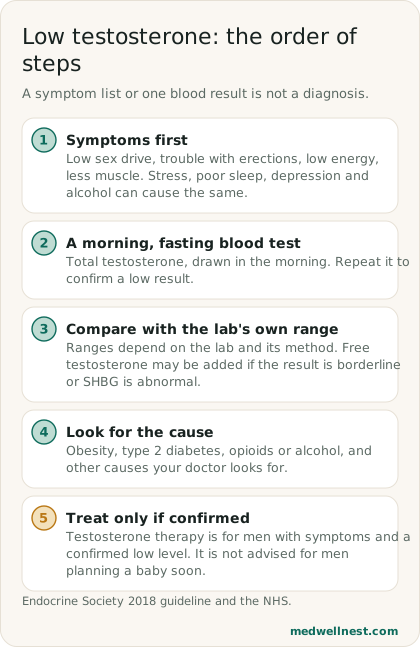
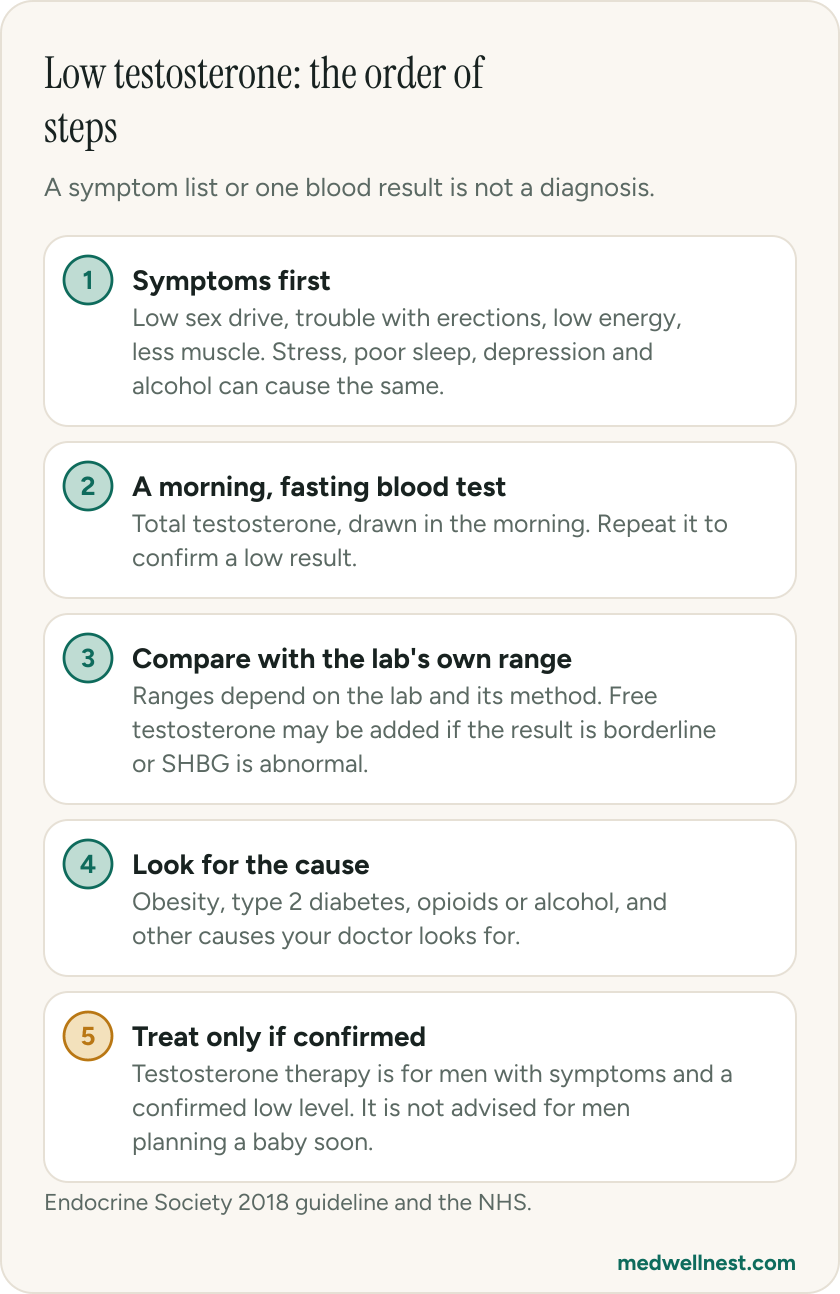
The NHS says stress, depression, anxiety, lack of sleep, a poor diet, lack of exercise, drinking too much alcohol and smoking can all cause the same symptoms, and that smoking or heart problems can cause erectile dysfunction. It calls the term male menopause misleading, because testosterone falls steadily by about 1% a year from around age 30 to 40, which it says is unlikely to cause problems in itself. The Endocrine Society guideline says to diagnose low testosterone, called hypogonadism, only in men who have symptoms and signs of testosterone deficiency and clearly and consistently low blood levels.
02
How and when should testosterone be tested: why a morning, fasting sample?
The Endocrine Society recommends fasting morning total testosterone, measured with an accurate and reliable assay, as the first test, and repeating the morning fasting measurement to confirm the diagnosis. The morning matters because testosterone follows a daily rhythm: our testosterone biomarker page notes it is typically highest early in the day, so a sample taken later can look falsely low. One low result is therefore not enough; the guideline wants two.
If total testosterone is near the lower limit of normal, or a condition changes the level of sex hormone-binding globulin (SHBG), the guideline recommends a free testosterone measurement, either by equilibrium dialysis or by an accurate formula. Once low testosterone is confirmed, the guideline recommends further tests to find the cause. Because the symptoms overlap with stress, poor sleep and low mood, a blood test alone does not settle the question; the symptoms and the repeat results have to fit together.
03
What is a normal testosterone level, and is 300 ng/dL the cut-off?
There is no single line that applies to every man and every lab. A study that harmonised results from four large groups of 9,054 men found that in healthy men aged 19 to 39 who were not obese, the 2.5th to 97.5th percentile range of total testosterone was 264 to 916 ng/dL, with a median of 531. All four cohorts were from North America and Europe; the paper did not study men from other regions. That range applies to laboratories whose assays are calibrated to a reference method, and the authors note that much of the difference between studies comes from the assay used.
The figure of 300 ng/dL that is often quoted comes from a trial rule: the TRAVERSE trial enrolled men with two fasting levels below 300 ng/dL. It is not a universal diagnostic line. Our testosterone biomarker page shows rounded illustrative bands, and the range printed on your own report is the one to use. The NHS adds that the slow fall with age is not a diagnosis by itself.
04
What causes low testosterone: obesity, diabetes, opioids or age?
The NHS says hypogonadism, where the testicles make little or no hormone, can occasionally develop later in life, particularly in men who are obese or have type 2 diabetes, and calls it an uncommon and specific condition that is not a normal part of ageing.
A 2019 review says alcohol, opioids and anabolic-androgenic steroids can reduce testosterone production, and that this can be a reversible cause once the substance is stopped. This is why the Endocrine Society says to look for the cause once low testosterone is confirmed. Our prolactin story covers another hormone result doctors check, and our sleep apnoea story covers a condition the guideline says should be treated, if severe, before testosterone therapy is started.
05
What does testosterone replacement (TRT) do, and is it safe for the heart?
The Endocrine Society recommends testosterone therapy for men with symptomatic testosterone deficiency, to induce and maintain secondary sex characteristics and correct the symptoms, after discussing benefits, risks and monitoring. It suggests aiming for mid-normal levels using an approved formulation, and monitoring symptoms, side effects, testosterone, haematocrit and prostate cancer risk during the first year. It recommends against starting therapy in men planning fertility soon, or with breast or prostate cancer, a prostate nodule, a PSA above 4 ng/mL (above 3 in men at higher risk without further urological evaluation), raised haematocrit, untreated severe sleep apnoea, severe urinary symptoms, uncontrolled heart failure, a heart attack or stroke in the last 6 months, or a clotting tendency.
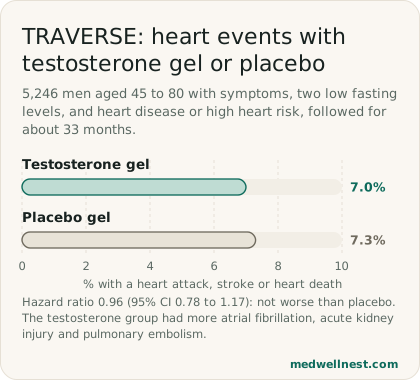
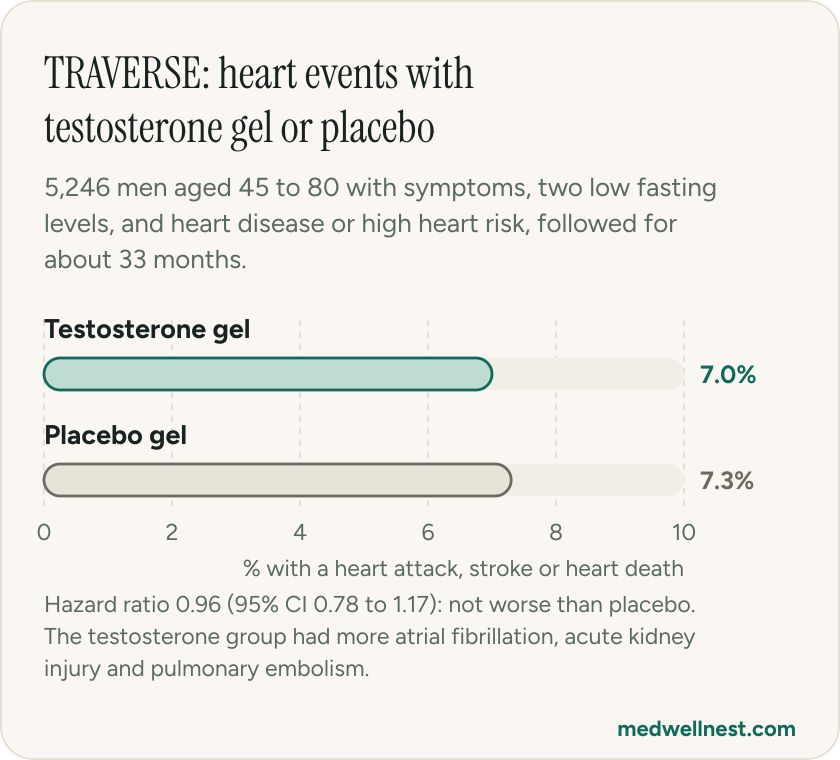
TRAVERSE, in the New England Journal of Medicine in 2023, tested heart safety. It randomly assigned 5,246 men aged 45 to 80 who had symptoms of low testosterone, two fasting levels below 300 ng/dL and existing or high risk of heart disease to testosterone gel or placebo gel. After a mean treatment of 21.7 months and follow-up of 33.0 months, a heart attack, stroke or death from heart causes happened in 182 men (7.0%) on testosterone and 190 (7.3%) on placebo (hazard ratio 0.96, 95% confidence interval 0.78 to 1.17), meeting the test for being no worse than placebo. The testosterone group had more atrial fibrillation, acute kidney injury and pulmonary embolism. The trial was funded by the drug maker AbbVie and others.
That result is reassuring about heart attacks and strokes over about three years in these men, but it was a safety trial, so it does not show that testosterone protects the heart, and it does not cover men outside that group. Our erectile dysfunction story notes that giving testosterone to a man whose level is normal does not reliably improve erections and carries risks of its own.
06
Does testosterone treatment affect fertility, and do testosterone boosters work?
A 2025 review says conventional testosterone replacement restores blood testosterone but suppresses the pituitary hormones that drive the testicles, which impairs sperm production. That is why the Endocrine Society recommends against starting therapy in men planning fertility in the near term, and why a man who is taking testosterone and wants a baby should talk to the prescriber rather than stop on his own. Our semen analysis story explains how testosterone can push sperm counts down.
We did not find a guideline or trial in the sources we used that describes a supplement that treats low testosterone, so we cannot recommend any testosterone booster. Do not buy testosterone or booster products online: the guideline's route is a confirmed diagnosis, a search for the cause, an approved formulation and blood tests and prostate checks during the first year, none of which an online purchase includes. What the NHS does suggest for the symptoms is to look at sleep, diet, exercise, alcohol and smoking, and to get help for stress, anxiety or low mood.
Low testosterone and treatment: how fast to act
Emergency — act now
You have sudden difficulty breathing, pain in your chest or upper back, a very fast heartbeat, or you have passed out, or you have pain and swelling in one leg together with shortness of breath or chest pain: call emergency services now or go to an emergency department now. These can be signs of a blood clot in the lung, and the TRAVERSE trial saw more pulmonary embolism with testosterone. If you feel you may be about to harm yourself, call emergency services now or go straight to an emergency department. The NHS gives this advice for suspected pulmonary embolism, deep vein thrombosis and suicidal thoughts.
Same-day — call promptly
You have throbbing pain and swelling in one leg, usually the calf, or you are coughing up blood: see a doctor the same day. The NHS puts a suspected deep vein thrombosis and coughing up blood in its urgent tier.
Routine — see a doctor
You have low sex drive, erection trouble, low energy or low mood and want to know if testosterone is the cause: see a doctor for a morning, fasting blood test and a check for other causes. If you take testosterone and want a baby, talk to the prescriber.
Values mentioned in this story
Each one opens a visual guide with its normal range and what moves it — upload a report and we place your own numbers on the same scale.
Sources
- Testosterone Therapy in Men With Hypogonadism: An Endocrine Society Clinical Practice Guideline (2018)pubmed.ncbi.nlm.nih.gov
- Cardiovascular Safety of Testosterone-Replacement Therapy (TRAVERSE) — New England Journal of Medicine, 2023pubmed.ncbi.nlm.nih.gov
- Harmonized Reference Ranges for Circulating Testosterone Levels in Men of Four Cohort Studies — Journal of Clinical Endocrinology and Metabolism, 2017pubmed.ncbi.nlm.nih.gov
- The 'male menopause' — NHSnhs.uk
- Preserving spermatogenesis in testosterone deficiency — review, 2025pubmed.ncbi.nlm.nih.gov
- Substance Abuse and Male Hypogonadism — review, 2019pubmed.ncbi.nlm.nih.gov
Share this story
Curious where your own values stand?
Two minutes from upload to a full visual picture. Free to analyze.