In short
Metabolic syndrome means 3 or more of 5 findings: a large waist, raised blood pressure, raised fasting sugar, raised triglycerides and low HDL. The waist cut-off depends on ethnic group, for example 90 cm or more in South Asian men and 80 cm or more in South Asian women. Lifestyle change is the first line of treatment.
Emergency if: You have chest pain that feels tight or squeezing, or chest pain spreading to the arms, neck or jaw; chest pain with feeling sick or being sick; chest pain with a heart that feels like it is racing, going too slowly, skipping a beat or fluttering; severe difficulty breathing; pale, blue or grey lips or skin; or someone has passed out and is not responding normally; or there are signs of a stroke such as a drooping face, weakness in one arm, or slurred speech, even if they have stopped: call emergency services now and do not drive yourself to hospital. Chest pain can be a sign of a heart attack, so do not wait for an appointment. The NHS says to treat signs of a stroke in the last 24 hours as an emergency even if they have gone.
On your report
Triglycerides, HDL Cholesterol, Fasting Glucose
On this page
01
What is metabolic syndrome?
Metabolic syndrome is a group of conditions that together raise your risk of coronary heart disease, diabetes, stroke and other serious health problems, according to the National Heart, Lung, and Blood Institute (NHLBI). It is also called insulin resistance syndrome. The 2009 joint statement from the International Diabetes Federation (IDF), the American Heart Association, the NHLBI and other bodies describes it as a cluster of risk factors for cardiovascular disease and type 2 diabetes that occur together more often than by chance.
The NHLBI says you may have it if you have three or more of the five conditions: a large waistline, high blood pressure, high blood sugar, high triglycerides, and low HDL cholesterol. It also says the good news is that metabolic syndrome is largely preventable.
02
What are the 5 criteria for metabolic syndrome, with exact numbers?
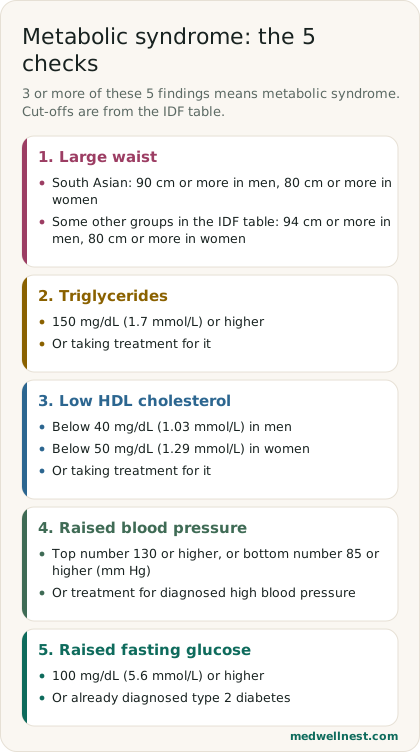
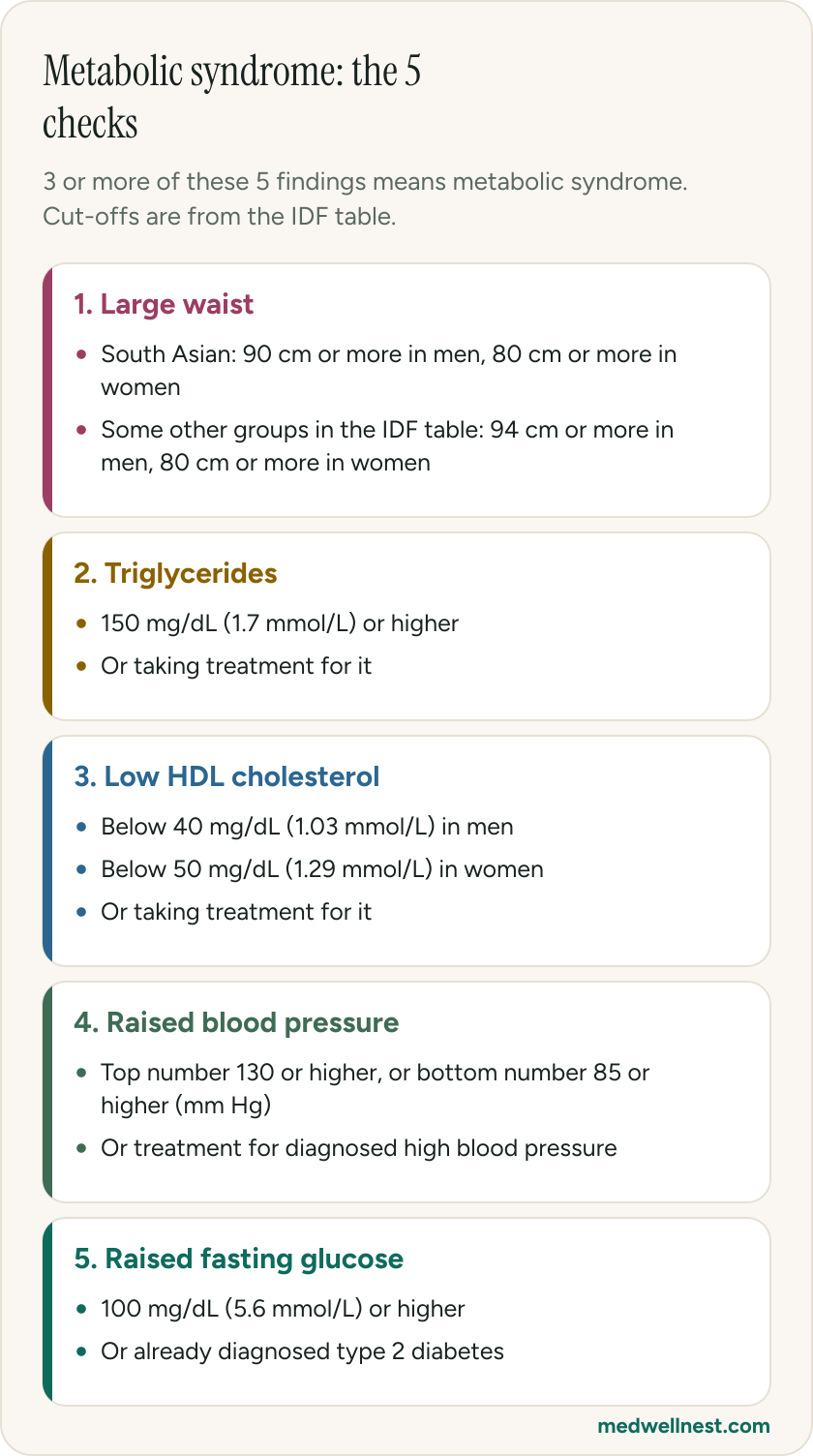
The 2009 joint statement agreed that three abnormal findings out of 5 qualify a person for metabolic syndrome, that no single component is obligatory, and that a single set of cut points would be used for every component except waist circumference. The numbers below are from the IDF consensus table. For triglycerides the line is 150 mg/dL (1.7 mmol/L) or higher, or treatment for it. For HDL cholesterol it is below 40 mg/dL (1.03 mmol/L) in men or below 50 mg/dL (1.29 mmol/L) in women, or treatment for it.
For blood pressure the line is a top number of 130 or higher or a bottom number of 85 or higher (mm Hg), or treatment for diagnosed high blood pressure. For fasting glucose it is 100 mg/dL (5.6 mmol/L) or higher, or previously diagnosed type 2 diabetes. The fifth criterion, waist size, depends on ethnic group and is covered next. The IDF table is from 2006 and the 2009 statement left waist cut-offs to national or regional values, so a doctor may use a slightly different waist line; the other four numbers are the ones to check on your own report.
03
What waist size counts for South Asians and other groups?
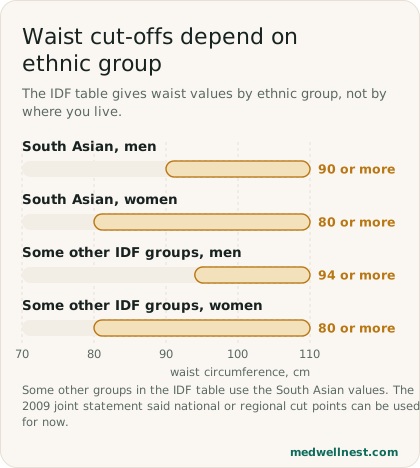
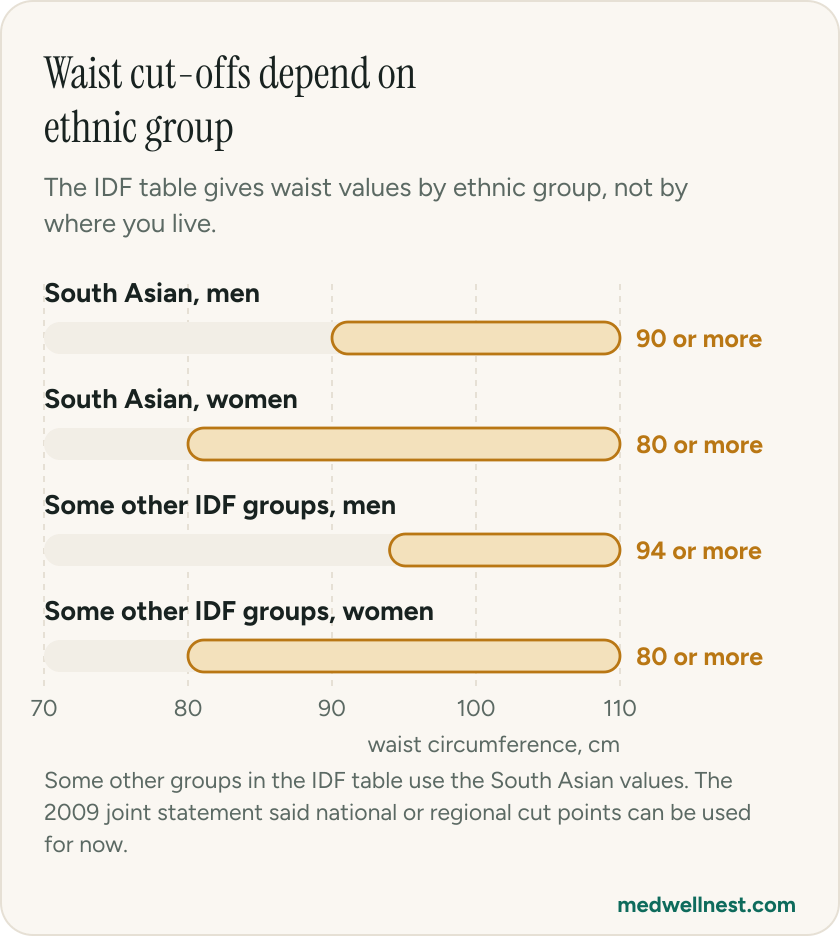
The IDF table gives waist cut-offs by ethnic group, not by where you live. For South Asians it lists 90 cm or more in men and 80 cm or more in women. Several other groups in the IDF table use a higher line for men, 94 cm or more, with 80 cm or more for women, and some groups are told to use the South Asian values.
The IDF adds that if body mass index (BMI) is above 30, central obesity can be assumed and waist does not need to be measured. It also says the initial step in diagnosis is to measure the waist, which people can do themselves, and that if it is raised, blood pressure and a fasting blood sample for glucose, triglycerides and HDL cholesterol should be checked. Our BMI and waist story shows how to measure a waist and explains the waist-to-height check.
04
Does metabolic syndrome cause symptoms?
Usually not. The NHLBI says that high blood pressure, high triglycerides and low HDL cholesterol usually do not cause any symptoms, and that a large waistline is something you or your provider may notice. High blood sugar may cause blurred vision, increased thirst, increased urination (especially at night) and tiredness and weakness.
That is why it is often found through routine tests rather than symptoms. The NHLBI says your provider may tell you that you have metabolic syndrome based on blood pressure readings and blood tests from a routine visit. Our guides to blood pressure basics, triglycerides and blood sugar levels explain each result.
05
Why does metabolic syndrome matter?
Each of the five findings is a risk factor on its own, and together they raise the risk of heart disease, diabetes and stroke. The NHLBI says that extra fat in the stomach area is a bigger risk factor for heart disease than extra fat in other parts of the body. The IDF says central obesity and insulin resistance are acknowledged as important causative factors.
The IDF says a diagnosis of metabolic syndrome is a useful tool to identify high-risk people so treatment can start. The goals of treatment, according to the NHLBI, are to lower your risk of heart disease and to prevent type 2 diabetes if it has not developed. Our heart disease prevention story covers the wider picture.
06
Can metabolic syndrome be reversed? What helps?
Lifestyle change is the first step. The NHLBI says heart-healthy lifestyle changes are the first line of treatment: a heart-healthy eating plan that limits saturated fat, salt, added sugars and alcohol; aiming for a healthy weight; regular physical activity; managing stress; quitting smoking; and getting 7 to 9 hours of good sleep a day for adults. It says that if you are overweight, losing just 3% to 5% of your current weight can help manage some risk factors, such as high blood cholesterol and diabetes.
The IDF recommends moderate calorie restriction to achieve a 5 to 10 per cent loss of body weight in the first year, and a moderate increase in physical activity, and calls lifestyle change by far the best way to prevent increased risk of cardiovascular disease and diabetes. The NHLBI says that if healthy lifestyle changes do not work you may need medicines or weight-loss surgery. None of the sources promises that the syndrome disappears, so recheck your five numbers over time. Ask your doctor before starting any exercise programme.
Metabolic syndrome: how fast to act
Routine — see a doctor
You have a large waist or any of the five findings, or a report that shows them: see a doctor to check blood pressure and fasting sugar, triglycerides and HDL cholesterol, and to plan lifestyle changes. Metabolic syndrome usually has no symptoms, so a normal feeling does not rule it out.
Same-day — call promptly
You are suddenly more short of breath than usual, without chest pain: get urgent medical help the same day. The NHS lists this as an urgent sign when a heart attack is possible. If breathing becomes severely difficult or chest pain starts, follow the emergency step below.
Emergency — act now
You have chest pain that feels tight or squeezing, or chest pain spreading to the arms, neck or jaw; chest pain with feeling sick or being sick; chest pain with a heart that feels like it is racing, going too slowly, skipping a beat or fluttering; severe difficulty breathing; pale, blue or grey lips or skin; or someone has passed out and is not responding normally; or there are signs of a stroke such as a drooping face, weakness in one arm, or slurred speech, even if they have stopped: call emergency services now and do not drive yourself to hospital. Chest pain can be a sign of a heart attack, so do not wait for an appointment. The NHS says to treat signs of a stroke in the last 24 hours as an emergency even if they have gone.
Values mentioned in this story
Each one opens a visual guide with its normal range and what moves it — upload a report and we place your own numbers on the same scale.
Sources
- Harmonizing the metabolic syndrome: a joint interim statement of the IDF, NHLBI, AHA, WHF, IAS and IASO (2009) — Circulationpubmed.ncbi.nlm.nih.gov
- The IDF consensus worldwide definition of the metabolic syndrome (2006) — International Diabetes Federationidf.org
- Metabolic syndrome: what is it? — NHLBInhlbi.nih.gov
- Metabolic syndrome: treatment — NHLBInhlbi.nih.gov
- Heart attack — NHSnhs.uk
- Symptoms of a stroke — NHSnhs.uk
Share this story
Curious where your own values stand?
Two minutes from upload to a full visual picture. Free to analyze.