In short
Hiccups, sneezing, milia, baby acne, erythema toxicum, blue-grey birthmarks, startles and short breathing pauses are common and fade by themselves in weeks to months. Blue lips, trouble breathing, a baby who is hard to wake, or a temperature of 38 °C or higher in a baby under 3 months needs emergency care now.
Emergency if: Your baby has blue or grey lips, tongue or face, has any difficulty breathing, or is grunting or moaning with each breath, is breathing very fast (more than 60 breaths a minute while calm and not crying) or sucking in the tummy or chest with each breath, stops breathing for more than 10 seconds, is very weak or not moving, is hard to wake or cannot be woken, has a weak or absent cry, is floppy or not feeding, has pale or blotchy skin, feels cold or has a temperature below 36 °C, has had no wet nappy for 12 hours, has jerking that could be a seizure (jerking while awake, or lasting more than 10 seconds), has a rash that does not fade when pressed, has purple or blood-coloured spots that were not there at birth, has yellow skin or eyes at under 24 hours old, or has yellow skin and is very sleepy or not feeding: call emergency services now or go to an emergency department now. The AAP, KidsHealth, the NHS and NICE list these as signs that need emergency or urgent care now. Get your baby seen now, and go to an emergency department if your baby's doctor cannot see your baby straight away, if your baby is under 1 month old and looks or acts abnormal in any way (for example a poor suck or poor colour), or has tiny blisters, pus-filled pimples that do not look like erythema toxicum, skin that looks infected (spreading redness, sores or pus) or a rash that is painful to touch; the AAP says to seek care now for these. Also go to an emergency department now if a baby under 3 months has a temperature of 38 °C or higher, unless a doctor can see your baby within 2 hours (NICE NG143).
On this page
01
Is it normal for my newborn to have hiccups and to sneeze a lot?
Yes. KidsHealth says sneezing and hiccups are common in newborns and are not signs of problems, and that sneezing is a normal reflex, not a sign of infection or allergy. It adds that newborns breathe through narrow nasal passages, so a little mucus can make them sound congested even without a cold. The AAP says hiccups are often caused by overeating and can also come from a little acid irritating the lower food pipe.
The sources do not give a time limit for newborn hiccups. Our hiccups symptom page says hiccups lasting longer than 48 hours need medical evaluation, and that applies to hiccups in general; the sources for newborns simply call occasional hiccups normal. What does matter is what comes with them. The AAP says to call your doctor if nasal washes with saline do not clear a blocked nose or if breathing becomes hard, and the last section lists the breathing and feeding signs that are not normal.
02
What are the white bumps (milia), baby acne and the red blotchy rash on my newborn?
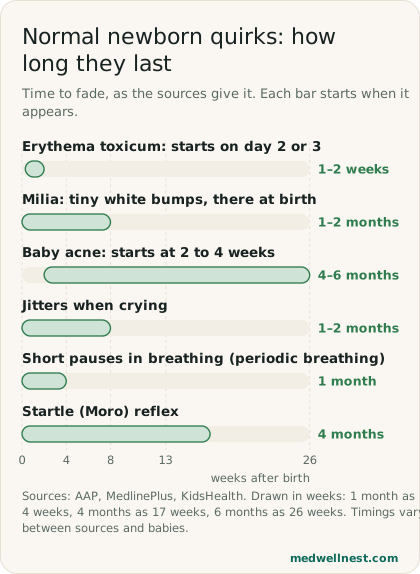
Milia are tiny white bumps, pinhead-sized, mostly on the nose and cheeks. The AAP says about 40% of newborns have them at birth, that they are blocked skin pores that will open up, and that they go away by 1 to 2 months of age. KidsHealth says they disappear within the first few weeks, and MedlinePlus says they go on their own. The AAP says ointments or creams can make them worse.
Baby acne is small red bumps on the face. The AAP says more than 30% of newborns get it, that it begins at 2 to 4 weeks and lasts until 4 to 6 months, and that it seems to be caused by maternal hormones passed on just before birth. MedlinePlus says mild acne most often clears in a few weeks, so the two sources differ on how long it lasts. The AAP says no treatment is needed and that baby oil or ointments make it worse.
Erythema toxicum is a harmless rash of red blotches, about 1 to 2.5 cm across, each with a small white or yellow bump in the centre. The AAP says more than 50% of babies get it, that it starts on day 2 or 3 and can appear anywhere except the palms and soles, that its cause is unknown, that it is not an infection and that it goes away by 1 to 2 weeks. MedlinePlus and KidsHealth say it clears within about a week. The AAP says many other unexplained newborn rashes are heat rashes: a pink, blotchy area with tiny bumps on the face, neck and chest.
03
What is the blue-grey patch on my baby's back (dermal melanocytosis), and what are stork marks?
KidsHealth uses the medical term dermal melanocytosis (blue-grey birthmarks). They are flat patches of slate-blue or blue-green colour that look like ink stains, usually on the back and buttocks. MedlinePlus says they mainly appear in dark-skinned babies, and the AAP says they are present at birth and do not indicate illness or any disease. The sources differ on how long they last: MedlinePlus says they should fade within a year, KidsHealth within a few years, and the AAP says most fade by 2 or 3 years and a trace may last into adult life.
Stork marks, also called stork bites or salmon patches, are flat pink patches on the bridge of the nose, eyelids or back of the neck. The AAP says more than 50% of newborns have them. Those on the eyelids clear by 1 year, those on the bridge of the nose may last a few more years, and about 25% of those on the back of the neck last into adult life. MedlinePlus says they often go away within 18 months.
Some marks are worth showing your baby's doctor at a routine check. MedlinePlus says congenital moles should be checked and followed up, and that children with many or large café-au-lait spots (light tan patches) may be more likely to have a condition called neurofibromatosis. The AAP says port-wine stains (deep red or purple, flat) do not fade like stork marks, and that raised red strawberry hemangiomas usually start at 2 to 4 weeks, grow for about a year, then fade, and should be discussed at the next regular visit.
04
Is it normal for a newborn's skin to peel, breasts to swell or girls to have vaginal discharge?
Yes, all three are described as normal. MedlinePlus says that by the second or third day the skin lightens and may become dry and flaky, and KidsHealth says the top layer flakes off during the first week or two without special skin care. MedlinePlus says the lips, hands and feet may turn bluish or spotted when the baby is cold. Blue colour that stays when the baby is warm is different and is covered in the last section.
KidsHealth says both boys and girls can have swollen breasts because of the mother's oestrogen passed on during pregnancy. There may be firm, disc-shaped lumps under the nipples that occasionally release a little milky fluid, and the swelling almost always disappears in the first few weeks. Do not squeeze the breast tissue, as it will not shrink faster. Most newborn girls have a vaginal discharge of mucus, perhaps with some blood, for a few days, which KidsHealth describes as normal bleeding from the baby's womb as the mother's oestrogen wears off.
05
Are startles, jitters and irregular breathing normal in a newborn?
The AAP says the startle (Moro) reflex, where the arms fling out after a noise or sudden movement, is frequent at birth and slowly resolves by 4 months. Trembling of the arms and legs during crying is normal and should stop by 1 to 2 months; the AAP says normal trembling stops with sucking, and that jitters when the baby is calm or jitters that get worse should be checked. Sleep twitches that last a few seconds soon after falling asleep are normal, but the AAP says to suspect a seizure if jerking happens when the baby is awake or lasts more than 10 seconds.
KidsHealth says newborn breathing is somewhat irregular, sometimes as fast as 60 breaths a minute (this happens when babies are excited or after crying, according to KidsHealth; the AAP says a normal rate should be under 60, and NICE treats a rate over 60 as a high-risk sign), with periods when the baby holds the breath for about 5 to 10 seconds and then restarts alone, called periodic breathing. The AAP says pauses of under 10 seconds are normal if the baby is comfortable, and usually stop by 1 month. Gurgling, whimpering and grunting with a stool are also normal, but new grunting or moaning with each breath is not. The NHS jaundice page lists difficulty breathing among its emergency signs for a jaundiced baby, and NICE lists pale, mottled or blue skin as a high-risk sign, so if pauses come with colour change, floppiness, poor feeding or fever, or if you are not sure, get help now. Our safe sleep guide covers how babies should sleep.
06
Which newborn signs are not normal, and when is it an emergency?
The AAP says to call emergency services now if a newborn cannot be woken, is not moving or is very weak, has a new weak or absent cry, has severe trouble breathing, has new moaning or grunting with each breath, or has bluish or grey lips, tongue or face, and to go to an emergency department now if a newborn is hard to wake. It says to seek care now if breathing stopped for more than 10 seconds, and KidsHealth says to go to the emergency room right away if a baby turns blue or stops breathing for longer stretches. The AAP also says to seek care now for purple or blood-coloured spots that were not there at birth, and the NHS says yellow skin or eyes in a baby under 24 hours old is an emergency. NICE puts a breathing rate over 60 breaths a minute in its high-risk group, and the NHS jaundice page lists very fast breathing among its emergency signs for a jaundiced baby. For a baby with jaundice, the NHS says to call emergency services or go to an emergency department if the baby is difficult to wake, not feeding, floppy or stiff, jerking or twitching, very cold (36 °C or less), without wet nappies, or having difficulty breathing. NICE lists pale, mottled, ashen or blue skin, a weak, high-pitched or continuous cry, and grunting among its high-risk signs. We apply these emergency signs to any newborn, because a baby with a serious illness may show them without jaundice.
For fever, NICE says a baby under 3 months with a temperature of 38 °C or higher is at high risk, and that a baby with high-risk features should be seen face to face within 2 hours. So a baby this young with a temperature of 38 °C or higher should go to an emergency department now, unless a doctor can see your baby within 2 hours. The AAP says not to give fever medicine before the baby is seen. NICE notes that some vaccines cause a fever in babies under 3 months, which a doctor will weigh.
Some signs look like the harmless rashes but are not, and in a newborn they need care now, not later in the day. The AAP says to get care now for tiny blisters, pimples that contain pus (unless they look like erythema toxicum), skin that looks infected with spreading redness, sores or pus, a rash that is painful to touch, and a cluster of blisters like a cold sore that appears in the first 2 weeks, which could be herpes where early treatment prevents serious problems. The AAP also says a baby under 1 month who looks or acts abnormal in any way should be seen now. We put these in the emergency tier: get your baby seen now, at an emergency department if your doctor cannot see your baby straight away. The NHS says a baby over 24 hours old who looks yellow, whose jaundice is not getting better, or who has dark yellow pee or pale poo needs an urgent appointment; we put that in the same-day tier. Jaundice with sleepiness, poor feeding or floppiness is an emergency. Do not use oils or ointments on newborn rashes; the AAP says they make several of them worse.
Newborn signs: how fast to act
Emergency — act now
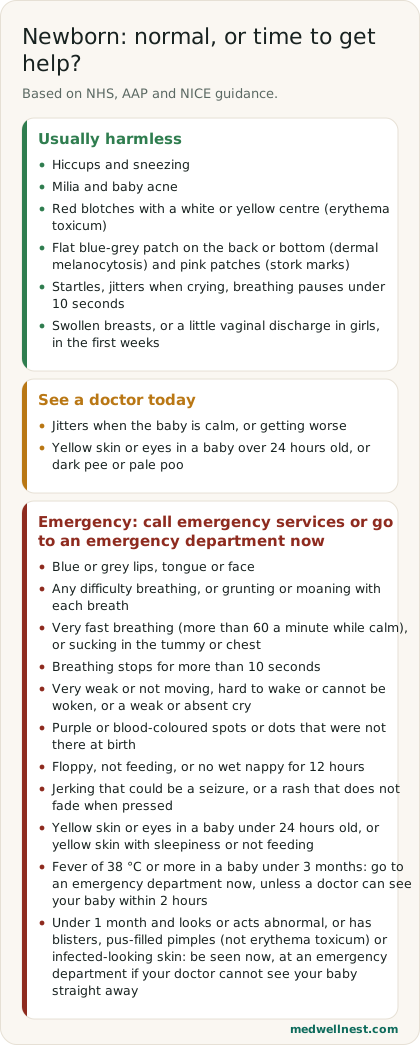
Your baby has blue or grey lips, tongue or face, has any difficulty breathing, or is grunting or moaning with each breath, is breathing very fast (more than 60 breaths a minute while calm and not crying) or sucking in the tummy or chest with each breath, stops breathing for more than 10 seconds, is very weak or not moving, is hard to wake or cannot be woken, has a weak or absent cry, is floppy or not feeding, has pale or blotchy skin, feels cold or has a temperature below 36 °C, has had no wet nappy for 12 hours, has jerking that could be a seizure (jerking while awake, or lasting more than 10 seconds), has a rash that does not fade when pressed, has purple or blood-coloured spots that were not there at birth, has yellow skin or eyes at under 24 hours old, or has yellow skin and is very sleepy or not feeding: call emergency services now or go to an emergency department now. The AAP, KidsHealth, the NHS and NICE list these as signs that need emergency or urgent care now. Get your baby seen now, and go to an emergency department if your baby's doctor cannot see your baby straight away, if your baby is under 1 month old and looks or acts abnormal in any way (for example a poor suck or poor colour), or has tiny blisters, pus-filled pimples that do not look like erythema toxicum, skin that looks infected (spreading redness, sores or pus) or a rash that is painful to touch; the AAP says to seek care now for these. Also go to an emergency department now if a baby under 3 months has a temperature of 38 °C or higher, unless a doctor can see your baby within 2 hours (NICE NG143).
Same-day — call promptly
Your baby has jitters when calm or jitters that are getting worse, yellow skin or eyes after 24 hours of age (new, or not getting better), or dark yellow pee or pale poo: see a doctor today, and do not wait for the next day. The AAP says to call your doctor if jitters happen when the baby is calm or get worse, and the NHS says to ask for an urgent appointment for yellow skin or eyes after 24 hours of age, or for dark yellow pee or pale poo.
Routine — see a doctor
You see milia, baby acne, a blue-grey patch, stork marks, peeling skin, swollen breasts, a little vaginal discharge, or occasional hiccups, sneezing and startles in a baby who is feeding and well: no treatment is needed. Show your baby's doctor any mole, many or large café-au-lait spots, a port-wine stain or a growing red birthmark at the next routine check, and ask if a rash is still there after the usual times in the chart.
Sources
- Newborn Rashes and Birthmarks — AAP KidsDoc symptom checker, HealthyChildren.orghealthychildren.org
- Newborn Reflexes and Behavior — AAP KidsDoc symptom checker, HealthyChildren.orghealthychildren.org
- Skin findings in newborns — MedlinePlusmedlineplus.gov
- Getting to Know Your Newborn — KidsHealth (Nemours)kidshealth.org
- Jaundice in babies — NHSnhs.uk
- Fever in under 5s: assessment and initial management (NG143) — NICE guidelinenice.org.uk
Share this story
Curious where your own values stand?
Two minutes from upload to a full visual picture. Free to analyze.