In short
Green or bloody vomit, or a temperature of 38 °C or higher in a baby under 3 months (unless a doctor can see the baby within 2 hours), needs emergency care now; forceful vomiting needs a doctor today.
Emergency if: Your baby is vomiting green or yellow-green fluid, or vomit with blood or that looks like ground coffee; or is limp, floppy, struggling to breathe, or has lips, tongue, face or skin that turn pale, blue or grey; or has a swollen, tight tummy and keeps vomiting: go to an emergency department now or call emergency services now. Also go to an emergency department now if a baby under 3 months has a temperature of 38 °C or higher, unless a doctor can see your baby within 2 hours. The NHS says yellow-green or green vomit in a child and vomiting blood need emergency care. NICE says bile-stained vomiting in an infant needs an urgent same-day study to rule out an intestinal blockage, lists abdominal distension as a sign that may suggest an intestinal obstruction or another acute surgical condition, and puts a temperature of 38 °C or higher in a baby under 3 months in its high-risk group.
On this page
01
Why does my baby bring up milk after feeds?
The NHS describes reflux as a baby bringing up milk, or being sick, during or shortly after feeding, and says it is very common and usually gets better on its own. The reason is a ring of muscle at the bottom of the baby's food pipe (oesophagus), which can be weak and lets milk come back up easily. The NHS says this muscle gets stronger as the baby gets older and the reflux should stop.
NICE, the guideline body for doctors, calls the regurgitation of feeds a common and normal occurrence in infants. It says this is a normal process in infancy, is managed by advising and reassuring parents, and does not usually need any investigation or treatment. Crying spells with no clear cause are a different question; our colic guide covers those.
02
Is baby spit-up normal, and for how long does it last?
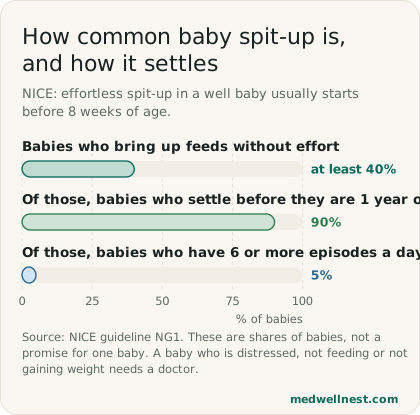
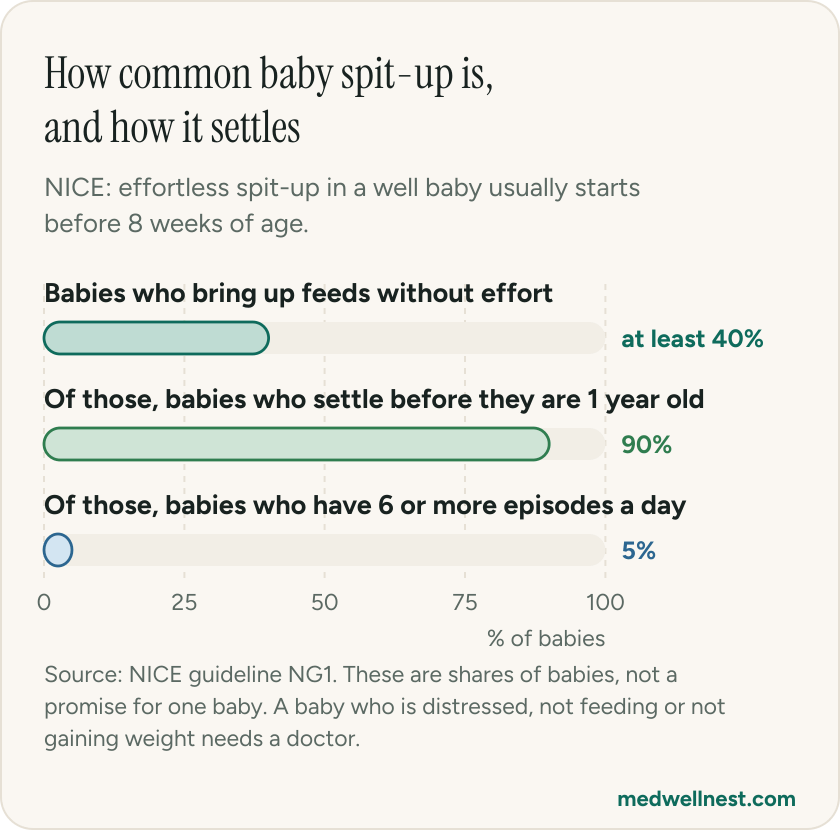
For a well baby, usually yes. NICE says effortless regurgitation of feeds affects at least 40% of infants, usually begins before the baby is 8 weeks old, and usually becomes less frequent with time: it resolves in 90% of affected infants before they are 1 year old. The NHS says the same arc in plain words: reflux usually starts before a baby is 8 weeks old and gets better by the time they are 1.
Some babies bring milk up often. NICE notes that 5% of affected infants have 6 or more episodes each day, and still says that in a well infant this does not usually need further investigation or treatment. The NHS says your baby does not usually need to see a doctor if they are happy, healthy and gaining weight. The numbers describe groups of babies, not a promise for one baby, so keep an eye on weight gain and on the warning signs below.
03
What is the difference between spit-up and vomiting, and what is silent reflux?
The useful difference is effort and the baby's state. NICE describes normal reflux as effortless regurgitation in a well infant. The NHS lists projectile vomiting, meaning being sick with more force than usual, among the signs that need a doctor the same day. A baby who brings up a little milk, feeds well, is settled and is gaining weight fits the usual pattern; one who is forcefully sick, distressed, refusing feeds or not gaining weight does not.
The NHS also describes silent reflux: babies may have signs of reflux but not bring up milk or be sick. NICE advises doctors not to routinely investigate or treat a child without visible regurgitation who has only one of these: unexplained feeding difficulties, distressed behaviour, faltering growth, chronic cough, hoarseness or a single episode of pneumonia. The NHS adds that cow's milk allergy can look very similar to reflux, so a doctor may check for it.
04
What can I do at home to reduce my baby's spit-up?
The NHS lists these steps: hold your baby upright during feeding and for as long as possible after feeding, burp your baby regularly during feeds, and get advice about your baby's breastfeeding position or how to bottle feed. When a baby is being sick, the NHS also suggests carrying on breast or bottle feeding and trying small feeds more often than usual, and it says not to make formula weaker: use it at its usual strength.
For a formula-fed baby with frequent regurgitation and marked distress, NICE sets out steps for a doctor to follow: review the feeding history, reduce the feed volumes only if they are excessive for the baby's weight, offer a trial of smaller, more frequent feeds while keeping the total daily amount of milk, and only then consider thickened formula. For a breastfed baby, NICE asks for an assessment by a person with the right training. Do not start a thickener, formula change or medicine on your own.
05
How should a baby with reflux sleep? Can I raise the head of the cot?
No. The NHS says to make sure your baby sleeps flat on their back, not on the side or front, and not to raise the head of the cot or Moses basket. NICE agrees: it says not to use positional management to treat reflux in sleeping infants, and that infants should be placed on their back when sleeping.
The AAP gives the reason parents worry about most. It says babies will not choke on their backs because their airway anatomy and gag reflex keep that from happening, and that even babies with gastro-oesophageal reflux disease should sleep flat on their backs. Our safe sleep story has the full list of ways to lower the risk of sudden infant death.
06
When is it not simple reflux? Which signs mean see a doctor, or go to an emergency department?
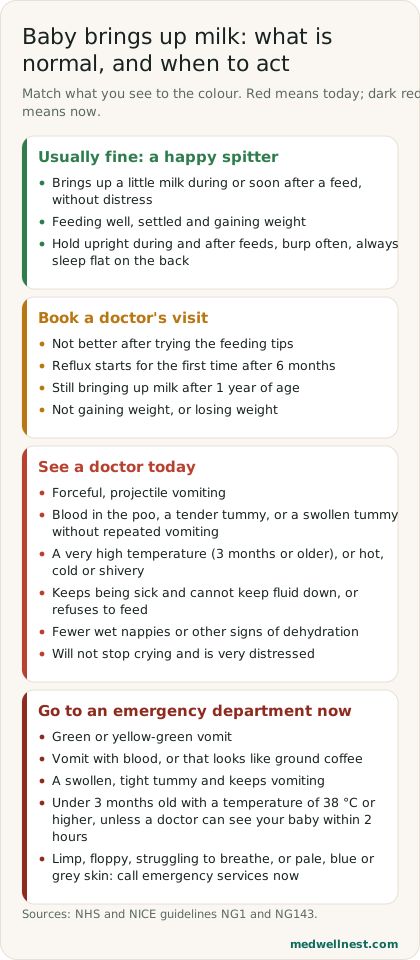
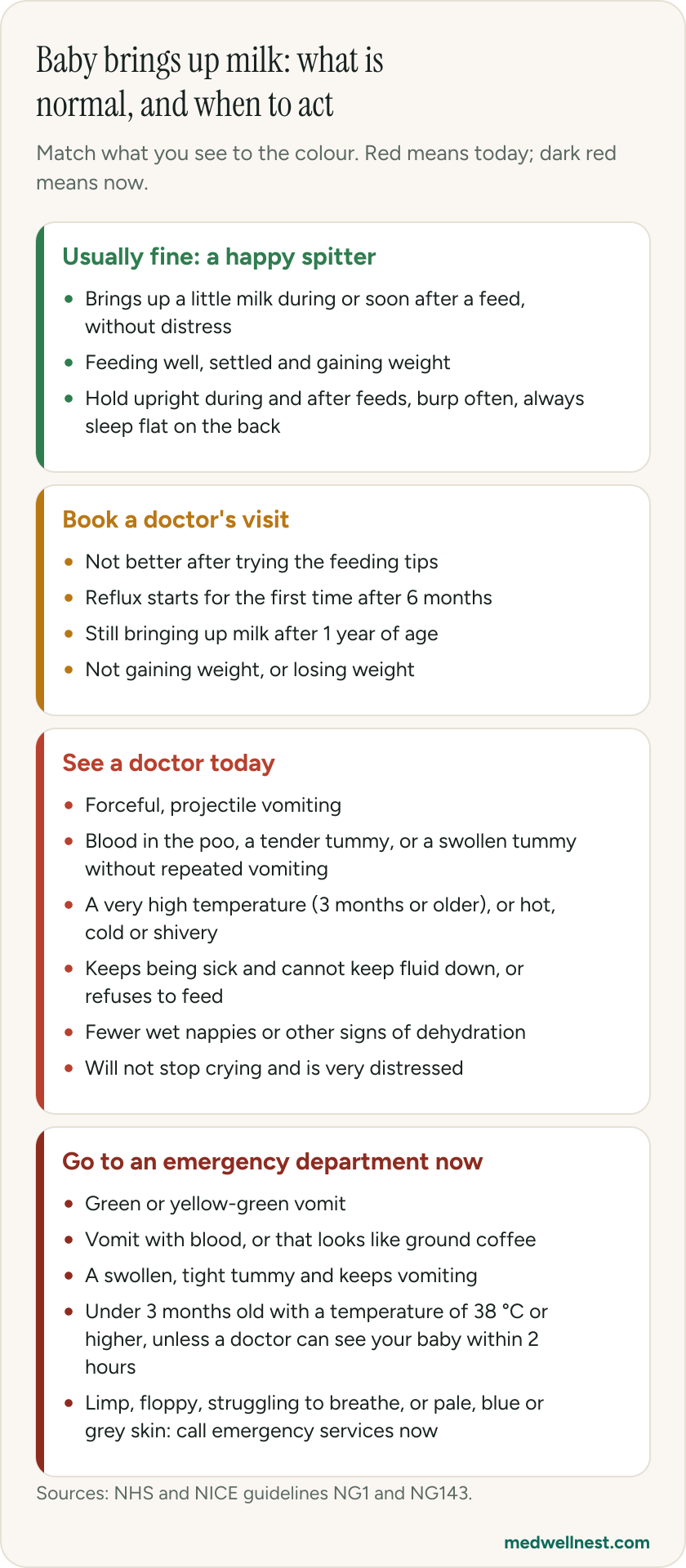
NICE lists red flags that suggest something other than reflux. Bile-stained vomit, which is green or yellow-green, may suggest an intestinal obstruction and needs a paediatric surgery referral; NICE says an infant with unexplained bile-stained vomiting should have an urgent same-day study. The NHS lists yellow-green or green vomit in a child, and vomiting blood or vomit that looks like ground coffee, as emergencies: go to an emergency department now or call emergency services now. NICE also lists abdominal distension among the signs that may suggest an intestinal obstruction or another acute surgical condition, so a baby with a swollen, tight tummy who keeps vomiting should go to an emergency department now. For a baby under 3 months, NICE guideline NG143 puts a temperature of 38 °C or higher in its high-risk group: go to an emergency department now, unless a doctor can see your baby within 2 hours.
Other red flags need a doctor the same day. Frequent forceful vomiting in a baby up to 2 months old may suggest a narrowed stomach outlet (pyloric stenosis), and NICE asks for same-day specialist assessment when vomiting is progressively worsening or forceful in an infant under 2 months. The NHS urgent list adds blood in the poo, a tender tummy or a swollen tummy without repeated vomiting, a very high temperature (in a baby 3 months or older) or feeling hot, cold or shivery, being sick and not keeping fluid down, refusing to feed, diarrhoea for over a week or signs of dehydration, and crying that will not stop with great distress. NICE also lists a bulging soft spot, lethargy or irritability and a baby who appears unwell. The NHS diarrhoea and vomiting page adds that you should get urgent advice if you are worried about a baby under 12 months, so see a doctor today.
Some signs are less urgent but still need a visit. The NHS says to book a doctor if reflux is not improving after trying the steps above, if it starts for the first time after 6 months, if the baby is older than 1 and still has reflux, or if the baby is not gaining weight or is losing weight. NICE notes that vomiting starting after 6 months suggests a cause other than reflux, for example a urinary infection.
07
Does a baby with reflux need medicine?
Usually not. The NHS says that if there is no sign of cow's milk allergy, a doctor may suggest a thickening powder or a pre-thickened formula for a formula-fed baby. Medicines that reduce distress and stomach acid are only an option if thickening does not help or the baby is breastfed, and surgery is very rarely needed, usually only when other things have been tried or the reflux is severe.
NICE says not to offer acid-suppressing drugs such as proton pump inhibitors to treat visible regurgitation in infants when it is the only symptom. It allows a short trial for babies who cannot tell you about symptoms and have regurgitation together with problems such as unexplained feeding difficulties. That decision belongs to a doctor who has examined your baby, so ask before giving any medicine, including anything bought without a prescription.
When to act
Emergency — act now
Your baby is vomiting green or yellow-green fluid, or vomit with blood or that looks like ground coffee; or is limp, floppy, struggling to breathe, or has lips, tongue, face or skin that turn pale, blue or grey; or has a swollen, tight tummy and keeps vomiting: go to an emergency department now or call emergency services now. Also go to an emergency department now if a baby under 3 months has a temperature of 38 °C or higher, unless a doctor can see your baby within 2 hours. The NHS says yellow-green or green vomit in a child and vomiting blood need emergency care. NICE says bile-stained vomiting in an infant needs an urgent same-day study to rule out an intestinal blockage, lists abdominal distension as a sign that may suggest an intestinal obstruction or another acute surgical condition, and puts a temperature of 38 °C or higher in a baby under 3 months in its high-risk group.
Same-day — call promptly
Your baby has forceful (projectile) vomiting, blood in the poo, a tender tummy or a swollen tummy without repeated vomiting, a very high temperature (in a baby 3 months or older) or feels hot, cold or shivery, keeps being sick and cannot keep fluid down, refuses to feed, has diarrhoea for over a week or signs of dehydration, or will not stop crying and is very distressed: see a doctor today. Also see a doctor today if you are worried about a baby under 12 months who is being sick. The NHS lists these as urgent, and NICE asks for same-day assessment of forceful or worsening vomiting in an infant under 2 months.
Routine — see a doctor
Reflux is not improving after the feeding steps, starts for the first time after 6 months, is still happening after 1 year of age, or your baby is not gaining weight or is losing weight: book a doctor's visit. Do not start a thickener, a formula change or a medicine without asking, and bring a note of how much your baby brings up, how often, and how feeds are going.
Sources
- Reflux in babies — NHSnhs.uk
- Gastro-oesophageal reflux disease in children and young people: diagnosis and management (NG1) — NICEnice.org.uk
- Diarrhoea and vomiting — NHSnhs.uk
- How to Keep Your Sleeping Baby Safe: Policy Explained — HealthyChildren.org (AAP)healthychildren.org
- Sudden infant death syndrome (SIDS) — NHSnhs.uk
- Fever in under 5s: assessment and initial management (NG143) — NICEnice.org.uk
Share this story
Curious where your own values stand?
Two minutes from upload to a full visual picture. Free to analyze.