In short
NSAID painkillers such as ibuprofen, naproxen and diclofenac tablets lower blood flow to the kidneys and can injure them. The NKF says people with kidney disease should avoid them, especially with eGFR below 60, and that paracetamol is in general safe for kidneys at recommended doses, after checking with a doctor.
Emergency if: You are passing almost no urine, or you are breathless at rest or when lying flat: go to an emergency department now. Call emergency services now for blood in your vomit, chest pain, shortness of breath, feeling weak or lightheaded, weakness on one side of the body, trouble speaking or thinking, or a swollen throat, lips or tongue or struggling to breathe after an NSAID; the NHS lists these as emergency signs for diclofenac. Also go to an emergency department now for black, sticky, tarry poo or severe tummy pain while taking an NSAID, which the NHS lists as emergency signs of a bleeding stomach ulcer. Do not drive yourself.
On your report
Creatinine, eGFR (Estimated Glomerular Filtration Rate)
On this page
01
Do painkillers like diclofenac and ibuprofen damage the kidneys?
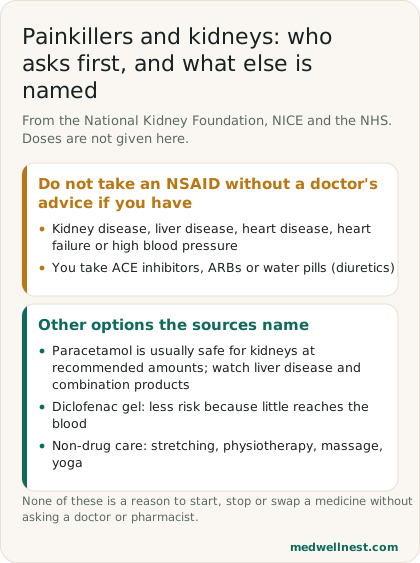
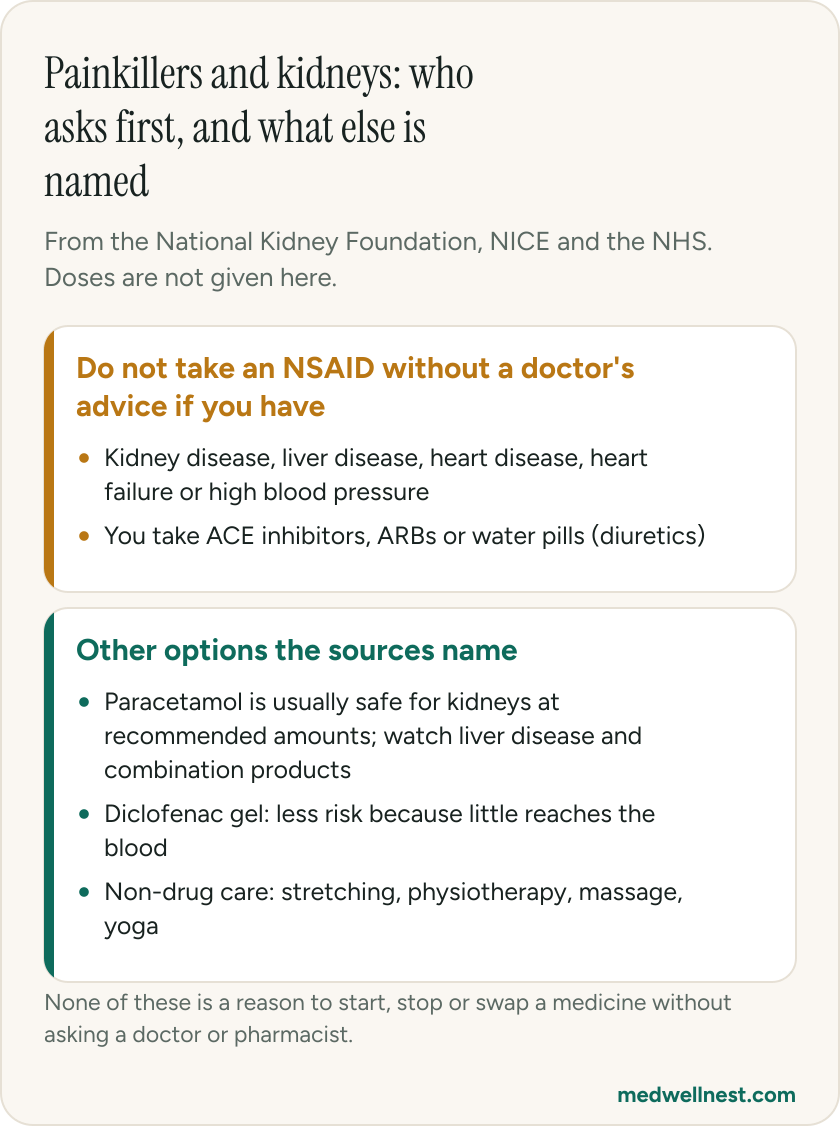
They can. The National Kidney Foundation (NKF) says NSAIDs (non-steroidal anti-inflammatory drugs) lower the amount of blood flowing through the kidneys, so they can lead to acute kidney injury, a sudden drop in kidney function, or worsen chronic kidney disease (CKD), especially at higher doses or with long-term use. The NKF names ibuprofen, naproxen, diclofenac, meloxicam, celecoxib, indomethacin and ketorolac as NSAIDs, and says higher-dose aspirin acts like an NSAID on the kidneys too.
NICE, the National Institute for Health and Care Excellence, says that in adults with CKD, chronic NSAID use may be associated with progression, and acute use is associated with a reversible fall in kidney filtration (GFR). It advises caution when NSAIDs are given to people with CKD for prolonged periods, with monitoring of kidney function, especially when baseline GFR is low or other risks are present. Many cold and flu products also contain NSAIDs, so the NKF says to look for the word NSAID on the label.
02
Who should not take NSAIDs without asking a doctor first?
The NKF says people with CKD should avoid NSAIDs and should not self-treat with them, and that they should also be avoided by people with liver disease, heart disease, heart failure or high blood pressure, or who take blood pressure medicines including ACE inhibitors, ARBs or water pills (diuretics). The NHS ibuprofen page says it may not be suitable if you have a heart, liver or kidney condition, a stomach ulcer, asthma, or have had a stroke.
The NHS says acute kidney injury is more common if you are 65 or older, have had it before or have recently had surgery. Causes include dehydration, low blood pressure and blood loss, long-term conditions that affect the kidneys, heart or liver, and long-term use of some medicines such as ACE inhibitors, NSAIDs or diuretics. NICE says adults with diabetes, high blood pressure or heart disease should be offered a kidney test (eGFR and urine ACR), and that kidney function should be checked at least yearly in people taking medicines that can harm the kidneys, including long-term NSAIDs.
03
What does eGFR 60 mean for painkillers?
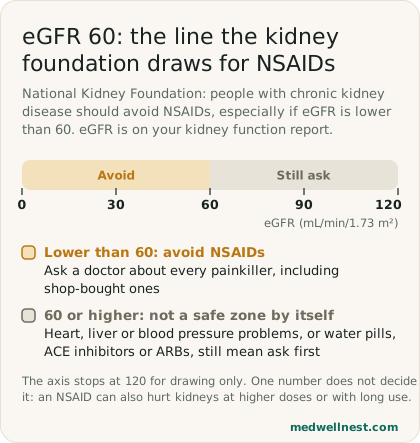
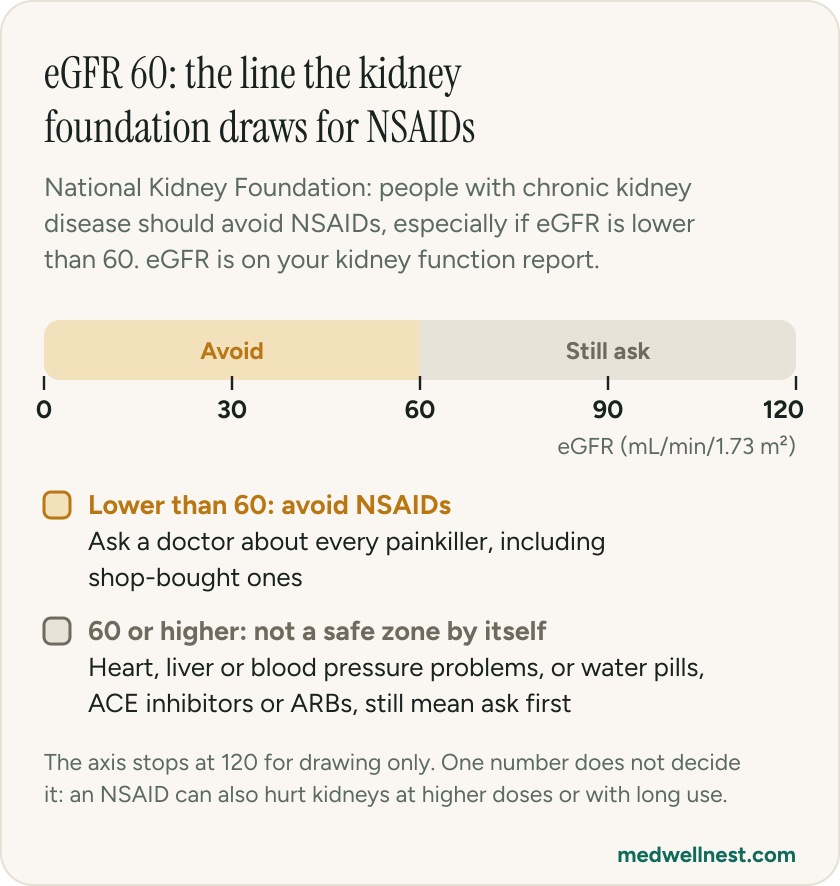
The eGFR is the kidney filtration estimate on your kidney function report, calculated from creatinine. The NKF says people with CKD should avoid NSAIDs, especially if their eGFR is lower than 60. That is not a green light above 60: the NKF also lists heart, liver and blood pressure conditions and the medicines above as reasons to avoid NSAIDs, and says the risk rises with higher doses and longer use.
If your eGFR is below 60, or you do not know it, ask your doctor to review every painkiller you use, including ones bought without a prescription. Our kidney function report story explains how to read the number.
04
Is diclofenac gel safe for the kidneys? Is diclofenac worse than ibuprofen?
The NKF says one kind of NSAID product that can be safe with CKD is the gel applied to the skin. Diclofenac gel is rubbed into the joints and lowers the risk of kidney damage because very little drug enters the blood. The NHS agrees you are less likely to have side effects with gel or plasters because less medicine gets into the body, but says you may still get side effects if you use a lot on a large area of skin. For rub-on pain relievers in general, the NKF warns against applying more than recommended, because more drug can then reach the blood and kidneys.
Diclofenac tablets and capsules are different: the NKF lists them with prescription NSAIDs that people with CKD should avoid. The sources we read put ibuprofen, naproxen and diclofenac in the same class and do not say that one is kidney-safer than another, so a different NSAID is not an answer to a kidney warning.
05
What can I take for pain instead?
Paracetamol is the option the sources name most often. The NKF says acetaminophen (paracetamol) is in general safe for the kidneys at recommended doses, but to check with a healthcare professional first to work out the cause of the pain. The NHS says ibuprofen can cause more side effects than paracetamol and that if you can take paracetamol it is a good idea to try it before ibuprofen. Paracetamol has limits: the NKF says it can make liver disease worse, it often hides in cough and cold products so it is easy to take too much by accident, and it does not lower inflammation, so it will not work for pain caused by swelling.
The NKF also says treatment works better when it includes things that are not medicines, such as stretching, yoga, physical therapy, acupuncture, massage or tai chi, and it advises avoiding alcohol with pain medicines, which raises the risk of kidney injury with NSAIDs. Low-dose aspirin that a doctor prescribes to protect the heart is not the same as higher aspirin doses used for pain. Do not stop a medicine your doctor prescribed without asking.
06
What are the warning signs, and what about vomiting or diarrhoea?
The NHS lists symptoms of acute kidney injury as peeing a lot less than usual, feeling very thirsty, feeling or being sick, swollen feet or legs, feeling tired, dizzy, confused or sleepy, and feeling breathless, especially when lying down. Many people have no symptoms if it is mild. For ibuprofen, the NHS lists kidney problem signs as shortness of breath, blood in the pee or swelling of the ankles, feet or hands, and says stomach bleeding can show as tummy pain, pale skin, vomiting blood or black, sticky, tar-like poo.
Dehydration is itself a cause of acute kidney injury, and the NHS says to drink enough fluids for pale, regular pee, especially in hot weather or when being sick or having diarrhoea, and to speak to a doctor before taking any new medicine. The sources we read do not give a rule on pausing NSAIDs during a stomach illness, so if you have kidney disease, take blood pressure medicines or are older, ask your doctor or pharmacist what to do before using an NSAID in that situation.
Painkillers and kidneys: how fast to act
Emergency — act now
You are passing almost no urine, or you are breathless at rest or when lying flat: go to an emergency department now. Call emergency services now for blood in your vomit, chest pain, shortness of breath, feeling weak or lightheaded, weakness on one side of the body, trouble speaking or thinking, or a swollen throat, lips or tongue or struggling to breathe after an NSAID; the NHS lists these as emergency signs for diclofenac. Also go to an emergency department now for black, sticky, tarry poo or severe tummy pain while taking an NSAID, which the NHS lists as emergency signs of a bleeding stomach ulcer. Do not drive yourself.
Same-day — call promptly
You are peeing a lot less than usual, are very thirsty, feel sick or are being sick, have swollen feet, legs, ankles or hands, blood in the pee, black poo, or feel tired, dizzy, confused or sleepy while taking an NSAID: contact your doctor today, and say which painkillers you take. The NHS says to ask for an urgent appointment or phone the health helpline if you think you may have acute kidney injury. If you pass almost no urine or become breathless at rest or when lying flat, go to an emergency department now.
Routine — see a doctor
You use painkillers often, have diabetes, high blood pressure, heart or liver disease, take water pills, ACE inhibitors or ARBs, or are 65 or older: ask your doctor or pharmacist which painkiller suits you and whether to have a kidney test (eGFR and urine ACR).
Values mentioned in this story
Each one opens a visual guide with its normal range and what moves it — upload a report and we place your own numbers on the same scale.
Sources
- Pain medications for CKD: risks, safety and alternatives — National Kidney Foundationkidney.org
- Chronic kidney disease: assessment and management (NG203) — NICEnice.org.uk
- Acute kidney injury (AKI) — NHSnhs.uk
- Ibuprofen for adults — NHSnhs.uk
- Side effects of diclofenac — NHSnhs.uk
- Stomach ulcer — NHSnhs.uk
Share this story
Curious where your own values stand?
Two minutes from upload to a full visual picture. Free to analyze.