In short
Fingers that go white, blue, then red in the cold are usually Raynaud's, common and often harmless; itchy red or purple patches after cold are chilblains. See a doctor if it is one-sided, starts after 30 or comes with joint pain or a rash; skin turning dark or black needs an emergency department now.
Emergency if: A finger or toe is turning dark red, purple or black and is numb or cold, especially with blisters or sores leaking foul-smelling pus or blood, or pain that keeps getting worse or is suddenly severe; or after very cold exposure you have hard, frozen skin, swelling and loss of feeling, or blisters filled with blood or clear fluid: call emergency services now or go to an emergency department now. The NHS gives this advice if you think you have gangrene or frostbite. Do not rub frostbitten skin or warm it with a radiator, fire or hot water bottle.
On this page
01
Why do my fingers turn white and blue in the cold: what is Raynaud's?
The NHS says Raynaud's phenomenon is where blood stops flowing properly to your fingers and toes. It is common and does not usually cause severe problems, you can often treat the symptoms yourself by keeping warm, and sometimes it can be a sign of a more serious condition. When you are cold, anxious or stressed, your fingers and toes may change colour, and you may also have pain, numbness or pins and needles. Some people also find that their ears, nose, lips or nipples are affected.
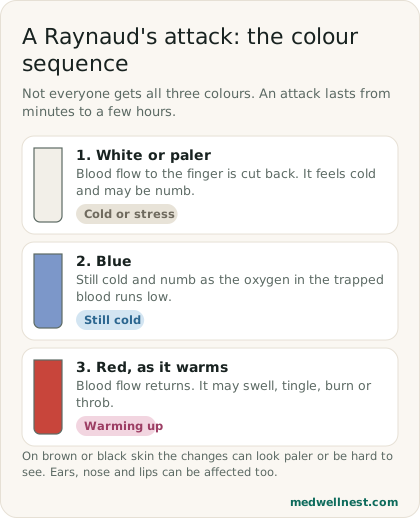
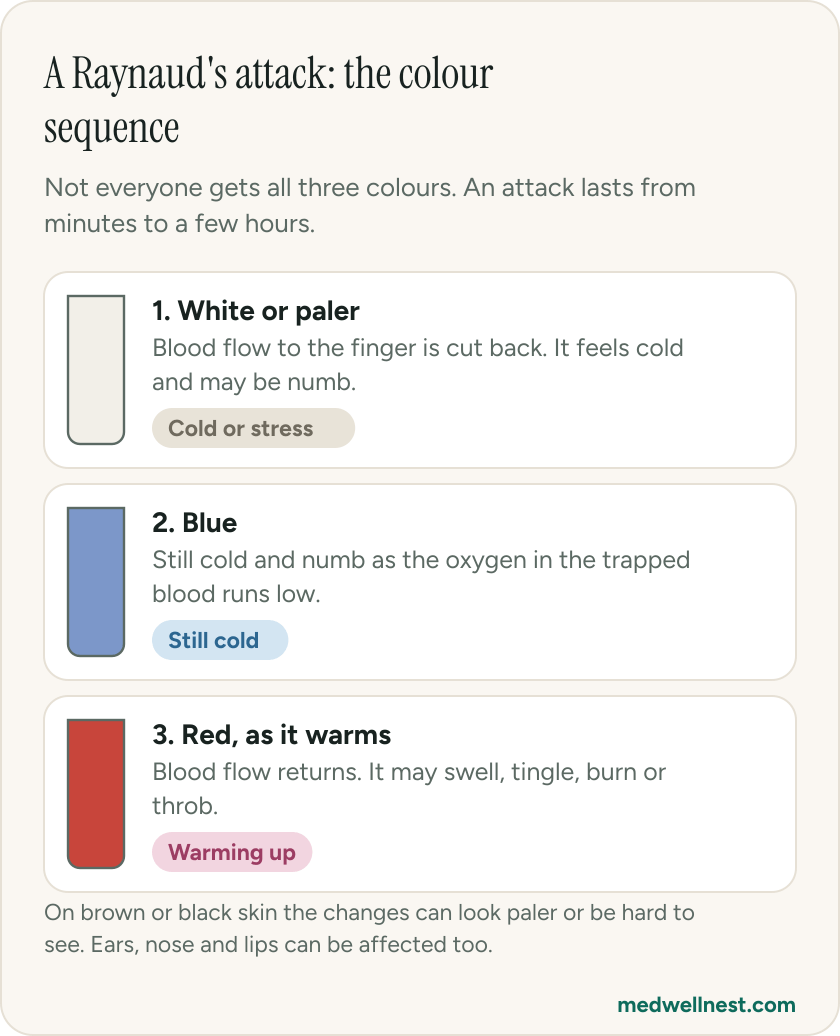
NIAMS describes a typical attack in three steps. The skin turns pale or white because of the lack of blood flow. It then turns blue and feels cold and numb as the blood left in the tissue loses its oxygen. Finally, as you warm up and circulation returns, the area turns red and may swell, tingle, burn or throb. Only one finger or toe may be affected at first. Not everyone gets all three colours: the NHS says the skin may turn white or lighter and sometimes blue.
The NHS says symptoms may last from a few minutes to a few hours. The American College of Rheumatology says attacks usually last seconds to many minutes, and that attacks lasting hours or not settling after rewarming can suggest more serious disease. On brown or black skin the NHS says fingertips may appear paler, so the colour changes may not be easy to see and numbness, coldness and pain are the cues to go by.
02
Is Raynaud's serious: what is the difference between primary and secondary?
NIAMS says there are two types. Primary Raynaud's has no known cause and is the more common form. Secondary Raynaud's is related to another health problem, especially autoimmune diseases such as lupus or scleroderma, and tends to be more serious and to need more treatment. Primary Raynaud's is more common in women, usually starts before age 30 and often begins in the teenage years, and runs in some families.
The conditions linked to the secondary form include lupus, scleroderma, inflammatory myositis, rheumatoid arthritis and Sjögren's disease, and also some thyroid disorders, clotting disorders and carpal tunnel syndrome. NIAMS says that medicines for high blood pressure, migraine or ADHD can cause similar symptoms or make them worse, as can repeated use of vibrating machinery, some chemicals and a history of frostbite. Do not stop any medicine on your own; ask your doctor.
NIAMS says the two types are most commonly told apart by nailfold capillaroscopy, a look at the tiny blood vessels at the base of the fingernail under a microscope. The NHS says a doctor may arrange tests if they think it could be a sign of a condition such as rheumatoid arthritis or lupus. Our ANA test and lupus stories explain those tests.
03
Haath pair thande aur neele: is it Raynaud's or chilblains?
The NHS says chilblains are small, itchy patches that can appear on your skin after you have been in the cold. They usually appear a few hours later, mostly on the fingers and toes but also on the face and legs, and the skin can feel itchy or burning. The fingers or toes may become red or purple, though redness may be harder to see on brown and black skin. They usually go away on their own in 2 to 3 weeks.
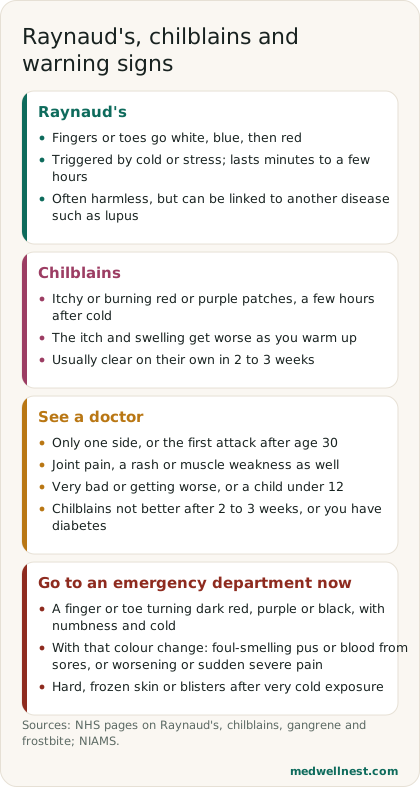
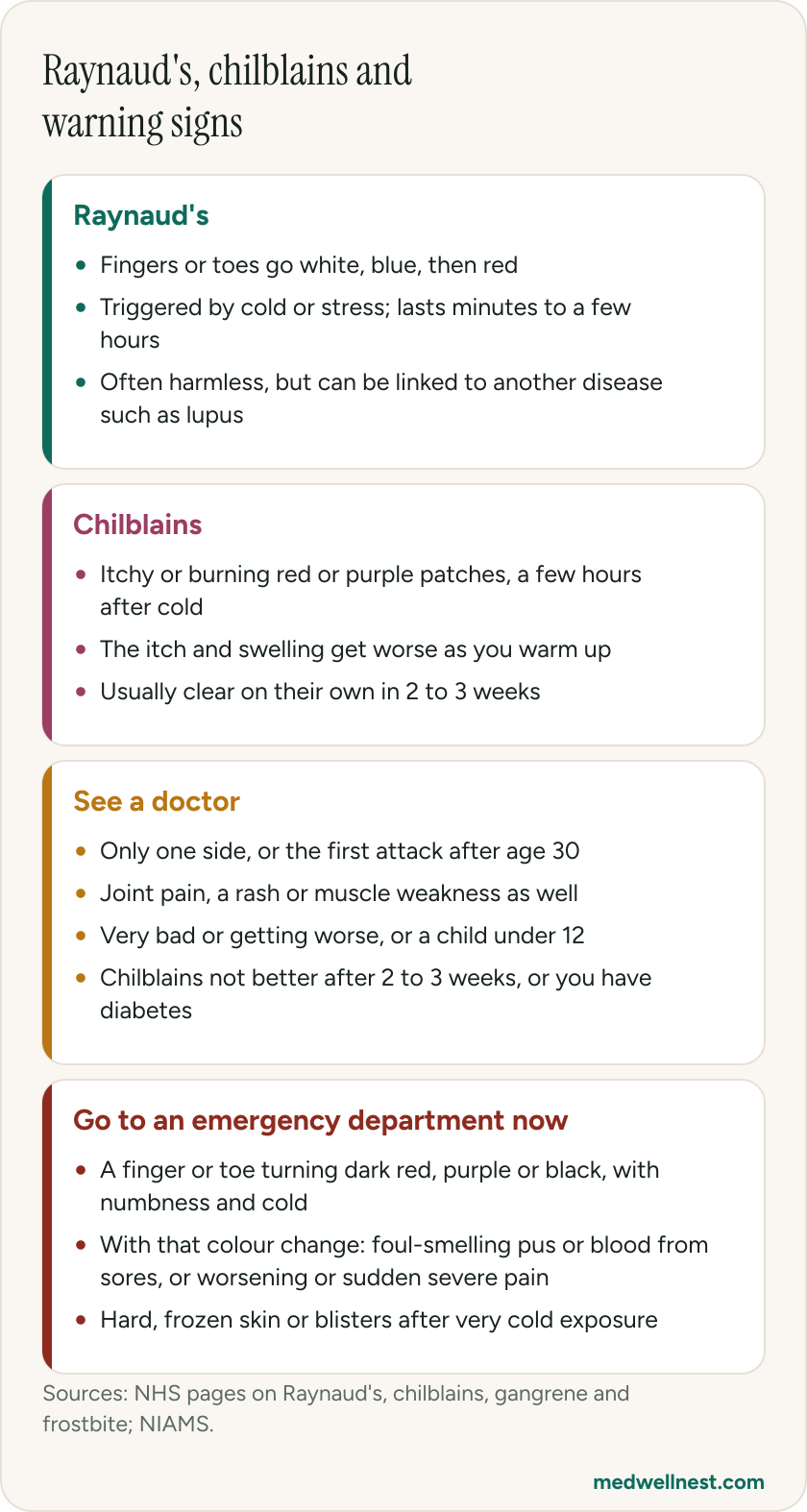
The NHS explains the cause: cold makes the blood vessels in the fingers and toes smaller, and chilblains happen when the deep vessels stay small but those near the surface get bigger as you warm up, which causes pain or itching and colour changes. Its comparison table lists a burning or itchy swelling on the fingers and toes that happens after being very cold and gets worse as you warm up as chilblains, and pins and needles that last a few minutes as the result of resting or sleeping on a part of the body. The difference to remember is that Raynaud's is a colour change of white, blue then red, while chilblains are itchy or burning red or purple patches that show up hours after the cold.
04
What should I do in an attack, and how do I prevent it?
For Raynaud's the NHS says to keep your home warm, wear warm clothes in cold weather especially on your hands and feet, avoid sudden changes in temperature, exercise regularly, try breathing exercises or yoga to relax, and eat a healthy balanced diet. It says not to smoke, and not to have too much caffeine, which may trigger symptoms. NIAMS says emotional stress, cigarette smoking and vaping can also trigger attacks. The American College of Rheumatology suggests mittens or gloves, thick socks and wearing gloves to take food out of the freezer.
During an attack, the American College of Rheumatology suggests tucking hands under the armpits, wiggling the fingers and toes, running them under warm (not hot) water, or massaging them. For chilblains the NHS says to dry and slowly warm the skin, not to put hands or feet on a radiator or under hot water, and not to scratch or pick at the skin. It also says not to smoke, have caffeine or take decongestant medicines for a blocked nose, because they can affect blood flow in the fingers and toes.
The NHS says a doctor may prescribe a medicine to improve circulation if Raynaud's is very bad or getting worse; it gives nifedipine, a blood pressure medicine, as an example, and some people take it only in cold weather. Keeping warm, avoiding triggers, not smoking and managing stress are the ways to help prevent attacks. Our smoking and winter heart stories cover those two triggers.
05
When should I see a doctor about cold fingers and toes?
For Raynaud's the NHS lists these reasons to see a doctor: symptoms that are very bad or getting worse; symptoms that affect daily life; symptoms on only one side of the body; joint pain, skin rashes or muscle weakness as well; symptoms that start for the first time after age 30; and symptoms in a child under 12. For chilblains it lists skin that is not better after 2 to 3 weeks, pus coming from the skin, a very high temperature or feeling hot, cold or shivery, chilblains that keep coming back, and having diabetes, because foot problems can be more serious.
The NHS puts all of these in its non-urgent, see-a-doctor list. We have moved two of the chilblain signs up to same day as a cautious choice of our own, not an NHS instruction: pus coming from a chilblain, and a very high temperature or feeling hot, cold or shivery with chilblains, because both can mean the skin is infected. NIAMS says severe Raynaud's can cause small, painful sores, especially at the fingertips or toes. A new sore on a fingertip or toe is worth showing to a doctor on the same day.
06
When is it an emergency: black fingertips, sores, frostbite?
NIAMS says that in rare cases an extended episode lasting days can lead to gangrene, the death and decay of tissue. The NHS describes gangrene as a body part, such as a toe or finger, that begins to die. Its signs are skin turning dark red, purple or black, numbness or cold, swelling, pain that gradually gets worse or a sudden severe pain, and blisters or sores that leak unpleasant-smelling pus or blood. The NHS says to call emergency services or go to an emergency department immediately if you think you have gangrene.
Frostbite can also look like a bad Raynaud's attack. The NHS says to call emergency services or go to an emergency department now if, after very cold exposure, you have hard, frozen skin, swelling and loss of feeling, or blisters filled with blood or a clear or milky fluid, or if you are constantly shivering with slurred speech, slow breathing and tiredness or confusion. For frostbite the NHS says not to rub the area and not to use a fire, radiator, hot water bottle or heat lamp. That rule is for frostbite, not for an ordinary Raynaud's attack, where the American College of Rheumatology lists massage and warm water.
Cold fingers and toes: how fast to act
Emergency — act now
A finger or toe is turning dark red, purple or black and is numb or cold, especially with blisters or sores leaking foul-smelling pus or blood, or pain that keeps getting worse or is suddenly severe; or after very cold exposure you have hard, frozen skin, swelling and loss of feeling, or blisters filled with blood or clear fluid: call emergency services now or go to an emergency department now. The NHS gives this advice if you think you have gangrene or frostbite. Do not rub frostbitten skin or warm it with a radiator, fire or hot water bottle.
Same-day — call promptly
You have pus coming from a chilblain, or a very high temperature or feel hot, cold or shivery with chilblains; a new painful sore on a fingertip or toe; or a finger or toe that stays white or blue for hours and does not recover after you warm it: see a doctor the same day. The NHS lists the two chilblain signs as see-a-doctor signs; we have moved them up as a cautious choice because they can mean infection. NIAMS says severe Raynaud's can cause painful sores on the fingertips or toes, and the American College of Rheumatology says attacks that last hours or do not settle after rewarming can suggest more serious disease.
Routine — see a doctor
Your cold-finger symptoms are only on one side, started for the first time after age 30, come with joint pain, a rash or muscle weakness, are very bad or getting worse, or are in a child under 12; or chilblains are not better after 2 to 3 weeks, keep coming back, or you have diabetes: see a doctor. These are the NHS non-urgent signs.
Sources
- Raynaud's — NHSnhs.uk
- Chilblains — NHSnhs.uk
- Raynaud's Phenomenon — NIAMS (National Institutes of Health)niams.nih.gov
- Frostbite — NHSnhs.uk
- Raynaud's Phenomenon — American College of Rheumatology patient pagerheumatology.org
- Gangrene — NHSnhs.uk
Share this story
Curious where your own values stand?
Two minutes from upload to a full visual picture. Free to analyze.