In short
Scrub typhus is a treatable fever caught from mite larvae in grass, fields and gardens. Here is what the tell-tale eschar looks like, why its absence proves nothing, which test fits which day, and the signs that mean hospital now.
Emergency if: Fever with breathlessness, confusion or drowsiness, a stiff neck, a seizure, yellow eyes or skin, much less urine than usual, or any bleeding: go to hospital now. These complications usually come after the first week, and the national guideline sends patients with serious complications to a larger hospital.
On your report
Platelet Count, SGPT (ALT), SGOT (AST), WBC / Total Leukocyte Count +1 more
On this page
01
A fever caught from grass, fields and gardens
Scrub typhus is a bacterial infection passed on by the bite of mite larvae called chiggers, which are too small to see with the naked eye. They live in scrub and bushes, on river banks, in rice fields, grassy lawns and poorly kept kitchen gardens, and a chigger may stay attached and feeding for 1 to 3 days. The national rickettsial guideline notes that it is commoner in rural areas and in people whose farming work or leisure brings them into grass and bushes.
It is seasonal in many places. In tropical regions, the CDC says, it can be caught all year, with peaks set by the rainy and dry seasons. It is also common: the guideline says that in some regions scrub typhus accounts for up to 50% of the unexplained fevers that reach hospital. Because it looks like so many other fevers, the guideline asks doctors to keep dengue, malaria, typhoid, leptospirosis and pneumonia in mind at the same time.
02
Symptoms, and when they start
Symptoms usually begin 7 to 10 days after the bite, according to the CDC. StatPearls gives a typical 10 to 12 days, with a range of 6 to 21. The illness starts suddenly with fever and chills, headache and body aches. Nausea, vomiting, belly pain, cough, breathlessness and swollen lymph glands are common, and some people become confused.
A rash is where the sources part ways. The national guideline calls a rash extremely rare in scrub typhus and more typical of spotted fever, while the CDC says about 25% to 50% of patients develop one, usually starting on the belly. So a rash neither makes the diagnosis nor rules it out.
Blood tests often give clues. The guideline says most patients have a platelet count below 1,00,000 per µL, liver enzymes are raised, and the white cell count may be normal early but can rise above 11,000 per µL later. The CDC adds that bilirubin and creatinine may be raised.
03
The eschar: look for it, but do not depend on it
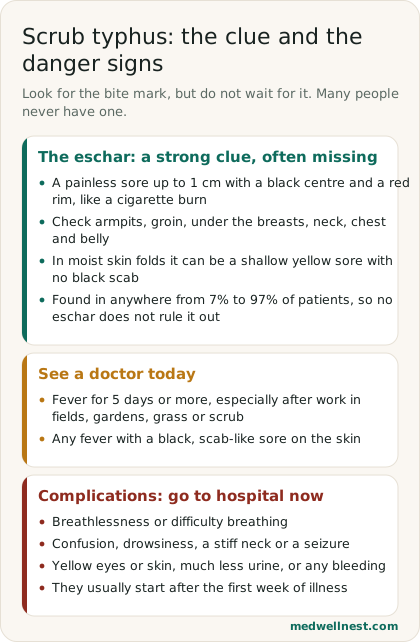
The single most useful clue is the eschar, the mark left where the chigger fed. The national guideline describes a painless, punched-out sore up to 1 cm across, with a black centre and a red rim, like the mark of a cigarette burn. It is usually single, on the neck, armpits, chest, belly or groin, and the CDC adds the skin under the breasts. It can appear before the fever does.
It is easy to miss. In moist skin folds such as the armpit, scrotum or around the anus, the guideline warns that an eschar may have no black scab and look like a shallow yellow sore. And many patients never have one: the guideline reports an eschar in anywhere from 7% to 97% of cases, depending on the study, and StatPearls gives 10% to 90%. Finding one is a strong pointer; not finding one proves nothing.
04
Which test on which day
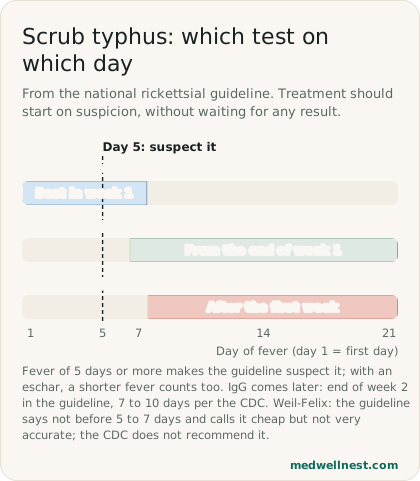
The national guideline asks doctors to suspect a rickettsial infection in any unexplained fever lasting 5 days or more, and to treat a shorter fever as scrub typhus if an eschar is present. Timing then decides the test. PCR detects the bacteria's DNA in blood, or in a swab or scab from the eschar, and the guideline says blood PCR works best in the first week, while the bacteria are still in the bloodstream.
Antibody tests need time. A significant IgM level usually appears towards the end of the first week, so an IgM ELISA done on day 3 can be negative in someone who has the infection. On the report, the guideline treats an optical density above 0.5 as positive. IgG comes later: at the end of the second week in the guideline, or 7 to 10 days after the illness starts according to the CDC. Because antibodies can persist for years, the CDC says firm confirmation needs a rise between two samples taken weeks apart.
The old Weil-Felix test is where the sources disagree. The national guideline calls it cheap and still useful where nothing else is available, but not very accurate, and says to do it only after 5 to 7 days of fever. The CDC says its accuracy is very low and does not recommend it. The guideline also does not recommend any rapid card test yet, because these still need evaluation.
05
Treatment starts on suspicion
Scrub typhus responds well to the right antibiotic, and timing matters more than proof. The national guideline says treatment should start when a rickettsial infection is suspected, without waiting for laboratory confirmation, and the CDC says treatment should never be held back while waiting for tests. Both name doxycycline as the drug of choice. The guideline uses azithromycin in pregnancy, because doxycycline is avoided then; the CDC says treatment in pregnancy should be decided with an infectious disease expert.
Take the full course your doctor prescribes. The CDC warns that single doses or short courses can let the illness come back. People treated early usually recover quickly. Left untreated, the guideline reports death rates as high as 30% to 45% once several organs fail. If the fever does not settle on treatment, go back: the guideline says persisting symptoms mean another diagnosis should be considered.
06
Complications, red flags and prevention
Complications usually appear after the first week of illness. The national guideline lists jaundice, kidney failure, pneumonia, a severe lung injury called acute respiratory distress syndrome (ARDS), shock, inflammation of the heart muscle and infection of the brain and its linings. Pneumonia is one of the commonest, with a dry cough and breathlessness. The CDC adds bleeding, and warns that in pregnancy scrub typhus often leads to miscarriage.
Any of these signs means hospital now: breathlessness, confusion or drowsiness, a stiff neck or a seizure, yellow eyes or skin, passing much less urine, or bleeding. The guideline refers patients with serious complications such as severe lung injury, kidney failure or brain involvement to a larger hospital, where treatment is given into a vein.
There is no vaccine. The CDC advises avoiding areas thick with vegetation and brush, using an insect repellent registered for chiggers on exposed skin and clothing, dressing children in clothes that cover their arms and legs, and treating clothes and boots with permethrin, never putting permethrin on the skin. After work in fields or gardens, mention it to your doctor whenever a fever starts.
When to act
Emergency — act now
Fever with breathlessness, confusion or drowsiness, a stiff neck, a seizure, yellow eyes or skin, much less urine than usual, or any bleeding: go to hospital now. These complications usually come after the first week, and the national guideline sends patients with serious complications to a larger hospital.
Same-day — call promptly
A fever lasting 5 days or more, or any fever with a black, scab-like sore on the skin, especially after time in fields, gardens, grass or scrub: see a doctor today and mention the exposure. Treatment should start on suspicion, without waiting for test results.
Already on treatment but the fever has not settled, or it came back after a short course: see your doctor again today. Persisting symptoms can mean another diagnosis, and a short course can let scrub typhus relapse.
Values mentioned in this story
Each one opens a visual guide with its normal range and what moves it — upload a report and we place your own numbers on the same scale.
Sources
- DHR-ICMR guidelines for diagnosis and management of rickettsial diseases — PMCpmc.ncbi.nlm.nih.gov
- Clinical Overview of Scrub Typhus — CDCcdc.gov
- About Scrub Typhus — CDCcdc.gov
- Scrub Typhus — StatPearls, NCBI Bookshelfncbi.nlm.nih.gov
Share this story
Curious where your own values stand?
Two minutes from upload to a full visual picture. Free to analyze.