In short
Statins are usually taken long term. In one trial, LDL rose back above 100 mg/dL in 79% of people within 10 weeks of stopping. In SAGA/SITE (age 75+, no heart disease, statin for prevention), stopping met the trial's "not worse" test for deaths over 3 years, but a small rise was not ruled out. Never stop on your own.
Emergency if: Chest pain or pressure that feels tight or like squeezing, or spreads to your arm, neck or jaw; severe difficulty breathing; pale, blue or grey skin; someone passing out and not responding normally; or sudden face drooping, arm weakness or slurred speech (stroke): call emergency services now. Do not drive yourself. Call emergency services now even if the stroke signs have stopped, if they happened in the last 24 hours.
On your report
LDL Cholesterol, Non-HDL Cholesterol, Total Cholesterol
On this page
01
How long do I have to take a statin?
The NHS says you will usually take statins long term, which helps keep the risk of a heart attack or stroke as low as possible as you get older. It says that if you stop taking them your cholesterol levels may be affected, and to talk to a doctor or pharmacist before stopping. NICE advises annual medication reviews for people on lipid-lowering treatment, which is the point to ask whether you still need it.
Long term does not mean unchangeable. NICE says that if someone stopped a statin because of a drug interaction or to treat another illness, they should be reminded to restart it, and the NHS says a doctor may recommend stopping a statin for a while if it interacts with another medicine. NICE also says not to stop a statin because blood glucose or HbA1c has risen. For muscle pain and other side effects, see our statin side effects story.
02
My cholesterol is normal now. Can I stop the statin?
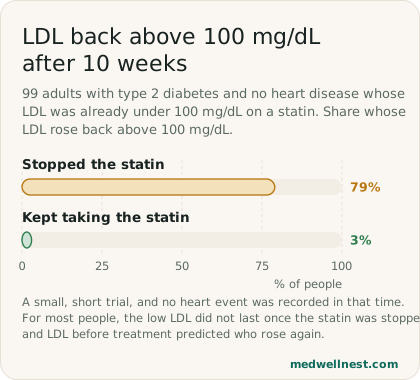
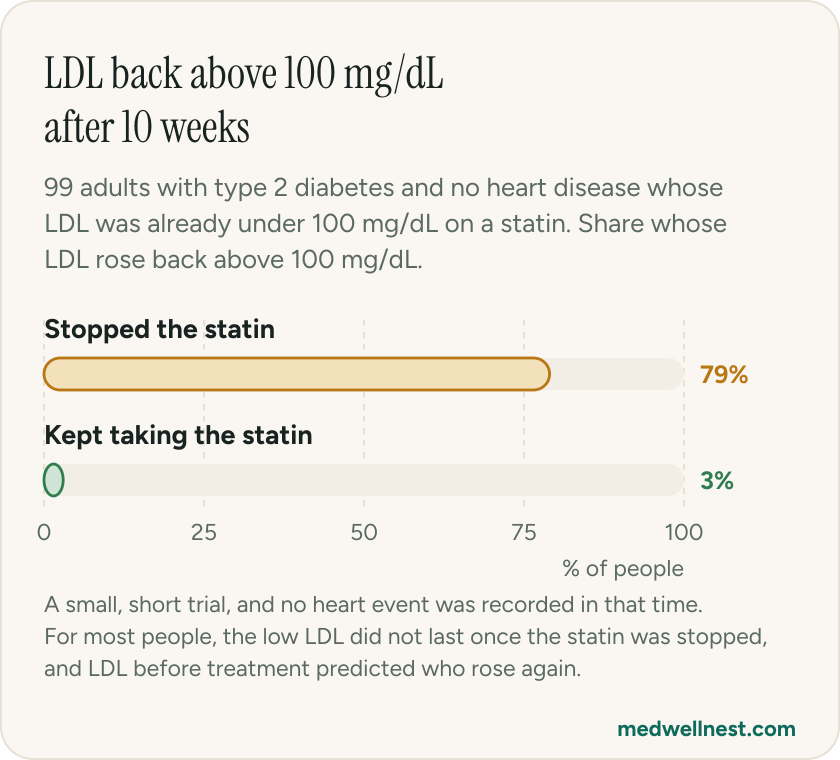
Usually no, because a normal LDL on a statin is largely the result of the statin. A randomised trial in adults with type 2 diabetes and no heart disease took 99 people whose LDL was already under 100 mg/dL on a statin and assigned them, 2 to 1, to stop or keep taking it. After 10 weeks, LDL had risen back above 100 mg/dL in 79% of those who stopped, against 3% of those who continued. The LDL level before treatment was the best predictor of who would rise again, with a cut-off of 123 mg/dL.
This was a small, short trial, and no heart event was recorded in that time, so it shows what happens to LDL rather than what happens to heart attacks. It matches the NHS statement that stopping may affect cholesterol levels. A normal result is a sign the treatment is working, so it is a reason to ask your doctor whether the plan should continue, not a reason to stop yourself.
03
I have had a heart attack, stroke or stent. Can I ever stop?
The NHS says statins may be offered to people who already have cardiovascular disease to reduce the risk of having a heart attack or stroke. Neither trial on this page studied this group: both included only people with no history of cardiovascular disease. So their results say nothing about stopping after a heart attack, stroke or stent, and stopping would go beyond what either trial tested.
If you have had one of these events, any change to a statin should come from your cardiologist or doctor, after looking at your own risk. The NHS tells everyone to talk to a doctor or pharmacist before stopping.
04
What did the SAGA/SITE trial find about stopping a statin after 75?
SAGA/SITE was a pragmatic, open-label randomised trial in 297 primary care offices, published in Lancet Healthy Longevity in 2026. It enrolled people aged 75 or older who had taken a statin for at least a year to prevent a first heart attack or stroke and had no history of cardiovascular disease. They were randomly assigned to continue or stop and followed for 36 months. People with dementia, a progressive disease with a life expectancy of 3 months or less, or known homozygous or double heterozygous FH were excluded. Among 1,160 people analysed, the median age was 80, 66.8% were women, 29.5% had diabetes and 77.2% had hypertension.
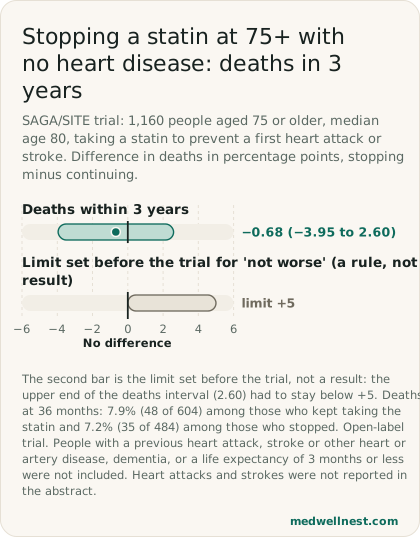
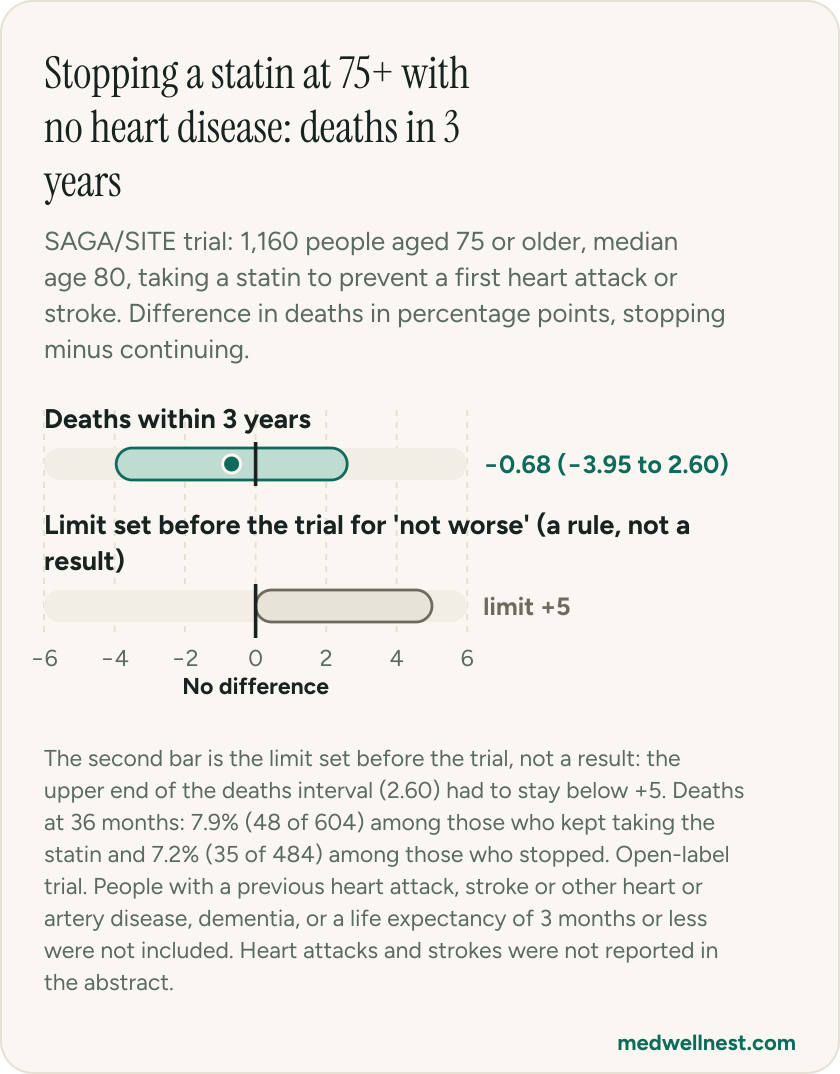
At 36 months, 7.9% (48 of 604) of those who continued had died, against 7.2% (35 of 484) of those who stopped. The difference was -0.68 percentage points (95% CI -3.95 to 2.60), which met the trial's rule for non-inferiority (a margin of 5 percentage points). Adverse events of any kind occurred in 73.1% of the continuation group and 74.0% of the discontinuation group, almost all non-cardiovascular. The authors say the findings support individualised decisions about stopping. A margin of 5 percentage points is wide when about 7 to 8 in 100 people died, and the interval does not rule out up to 2.6 more deaths per 100 after stopping.
05
Who might reasonably stop a statin after 75, and who should not?
The abstract reports death from any cause and adverse events. It does not report heart attacks or strokes, so this page cannot say whether those differed. The trial was open-label, lasted 3 years, and all participants had already taken a statin for at least a year. It did not include people with previous heart disease, dementia, or a very short life expectancy.
NICE, in its lipid guideline, says the decision to take a statin should follow an informed discussion about benefits and risks, taking into account preferences, other conditions, the number of medicines taken, frailty and life expectancy. It lists statin treatment for older people as an area where there is still a lack of direct evidence. It also says that for people aged 85 or older, treatment can be considered while being aware of factors that may make it inappropriate. Age alone is therefore not a reason either way. If you are 75 or older, have never had a heart attack or stroke, and are taking several medicines or are frail, ask your doctor at your annual review whether your statin still makes sense for you.
If you and your doctor decide to stop, ask what to watch for and whether your cholesterol should be checked afterwards, since the trial above showed LDL tends to rise. Do not stop a statin because you feel well, or because a relative or social media post said it is unnecessary.
06
What warning signs need emergency help?
If you take a statin, you may have heart or artery disease, or be at risk of it. The NHS says to call emergency services now for chest pain that feels tight or like squeezing, chest pain spreading to the arms, neck or jaw, severe difficulty breathing, pale, blue or grey skin, or someone passing out and not responding normally. Do not drive yourself.
The NHS lists the stroke signs as face weakness, arm weakness and speech problems (FAST), and says to call emergency services now if you think you are having, or have had, a stroke, including signs in the last 24 hours that have stopped. Treat these as an emergency, not as a statin question.
Statins and warning signs: how fast to act
Routine — see a doctor
You are wondering whether to stop or keep your statin, your LDL is now normal, or you are 75 or older: book a medicine review with your doctor and bring your cholesterol results and a list of your medicines. Do not stop the statin before that conversation.
Emergency — act now
Chest pain or pressure that feels tight or like squeezing, or spreads to your arm, neck or jaw; severe difficulty breathing; pale, blue or grey skin; someone passing out and not responding normally; or sudden face drooping, arm weakness or slurred speech (stroke): call emergency services now. Do not drive yourself. Call emergency services now even if the stroke signs have stopped, if they happened in the last 24 hours.
Values mentioned in this story
Each one opens a visual guide with its normal range and what moves it — upload a report and we place your own numbers on the same scale.
Sources
- Discontinuation of statins for primary prevention in adults aged 75 years or older (SAGA/SITE) — Lancet Healthy Longevity 2026pubmed.ncbi.nlm.nih.gov
- Statin Discontinuation after Achieving a Target LDL Cholesterol Level in Type 2 Diabetic Patients without Cardiovascular Disease — Diabetes Metab J 2014pubmed.ncbi.nlm.nih.gov
- Cardiovascular disease: risk assessment and reduction, including lipid modification (NG238) — NICEnice.org.uk
- Statins — NHSnhs.uk
- Heart attack — NHSnhs.uk
- Symptoms of a stroke — NHSnhs.uk
Share this story
Curious where your own values stand?
Two minutes from upload to a full visual picture. Free to analyze.