In short
Familial hypercholesterolaemia (FH) is inherited and affects an estimated 1 in 200 to 1 in 250 people. NICE says to suspect it when total cholesterol is above 7.5 mmol/L (about 290 mg/dL) or heart disease runs in the family before 60. Treatment starts early and is lifelong.
Emergency if: Chest pain or pressure that feels tight or like squeezing, or spreads to your arm, neck or jaw; severe difficulty breathing; pale, blue or grey skin; someone passing out and not responding normally; or sudden face drooping, arm weakness or slurred speech (stroke): call emergency services now. Do not drive yourself. Call emergency services now even if the stroke signs have stopped, if they happened in the last 24 hours.
On your report
LDL Cholesterol, Total Cholesterol, Non-HDL Cholesterol, Apolipoprotein B (ApoB)
On this page
01
Why is my cholesterol high at a young age?
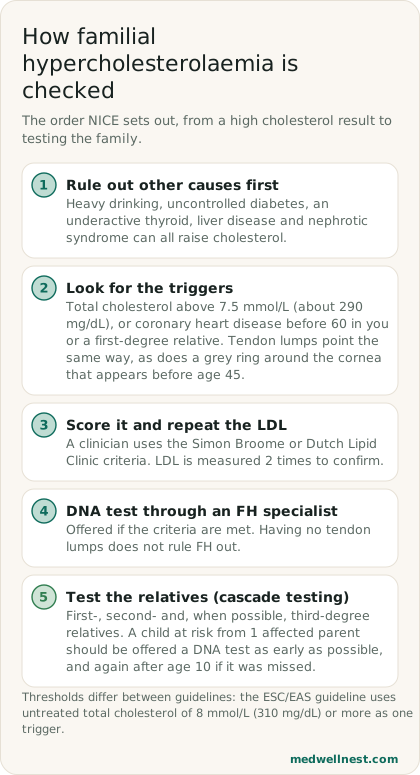
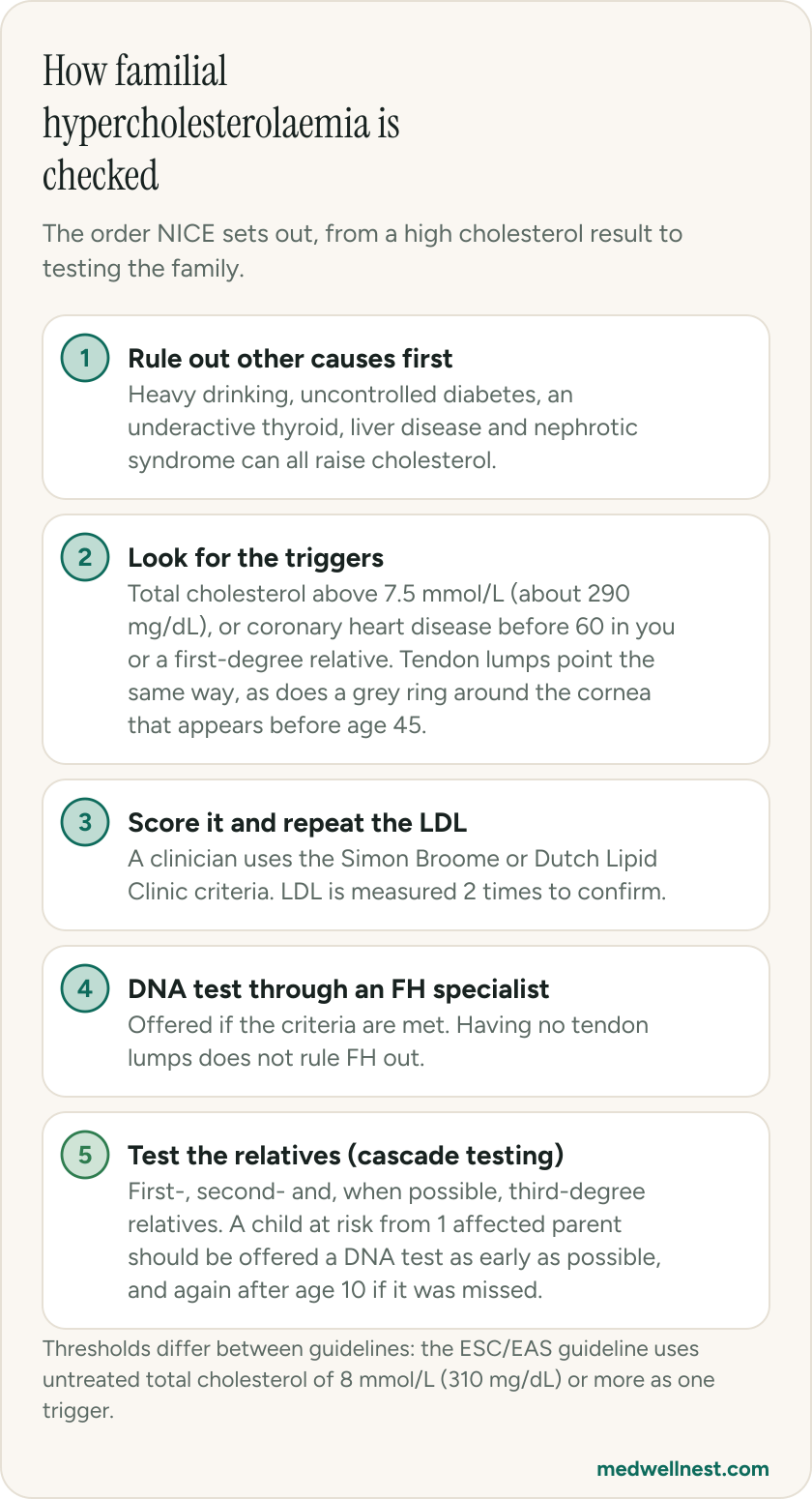
Most high cholesterol is not inherited as a single-gene condition. MedlinePlus says familial hypercholesterolaemia accounts for only a small percentage of all cases of high cholesterol. Before FH is considered, NICE says to exclude other causes. Its lipid guideline lists excess alcohol, uncontrolled diabetes, an underactive thyroid, liver disease and nephrotic syndrome, so a young person with a high result should have these checked first.
If those are ruled out and the number is very high, or the family history points that way, FH becomes likely. The NICE and ESC/EAS criteria below do not use body weight, so FH can be present in someone who is not overweight. MedlinePlus notes that both genetic and environmental factors play a part, including diet, exercise and smoking.
02
What is familial hypercholesterolaemia (FH)?
MedlinePlus describes FH as an inherited condition with very high blood cholesterol, in which the body is unable to get rid of the extra. It says people with FH have a high risk of coronary artery disease at a young age. Gene changes in LDLR are the most common cause, and APOB, PCSK9 or LDLRAP1 are less common. FH from LDLR, APOB or PCSK9 changes is autosomal dominant, meaning one altered copy of the gene is enough to cause it, so a parent can pass it on. Some people with FH have no change found in these genes.
The ESC/EAS guideline gives the frequency of the common (heterozygous) form as 1 in 200 to 1 in 250, matching MedlinePlus, which calls FH probably the most common inherited condition affecting the heart and blood vessels. The ESC/EAS guideline says a gene change is found in 60% to 80% of people with a clinically definite or probable diagnosis. The rare form with changes in both gene copies, homozygous FH, is estimated at 1 in 160,000 to 1 in 320,000 and is far more severe.
03
What are the signs of FH?
Signs are not always present. When cholesterol collects in tissue it causes tendon xanthomas, which are firm growths most often on the Achilles tendons and the tendons of the hands and fingers; xanthelasmata, yellowish deposits under the eyelid skin; and arcus cornealis, a grey ring at the edge of the cornea. MedlinePlus lists all three.
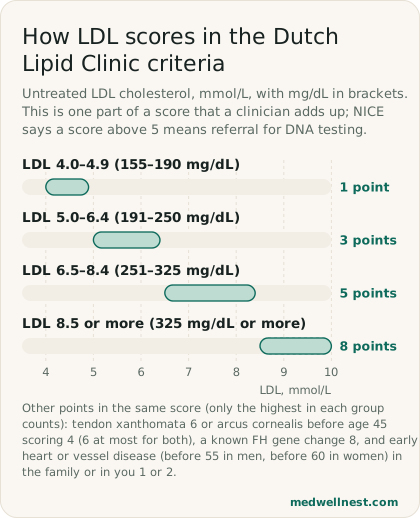
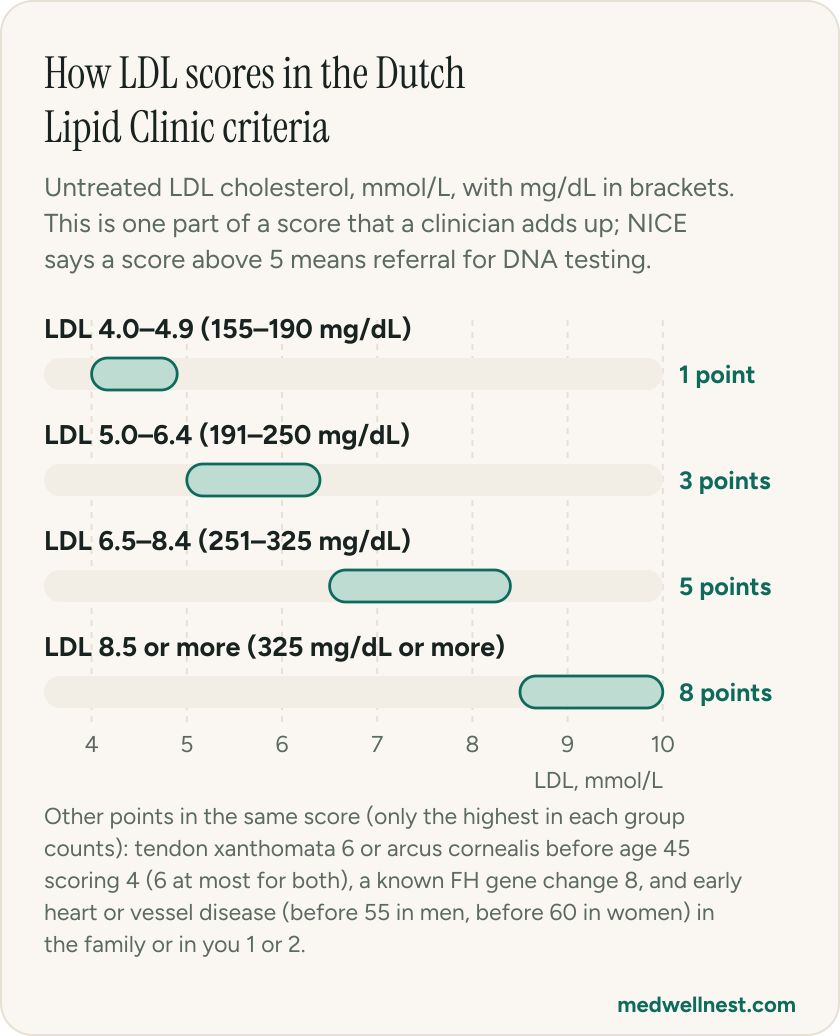
The Dutch Lipid Clinic criteria give tendon xanthomata 6 points and arcus cornealis before age 45 4 points. NICE warns that having no clinical signs such as tendon xanthomata does not exclude FH, in adults or in children. A normal-looking tendon or eye is therefore not reassurance if the numbers or the family history are suggestive.
04
When should I be tested for FH, and which numbers matter?
NICE says to suspect FH in adults with a total cholesterol above 7.5 mmol/L (about 290 mg/dL), or a personal or family history of premature coronary heart disease, defined as an event before age 60 in the person or a first-degree relative. If the cholesterol is unknown but there is such a history, NICE says to measure it. It says records should be searched for people under 30 with total cholesterol above 7.5 mmol/L and people 30 or older with above 9.0 mmol/L (about 350 mg/dL), who are at highest risk. NICE's lipid guideline also asks for specialist assessment if total cholesterol is above 9.0 mmol/L or non-HDL cholesterol is above 7.5 mmol/L, even without a family history.
Guidelines use different cut-offs. The ESC/EAS guideline says to identify index cases for further testing when untreated total cholesterol is 8 mmol/L (310 mg/dL) or more, or there is premature coronary heart disease or tendon xanthomas in the person or a family member, or a sudden premature cardiac death in the family. NICE says that, to confirm FH, LDL should be measured twice. It also says heart-risk calculators such as QRISK should not be used for someone with FH, because they are already at high risk. Our lipid profile story explains how to read these numbers on a report.
05
How is FH diagnosed: Simon Broome, Dutch Lipid Clinic criteria and the DNA test?
NICE says to use the Simon Broome criteria or the Dutch Lipid Clinic Network criteria to make a clinical diagnosis, done by a professional competent in using them. It says to refer for DNA testing through an FH specialist service if a person meets the Simon Broome criteria for possible or definite FH, or has a score above 5 on the Dutch Lipid Clinic Network criteria. The ESC/EAS guideline's table sets the Dutch Lipid Clinic points for family history, personal history, physical signs, untreated LDL level and DNA result. For LDL, the points are 1 for 4.0 to 4.9 mmol/L, 3 for 5.0 to 6.4, 5 for 6.5 to 8.4 and 8 for 8.5 or more.
NICE says that someone with a known FH-causing gene change has an unequivocal diagnosis even if their LDL does not meet the criteria. In a family where a gene change is known, a relative whose DNA test excludes FH should have their heart risk managed as in the general population. NICE does not recommend an ultrasound scan of the Achilles tendon to diagnose FH.
06
Should my children and relatives be tested?
Yes, that is the purpose of cascade testing. NICE says to use DNA testing to find affected first- and second-degree relatives and, when possible, third-degree biological relatives of a person with a genetic diagnosis of FH. The ESC/EAS guideline says cascade screening is best done by a lipid clinic and that in most families cholesterol or LDL tests can identify cases, with genetic testing recommended once the causative gene change is known. Our Lp(a) story covers the other inherited cholesterol-related risk.
For children, NICE says that a child aged 0 to 10 years who is at risk because 1 parent is affected should be offered a DNA test at the earliest opportunity, with another chance if it has not been done by age 10. It says to measure LDL before age 5, or as early as possible after, in children at risk of the rare homozygous form.
07
How is FH treated, and does treatment start early?
Yes. The ESC/EAS guideline says cholesterol-lowering treatment should start as soon as possible after diagnosis, and that cumulative cholesterol burden is why early treatment matters. It says treatment starts with a high-intensity statin, in most cases with ezetimibe added. NICE says to tell adults that lipid-lowering treatment should be lifelong, to offer a high-intensity statin first and aim for at least a 50% fall in LDL from the starting level, and to refer to an FH specialist if that is not reached on the maximum tolerated treatment with ezetimibe. The ESC/EAS guideline says PCSK9 inhibitors are recommended in very-high-risk people with FH if goals are not met on a maximum tolerated statin plus ezetimibe.
For children, NICE says statins should be offered by age 10 or the earliest opportunity after, started by a clinician with expertise in children with FH, with growth and puberty monitored. NICE says lifestyle advice is part of medical management and not a substitute for drug treatment. Do not stop or change treatment on your own; a doctor decides this with you. If you become pregnant while taking a statin, contact your doctor straight away, because NICE advises stopping it and an urgent specialist review.
08
What warning signs need emergency help?
High cholesterol, including FH, usually causes no symptoms, and the first sign can be a heart attack or stroke. The NHS says to call emergency services now for chest pain that feels tight or like squeezing, chest pain spreading to the arms, neck or jaw, severe difficulty breathing, pale, blue or grey skin, or someone passing out and not responding normally. Do not drive yourself to hospital.
For stroke, the NHS lists face weakness, arm weakness and speech problems (FAST), and says to call emergency services now if you think you are having, or have had, a stroke, including signs that came in the last 24 hours and have stopped. The NHS says symptoms that pass in a short time still need medical help straight away.
High cholesterol and warning signs: how fast to act
Routine — see a doctor
Your total cholesterol is above 7.5 mmol/L (about 290 mg/dL), or a first-degree relative (parent, brother, sister or child) had heart disease before 60, or you notice tendon lumps, yellow patches on the eyelids, or (before age 45) a grey ring on the cornea: book a visit and bring your lipid profile. Ask whether other causes were checked and whether FH criteria or a specialist referral apply. If total cholesterol is above 9.0 mmol/L (about 350 mg/dL), NICE says to arrange specialist assessment.
Emergency — act now
Chest pain or pressure that feels tight or like squeezing, or spreads to your arm, neck or jaw; severe difficulty breathing; pale, blue or grey skin; someone passing out and not responding normally; or sudden face drooping, arm weakness or slurred speech (stroke): call emergency services now. Do not drive yourself. Call emergency services now even if the stroke signs have stopped, if they happened in the last 24 hours.
Values mentioned in this story
Each one opens a visual guide with its normal range and what moves it — upload a report and we place your own numbers on the same scale.
Sources
- Familial hypercholesterolaemia: identification and management (CG71) — NICEnice.org.uk
- Cardiovascular disease: risk assessment and reduction, including lipid modification (NG238) — NICEnice.org.uk
- 2019 ESC/EAS Guidelines for the management of dyslipidaemiasdoi.org
- Familial hypercholesterolemia — MedlinePlus Geneticsmedlineplus.gov
- Heart attack — NHSnhs.uk
- Symptoms of a stroke — NHSnhs.uk
Share this story
Curious where your own values stand?
Two minutes from upload to a full visual picture. Free to analyze.