In short
Lp(a) is an inherited cholesterol particle that a standard lipid profile does not measure. Guidelines say to test it at least once in adulthood. Diet barely changes it, and Lp(a)-lowering drugs are still investigational: a large outcomes trial of one of them, pelacarsen, missed its main goal in September 2026.
Emergency if: Chest pain or pressure that feels tight, crushing or squeezing, or pain spreading to your arm, neck or jaw, especially with sweating, feeling or being sick or shortness of breath; severe difficulty breathing; lips or skin turning pale, blue or grey; someone passing out and not responding normally; or a sudden drooping face, weakness in one arm, slurred or confused speech or other stroke signs (FAST): call emergency services now. Do not drive yourself to hospital. The NHS lists these as heart attack and stroke symptoms, and says stroke symptoms that stop after a short time still need medical help straight away.
On your report
Lipoprotein(a), LDL Cholesterol, Apolipoprotein B (ApoB)
On this page
01
What is the Lp(a) test?
Lp(a), or lipoprotein(a), is an LDL particle with an extra protein, apo(a), attached to it. The ESC/EAS guideline says it can pass into the artery wall and be retained there like LDL, and that it resembles plasminogen, a clot-related protein, which may add a clotting effect. MedlinePlus says Lp(a) particles are stickier than other LDL particles.
It is not part of a standard lipid profile. MedlinePlus explains that a routine cholesterol test can look healthy while a large share of your LDL is carried by Lp(a) particles, so the risk can still be high. That is one possible answer to 'my cholesterol was normal, so why did the heart attack happen?' It is only one possible answer, and not the usual one: the ESC/EAS says Lp(a) appears to be a much weaker risk factor than LDL for most people.
02
Is Lp(a) genetic, and can diet or exercise lower it?
It is mostly inherited. The EAS 2022 consensus says Lp(a) concentration is predominantly, over 90%, determined by genetic variation, that the gene is fully active by age 2, that adult levels are usually reached by about age 5, and that levels may still rise until adulthood. It says lifestyle interventions have minimal impact. MedlinePlus agrees that diet and exercise may not change your Lp(a), and that it tends to stay about the same for the rest of your life.
Statins do not fix it either. The ESC/EAS says statins only marginally affect Lp(a), and the EAS adds that although statins may slightly increase it, treatment should not be stopped, because the cardiovascular benefits in people with high Lp(a) far outweigh any risk from modest rises.
Levels range from under 0.1 to over 300 mg/dL between people, and they differ between ancestry groups. In one large biobank cited by the EAS, the median was 19 nmol/L in white people and 31 nmol/L in people of South Asian ancestry. The EAS estimates that elevated Lp(a) affects about 1.4 billion people worldwide.
03
Who should get an Lp(a) test, and when?
Once in adult life. The ESC/EAS 2019 guideline says measurement of Lp(a) 'should be considered at least once in each person's lifetime, if available', and the EAS 2022 consensus recommends testing at least once in adults. It also recommends testing young people who have had an ischaemic stroke, or who have a family history of early heart disease or high Lp(a) and no other identifiable risk factor. Because levels can still rise until adulthood, a result in childhood may need repeating.
MedlinePlus describes it as not a routine screening test and lists the situations in which a doctor may order it: a father or brother with heart or blood vessel disease before age 55, or a mother or sister before age 65; high LDL despite medicine; signs of familial hypercholesterolaemia (inherited high cholesterol); heart or blood vessel disease with normal cholesterol and triglycerides; or more than one heart attack or angioplasty.
Ask the lab about preparation. MedlinePlus says it depends on the lab and often includes fasting, and that alcohol, niacin supplements, aspirin and oral oestrogen can affect results, so tell your doctor what you take.
04
What do the numbers mean, and why do mg/dL and nmol/L differ?
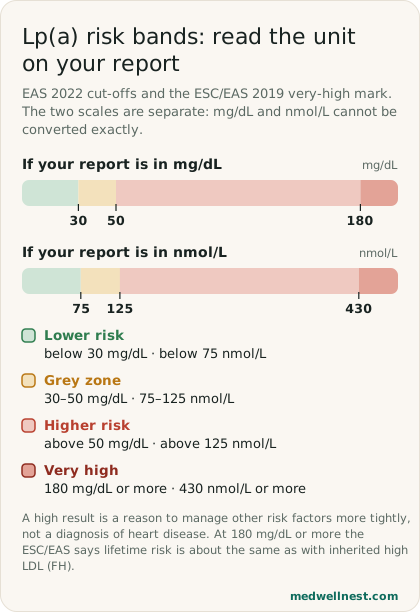
The EAS 2022 consensus suggests practical cut-offs. Below 30 mg/dL (below 75 nmol/L) makes extra risk unlikely, and above 50 mg/dL (above 125 nmol/L) marks higher risk. The grey zone, 30 to 50 mg/dL (75 to 125 nmol/L), matters more when other risk factors are present. The ESC/EAS 2019 guideline flags 180 mg/dL (430 nmol/L) or more as very high, with a lifetime risk roughly equal to that of inherited high LDL (heterozygous familial hypercholesterolaemia).
Check the unit on your report. The EAS says it does not recommend a standard factor to convert mg/dL into nmol/L, because assays vary widely, and that 2 to 2.5 is only a best guess. So do not convert it yourself: compare your result with the cut-offs in the same unit, and ask your doctor which assay your lab used.
A high result raises risk; it does not mean a heart attack is certain. The EAS describes a causal and continuous link between Lp(a) and heart disease and aortic valve stenosis, present even when LDL is very low, but it does not support Lp(a) as a risk factor for venous blood clots.
05
What should I do if my Lp(a) is high?
Because nothing yet lowers Lp(a) reliably, the EAS says to manage everything else harder and earlier: early intensive risk factor management, targeted according to your overall cardiovascular risk and your Lp(a) level. MedlinePlus lists what your provider may suggest: medicine to lower your LDL if it is high, a healthy diet, weight loss, quitting smoking, regular exercise, reducing stress and lowering blood pressure. These will not change your Lp(a) much, but they lower your overall risk.
Tell your family. Lp(a) is inherited, and the EAS says testing relatives, known as cascade testing, has potential value in familial hypercholesterolaemia and when you or a relative has very high Lp(a) or early heart or artery disease. Parents, brothers, sisters and children may share your result.
The EAS says lipoprotein apheresis, a procedure that filters Lp(a) from the blood, is an option for very high Lp(a) with progressive cardiovascular disease despite optimal management of other risk factors, and that niacin is not recommended for lowering Lp(a).
06
Is there a medicine to lower Lp(a)?
Not one proven to lower heart risk. When the EAS statement was written, specific Lp(a)-lowering drugs were in phase II and III trials, and early trials reported average falls in Lp(a) of 72 to 80% with pelacarsen and 71 to 97% with olpasiran. Then, on 4 September 2026, Novartis announced that its phase III Lp(a)HORIZON trial, with 8323 people who had elevated Lp(a) and established cardiovascular disease, did not meet its primary goal of reducing cardiovascular events compared with placebo, although Lp(a) levels were lower on pelacarsen. The company still calls pelacarsen investigational and says the full data will be presented at a medical meeting.
So lowering the Lp(a) number is not yet proven to lower risk. We could not confirm that any Lp(a)-lowering drug is approved for general use, and news in this area changes quickly, so ask your doctor rather than buying a product that claims to lower Lp(a): the EAS says lifestyle changes have minimal impact on it.
07
What warning signs need emergency help?
A high Lp(a) can contribute to a heart attack or stroke without any earlier warning. The NHS lists chest pain that may feel tight or squeezing and may spread to the arm, neck or jaw, shortness of breath, sweating and feeling sick as heart attack symptoms, and face weakness, arm weakness and speech problems as stroke signs. Do not wait for a repeat test or a doctor's appointment if these appear.
Lp(a) and warning signs: how fast to act
Routine — see a doctor
You have never had an Lp(a) test, a close relative had a heart attack, stroke or heart procedure early in life, or your result is above the cut-offs on your report: book a visit, bring the report with the unit and assay name, and ask how to manage your other risk factors. Tell close relatives so they can ask about testing.
Emergency — act now
Chest pain or pressure that feels tight, crushing or squeezing, or pain spreading to your arm, neck or jaw, especially with sweating, feeling or being sick or shortness of breath; severe difficulty breathing; lips or skin turning pale, blue or grey; someone passing out and not responding normally; or a sudden drooping face, weakness in one arm, slurred or confused speech or other stroke signs (FAST): call emergency services now. Do not drive yourself to hospital. The NHS lists these as heart attack and stroke symptoms, and says stroke symptoms that stop after a short time still need medical help straight away.
Values mentioned in this story
Each one opens a visual guide with its normal range and what moves it — upload a report and we place your own numbers on the same scale.
Sources
- Lipoprotein(a) in atherosclerotic cardiovascular disease and aortic stenosis: EAS consensus statement — Eur Heart J 2022doi.org
- 2019 ESC/EAS Guidelines for the management of dyslipidaemias — Atherosclerosisdoi.org
- Lipoprotein (a) blood test — MedlinePlusmedlineplus.gov
- Novartis announces Lp(a)HORIZON Phase III topline results for pelacarsen — Novartis, 4 September 2026novartis.com
- Heart attack — NHSnhs.uk
- Symptoms of a stroke — NHSnhs.uk
Share this story
Curious where your own values stand?
Two minutes from upload to a full visual picture. Free to analyze.