In short
A cough that lingers for 3 to 8 weeks after a cold or fever is common and usually harmless. Here is what a post-viral cough is, what else can keep a cough going, why a cough of more than 2 weeks should be tested for TB, and the signs that need a doctor today.
Emergency if: Go to an emergency department now if you are coughing up more than a few streaks of blood, are struggling to breathe, your lips or skin look blue, grey or very pale, you suddenly feel confused, you have chest pain together with blood in the cough or breathlessness, you have sudden chest pain that feels like squeezing or pressure, spreads to your arm, neck, jaw or back, or comes with sweating or feeling sick, or your face or throat swells, with hives or trouble swallowing.
On your report
WBC / Total Leukocyte Count, CRP, ESR
On this page
01
Is it normal for a cough to last more than 3 weeks after a cold?
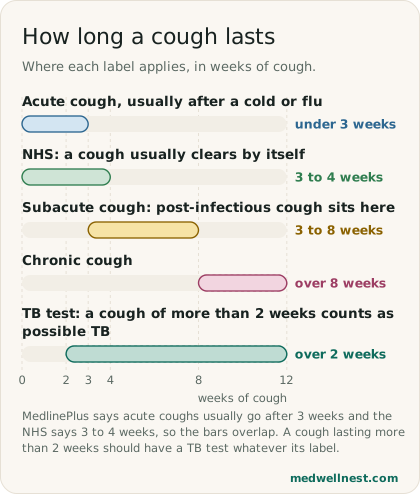
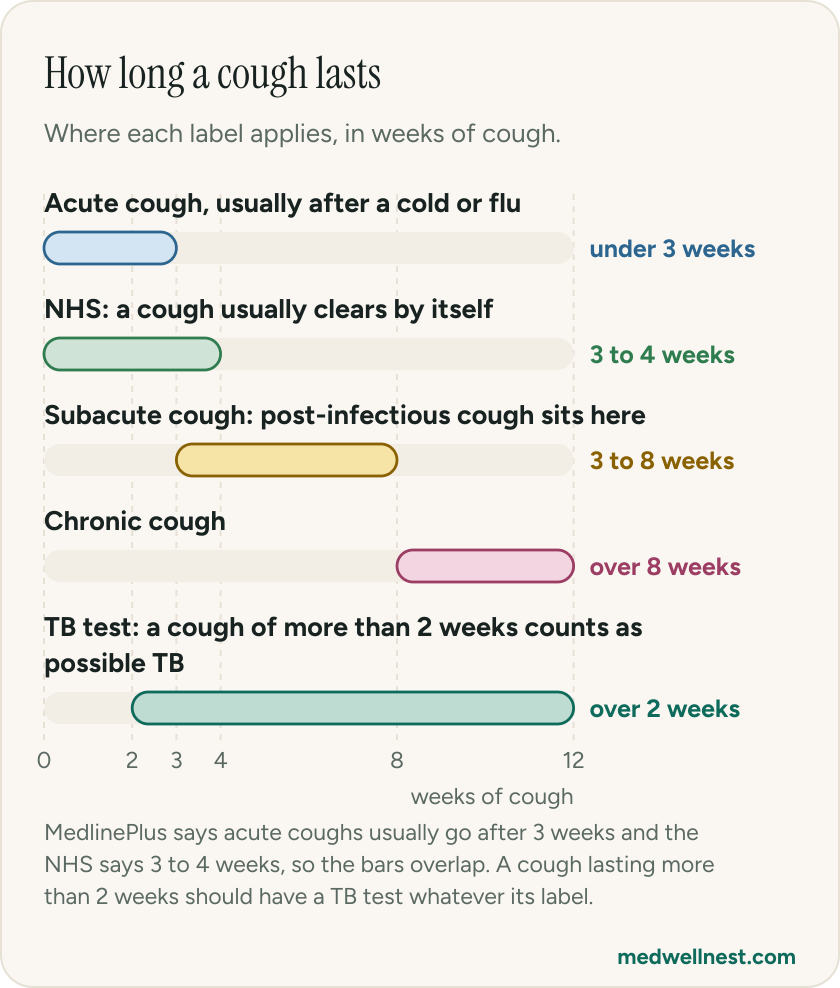
Yes, it is common. The NHS says a cough will usually clear up on its own within 3 to 4 weeks, and MedlinePlus says acute coughs, which usually follow a cold, flu or sinus infection, usually go away after 3 weeks. Doctors call a cough that lasts 3 to 8 weeks a subacute cough, and one that goes on for more than 8 weeks a chronic cough.
So a cough that is still there at week 3 or 4 after a fever or a cold is not, by itself, a sign that something is wrong, as long as it is slowly easing and none of the warning signs further down are present.
Two limits matter. A cough that has lasted more than 2 weeks should be tested for TB under the national programme, and a cough that has not gone by 8 weeks needs a proper work-up rather than more waiting.
03
What else can make a cough last more than 3 weeks?
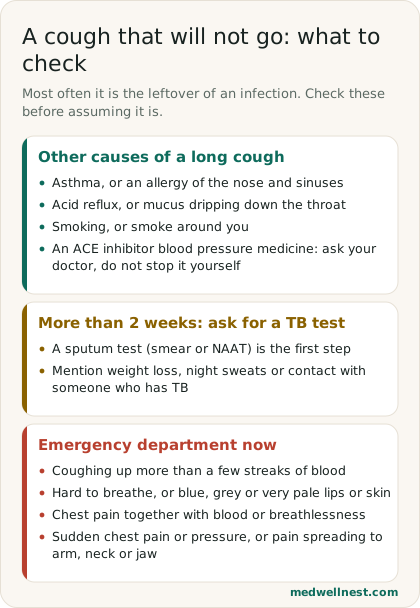
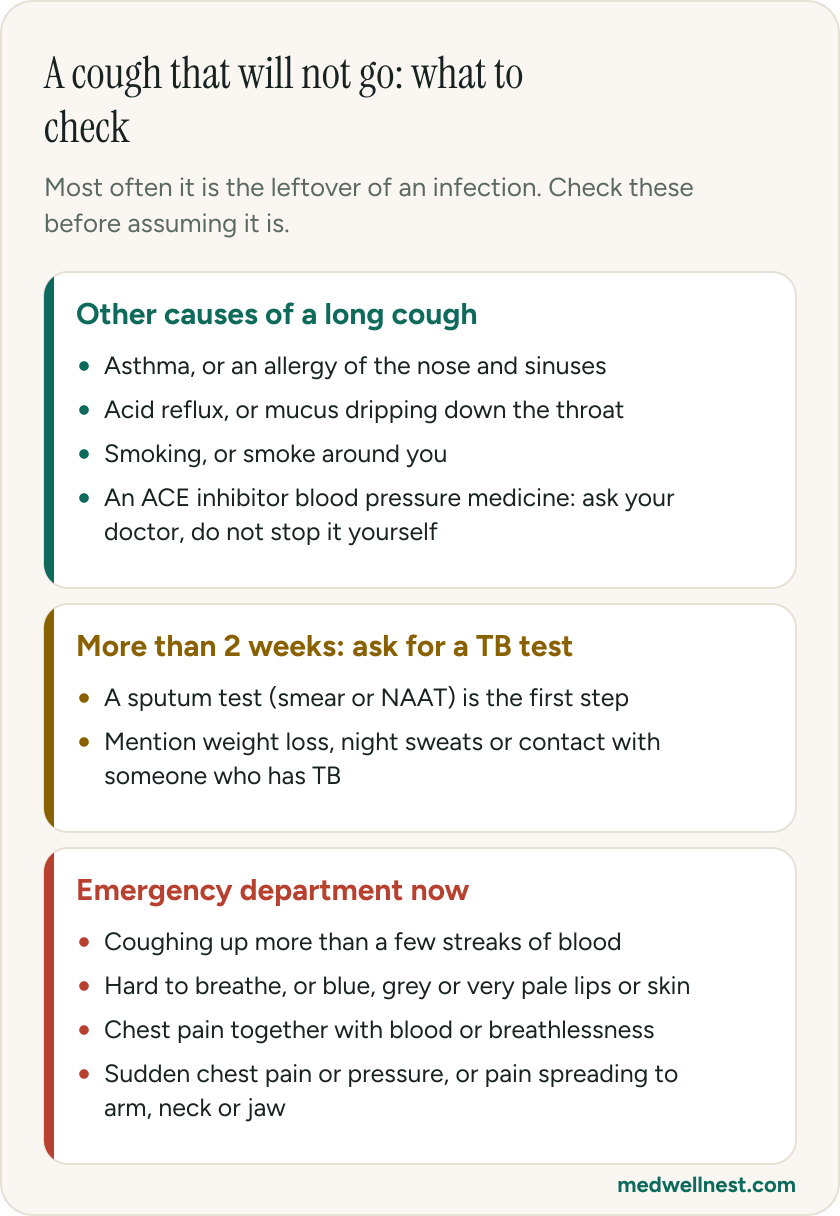
Several common conditions keep a cough going, and they are often mistaken for a leftover infection. MedlinePlus lists allergies that involve the nose or sinuses, asthma and COPD, sinus problems with mucus dripping down the back of the throat (postnasal drip), and acid reflux (GERD) among the common causes. The NHS also lists smoking and heartburn.
Two causes are easy to miss. ACE inhibitors, and less often ARB medicines, used for high blood pressure, heart failure or kidney disease, can cause a cough that does not go away; if you take one, tell your doctor rather than stopping it yourself. Smoking, or breathing other people's smoke, also keeps a cough going.
TB and, rarely, lung cancer are the causes people fear most. The NHS says a cough is rarely a sign of something serious like lung cancer, but MedlinePlus lists weight loss without trying, night sweats and contact with someone who has TB as reasons to contact a doctor right away. Sometimes no specific cause is found.
04
Should a cough of more than 2 weeks be tested for TB?
Yes. Under the national TB elimination programme, a person with a cough of more than 2 weeks, with or without other symptoms, is identified as presumptive (possible) pulmonary TB and is evaluated for TB. The first test is a sputum examination: a smear, or a molecular test (NAAT) in places where the laboratory offers it.
You do not need to wait for the 3 weeks that most guides use for a persistent cough. A cough this long has many causes and TB is only one of them, but testing early means that, if it is TB, treatment can start sooner.
Our guide to TB tests explains the sputum smear, CBNAAT and the skin and blood tests, and what each one can and cannot tell you.
05
What can I do at home for a cough that will not go?
Be gentle with the cough while it settles. Drink plenty of fluids, which thin the mucus and make it easier to cough up. A steamy shower or a clean vaporizer can soothe a dry throat. Do not smoke, and stay away from other people's smoke. If you have asthma or another long-term lung disease, keep taking the medicines prescribed for it.
Hot lemon and honey in a warm drink is a traditional choice. The NHS says it can have a similar effect to cough syrup, but it also says the evidence for hot lemon and honey and for herbal medicines is limited. Never give honey to a baby under 1 year. Cough drops and hard sweets can cause choking in a child under 3.
Decongestants and cough medicines that contain codeine will not stop a cough, according to the NHS. A pharmacist's cough syrup or sweets will not stop the cough but may help you cough less. Antibiotics are prescribed only if you need them, for example for a bacterial infection or when you are at risk of complications.
06
Can I give a child cough medicine with codeine?
No. The medicines regulator MHRA says codeine must not be used for cough and cold in children under 12, because of a risk of serious breathing side effects, and that it is not recommended for teenagers aged 12 to 18 who have breathing problems. Its review also found limited evidence that codeine works for cough in children.
MedlinePlus advises talking to the child's doctor before giving any over-the-counter cough medicine to a child aged 6 or younger, even one labelled for children, because these medicines likely do not work and can have serious side effects. The NHS adds that some cough medicines should not be given to children under 12.
For a child with a cough, fluids, rest and, from 1 year of age, a warm (not hot) drink with honey are the usual basics. Go to an emergency department now if the child is struggling to breathe. See a doctor the same day if a baby under 3 months has a cough, and book a visit if a child's cough has lasted more than 2 weeks, so the doctor can check for TB and other causes.
07
When should I see a doctor for a cough?
The NHS advises seeing a doctor if a cough has lasted more than 3 weeks, if you are losing weight for no reason, or if your immune system is weakened, for example by chemotherapy or diabetes. MedlinePlus advises contacting a provider if a cough lasts longer than 10 to 14 days, and also for fever, thick foul-smelling yellowish-green phlegm, or a cough with leg swelling or one that is worse lying down, which can be signs of heart failure.
Your doctor will listen to your chest and may order a chest X-ray if you have blood in the cough, fever or other whole-body symptoms such as weight loss, trouble swallowing, hoarseness or marked breathlessness. A cough that lasts more than 8 weeks is chronic and needs further assessment, such as a breathing test (spirometry) to look for asthma or COPD. The warning signs that cannot wait are listed below.
When to act
Emergency — act now
Go to an emergency department now if you are coughing up more than a few streaks of blood, are struggling to breathe, your lips or skin look blue, grey or very pale, you suddenly feel confused, you have chest pain together with blood in the cough or breathlessness, you have sudden chest pain that feels like squeezing or pressure, spreads to your arm, neck, jaw or back, or comes with sweating or feeling sick, or your face or throat swells, with hives or trouble swallowing.
Same-day — call promptly
See a doctor today if you have chest pain that comes and goes or hurts when you breathe in or cough (go to an emergency department now if it is severe or you are also breathless), a few streaks of blood in your phlegm, a fever with thick foul-smelling yellowish-green phlegm, a cough that is very bad or quickly getting worse, or weight loss, night sweats or contact with someone who has TB. Also today if a baby under 3 months has a cough.
Routine — see a doctor
Book a visit if your cough has lasted more than 2 weeks (ask for a sputum test for TB), has not gone by 3 weeks, or you smoke, take an ACE inhibitor or have heartburn and want to find the cause. A cough that lasts more than 8 weeks needs a full assessment.
Values mentioned in this story
Each one opens a visual guide with its normal range and what moves it — upload a report and we place your own numbers on the same scale.
Sources
- Cough — NHSnhs.uk
- Cough — MedlinePlus Medical Encyclopediamedlineplus.gov
- Five things to know about postinfectious cough in adults — CMAJ, 2024pmc.ncbi.nlm.nih.gov
- Diagnostic Algorithm for TB Disease in NTEP — NTEP Knowledge Basentep.in
- Codeine for cough and cold: restricted use in children — MHRA Drug Safety Updategov.uk
- Coughing up blood — NHSnhs.uk
Share this story
Curious where your own values stand?
Two minutes from upload to a full visual picture. Free to analyze.