In short
Heavy hair fall a few months after birth is usually telogen effluvium, extra shedding triggered by falling oestrogen. The AAD says it usually peaks around 4 months and most women see their hair return to normal fullness by the baby's first birthday. See a doctor if it lasts longer or comes with other signs.
Emergency if: A hair is wrapped around your baby's finger or toe and is too tight to remove, or is stuck in the skin: take your baby to an emergency department now. The AAD says a hair tourniquet can cut off circulation or cause an infection, and a doctor sometimes has to remove it.
On your report
Ferritin, TSH, Hemoglobin
On this page
01
Why is my hair falling out after delivery?
The AAD says many new mothers see noticeable hair loss a few months after having a baby, and that this is normal and is not true hair loss. Dermatologists call it telogen effluvium, which means excessive hair shedding, and the AAD says it is caused by falling oestrogen levels. The NHS says it is normal to lose 50 to 100 hairs a day, so the shedding after birth is an increase on a number that is already not zero.
Birth is one of several triggers for the same pattern. The AAD lists giving birth among several events after which excessive shedding is common; the others are a high fever, an operation, recovering from an illness, a lot of stress, losing a large amount of weight and stopping birth-control pills. The AAD separates this from hair loss proper, which happens when something stops the hair from growing, and says some people have both.
02
When does hair fall start after delivery, and how many months does it last?
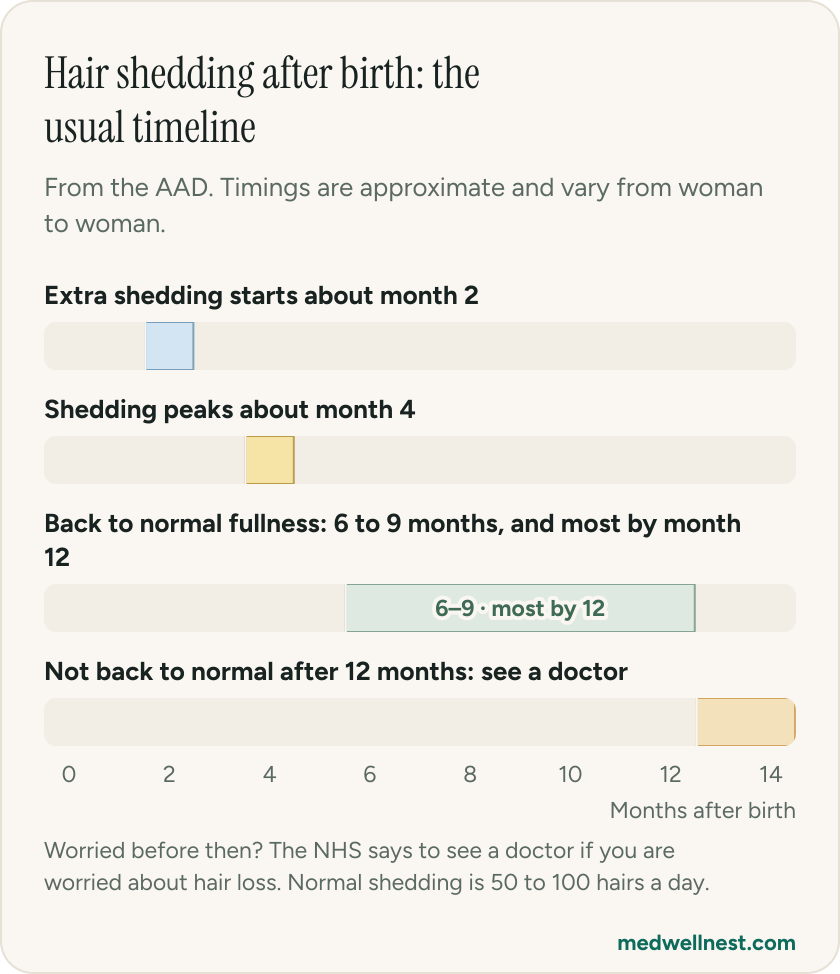
The AAD says a new mother can see excessive shedding about 2 months after giving birth, and that shedding usually peaks about 4 months after birth. It describes this shedding as normal and temporary. It gives two timings for recovery on two different pages: that within 6 to 9 months the hair tends to regain its normal fullness, and that most women see their hair return to normal fullness by their child's first birthday, with many regaining it earlier.
So if you are at month 5 or 6 and still finding hair everywhere, that is within what the AAD describes. The AAD adds that if the stressor stays with you, shedding can last longer.
03
What helps postpartum hair fall, and what does not?
The AAD says the shedding is temporary and you do not have to do anything to remedy it. For hair that looks thin in the meantime, it suggests a volumizing shampoo, a conditioner formulated for fine hair applied mainly to the ends, and a new haircut, because some cuts make hair look fuller and many new mothers prefer short hair. These change how the hair looks; they do not stop shedding.
The AAD pages quoted here recommend no supplement, oil or treatment for the shedding itself, and the AAD says there is no single ingredient that makes one volumizing shampoo or fine-hair conditioner better than the rest. The NHS says no treatment for hair loss is 100% effective and advises seeing a doctor to find out what is causing hair loss before going to a commercial hair clinic.
04
Is it postpartum hair fall, or thyroid or iron deficiency? When should I see a doctor?
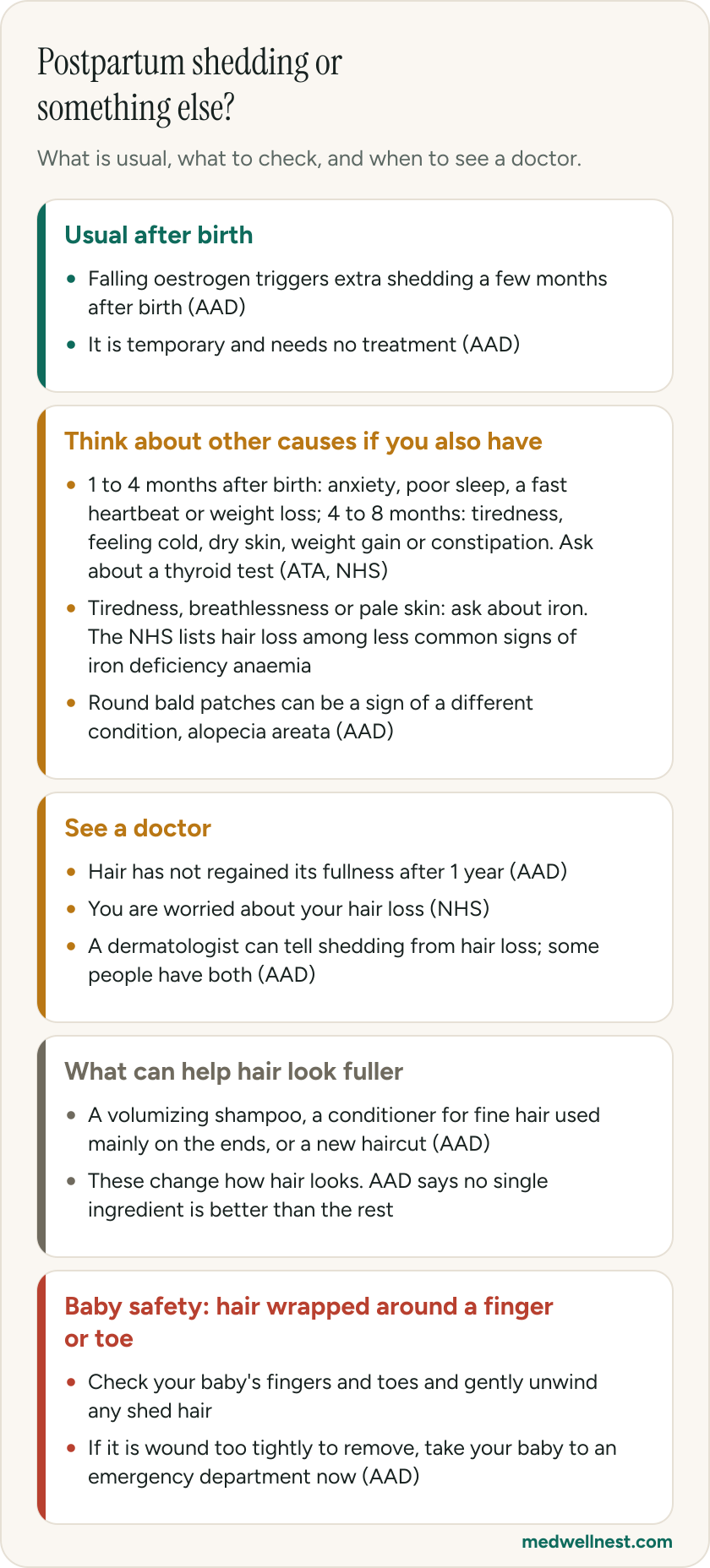
Postpartum shedding is the most common explanation, but two treatable causes can overlap with it. The ATA says postpartum thyroiditis is a common thyroid problem after delivery, and more frequent in some higher-risk groups. Its overactive phase typically comes 1 to 4 months after delivery, with anxiety, insomnia, a fast heartbeat, fatigue and weight loss, and is often overlooked because the symptoms are put down to a new baby. The underactive phase is the one women more often present with, typically 4 to 8 months after delivery, with fatigue, weight gain, constipation, dry skin, depression and poor exercise tolerance. The NHS lists dry skin, dry hair or hair loss among the symptoms of an underactive thyroid and says the doctor will ask whether you have recently been pregnant and may check TSH and thyroxine in a blood test.
Iron is the other. The NHS lists tiredness, shortness of breath, noticeable heartbeats and paler than usual skin as symptoms of iron deficiency anaemia, with hair loss among the less common ones, and says heavy periods and pregnancy are very common causes. Our ferritin story explains how to read the test. The AAD says alopecia areata, a different condition, can cause round bald patches on the scalp. And if your hair has not regained its normal fullness after one year, the AAD says to see a dermatologist, because something else may be causing it and an accurate diagnosis is essential for treatment. The NHS says to see a doctor if you are worried about your hair loss.
05
Can my shed hair hurt my baby?
Rarely, yes. The AAD describes a hair tourniquet: a strand of shed hair that wraps around a baby's finger, toe or another body part and can be tight enough to cut off circulation or cause an infection. It says the likelihood is very rare, and that if you see a hair wrapped around a finger or toe you must remove it, by looking for a loose end and gently unwinding it. If it is wound too tightly to remove, or is stuck in the skin, take your baby to an emergency department now; the AAD says a doctor sometimes has to remove it.
When to act
Emergency — act now
A hair is wrapped around your baby's finger or toe and is too tight to remove, or is stuck in the skin: take your baby to an emergency department now. The AAD says a hair tourniquet can cut off circulation or cause an infection, and a doctor sometimes has to remove it.
Routine — see a doctor
You have anxiety, a fast heartbeat or weight loss 1 to 4 months after birth, or tiredness, feeling cold, dry skin, weight gain or constipation 4 to 8 months after birth, or tiredness with breathlessness or pale skin, or round bald patches: see your doctor, who can check for thyroid problems or iron deficiency. The ATA describes the thyroid symptoms, and the NHS lists hair loss as a symptom of both an underactive thyroid and iron deficiency anaemia.
Your hair has not regained its normal fullness after one year, or you are worried about your hair loss at any point: see your doctor or a dermatologist. The AAD says something else may be causing it, and the NHS says to see a doctor if you are worried.
Values mentioned in this story
Each one opens a visual guide with its normal range and what moves it — upload a report and we place your own numbers on the same scale.
Sources
Share this story
Curious where your own values stand?
Two minutes from upload to a full visual picture. Free to analyze.