In short
Braxton Hicks tightenings have no pattern and may stop when you rest or change position. Real labour contractions come regularly, get closer together and stronger, and keep coming. Here is how to tell them apart, what a show and waters breaking mean, and when to call your maternity unit.
Emergency if: You think the baby is coming now or you have a strong urge to push: call emergency services for an ambulance now. Regular contractions or waters breaking before 37 weeks; fluid that is green, brown or smelly; vaginal bleeding; your baby moving less than usual; or constant, severe pain with no relief between contractions: call your maternity unit and go to hospital now, and if you cannot reach them, go to the nearest emergency department. The NHS says not to wait until the next day, even at night; ACOG says to go to the hospital for bleeding, constant severe pain or reduced movements.
On this page
01
How do I tell Braxton Hicks from real labour?
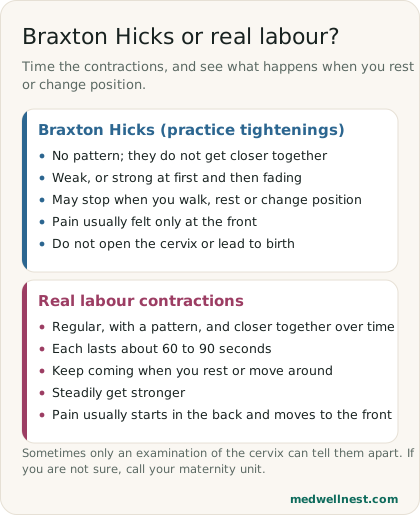
Braxton Hicks contractions are 'practice' tightenings of the womb that can happen for many weeks before real labour. StatPearls says they may start around 6 weeks of pregnancy but are usually not felt until the second or third trimester, and that they do not open the cervix or lead to birth. ACOG says false contractions are less regular and not as strong as true labour, and the NHS says they generally do not last long, do not happen very often and do not build up.
Pain alone does not sort them out. The NHS says Braxton Hicks may feel uncomfortable but are usually painless; StatPearls says they are uncomfortable rather than painful; ACOG says they can be very painful and can make you think you are in labour when you are not. Look at the pattern instead: time each contraction, and see what happens when you rest, drink water or change position.
02
What do real labour contractions feel like, and how often do they come?
In a contraction the womb tightens and then relaxes. The NHS says that for some people contractions feel like extreme period pains, that if you put a hand on your tummy you feel it get hard and then ease, and that contractions tend to become longer, stronger and more frequent as labour goes on. ACOG says true contractions come at regular intervals, get closer together, and each lasts about 60 to 90 seconds. They continue when you rest or move, and the pain usually starts in the back and moves to the front. Backache is common in labour.
ACOG says that if rest and drinking water make the contractions go away, they are not true labour contractions. It also says that sometimes the only way to tell is an examination that checks for changes in your cervix. The start of labour, called the latent phase, can take hours or sometimes days, and the NHS says you will probably be advised to stay at home during it.
03
What is a show, and does it mean labour has started?
A show is the plug of mucus that sat in the cervix during pregnancy coming away. The NHS describes it as sticky, jelly-like pink mucus that may pass in one piece or several, and says it is pink because it contains a small amount of blood. It means the cervix is starting to open. Labour may follow quickly or may take a few days, and some women have no show at all.
A show on its own is not an emergency. But if you are losing more blood than a streak of pink mucus, the NHS says it may be a sign something is wrong and to phone your hospital or midwife straight away.
04
What if my waters break?
Your waters are the fluid around the baby. When the bag breaks you may feel a slow trickle or a sudden gush you cannot control. The NHS says amniotic fluid is clear and pale, but it can be hard to tell from urine, and it may be a little bloodstained to begin with. Use a period pad, not a tampon, so your midwife can check the colour.
Call your midwife or maternity unit as soon as your waters break, even if you feel well. The NHS says it is usual to go into labour within 24 hours, and that you will be offered an induction if you do not, because without amniotic fluid there is a small increased risk of infection. ACOG says to go to the hospital if your water has broken and you are not having contractions, and otherwise to call and follow your provider's instructions, while the NHS says to call. Follow what your own unit has told you.
Tell them immediately if the fluid is smelly, coloured, green or brown, or if you are losing blood. A hospital trust's leaflet says green-brown fluid can mean the baby has passed a first stool in the womb and that you should call the maternity triage line immediately. Also call if your baby moves less than usual. The NHS says to take your temperature every 4 hours while awake after the waters break and to tell your midwife if it is raised, which it says is usually above 37.5C.
05
When should I call the maternity unit or go to hospital?
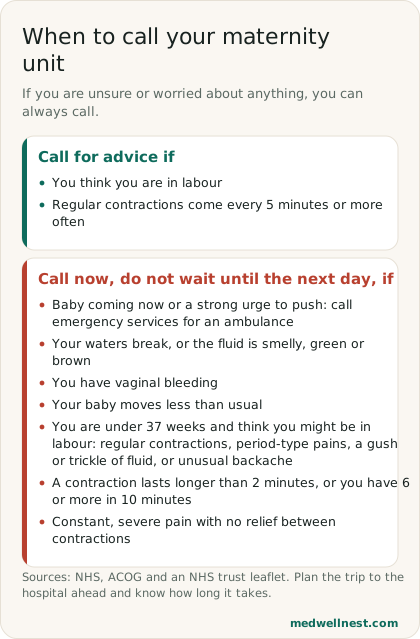
The NHS says to call your midwife or maternity unit for guidance if you think you are in labour, or if you have regular contractions coming every 5 minutes or more often. You can call if you are unsure or worried about anything. It says to call urgently, and not wait until the next day even in the middle of the night, if your waters break, you have vaginal bleeding, your baby is moving less than usual, you are less than 37 weeks pregnant and think you might be in labour, any contraction lasts longer than 2 minutes, or you are having 6 or more contractions every 10 minutes. ACOG also lists constant, severe pain with no relief between contractions.
Before 37 weeks the same signs matter more. The NHS says to call if you have regular contractions or tightenings, period-type pains, a gush or trickle of fluid, or backache that is not usual for you. About 8 in 100 babies are born early. Our guide to the cervical length scan explains one check used when there is a risk of early labour, and our tests and scans timeline shows what else is offered.
Plan the trip ahead. ACOG advises working out how far you live from the hospital and how long it takes, allowing for traffic and delays. If the journey is long, ask your unit well before your due date when you should set off. Keep a hospital bag ready.
When to act
Emergency — act now
You think the baby is coming now or you have a strong urge to push: call emergency services for an ambulance now. Regular contractions or waters breaking before 37 weeks; fluid that is green, brown or smelly; vaginal bleeding; your baby moving less than usual; or constant, severe pain with no relief between contractions: call your maternity unit and go to hospital now, and if you cannot reach them, go to the nearest emergency department. The NHS says not to wait until the next day, even at night; ACOG says to go to the hospital for bleeding, constant severe pain or reduced movements.
Same-day — call promptly
Your waters have broken at or after 37 weeks with clear fluid, or you have regular contractions every 5 minutes or more often: call your midwife or maternity unit now for advice. They will tell you whether to come in or stay at home.
Routine — see a doctor
Tightenings that are irregular, do not get closer together or stronger, and ease when you rest, drink water or change position are likely Braxton Hicks: mention them at your next antenatal visit, and call the unit at any time if you are unsure.
Sources
- Signs that labour has begun — NHSnhs.uk
- How to Tell When Labor Begins — ACOG patient FAQacog.org
- Premature labour and birth — NHSnhs.uk
- If your waters break before labour starts — University Hospital Southampton NHS Foundation Trust patient informationuhs.nhs.uk
- Braxton Hicks Contractions — StatPearlsncbi.nlm.nih.gov
Share this story
Curious where your own values stand?
Two minutes from upload to a full visual picture. Free to analyze.